
CSCE 496/896 Lecture 7: Reinforcement Learning Stephen Scott Introduction MDPs Q Learning TD Learning DQN Atari Example Go Example
CSCE 496/896 Lecture 7: Reinforcement Learning
Stephen Scott
(Adapted from Paul Quint)
sscott@cse.unl.edu
1 / 53 CSCE 496/896 Lecture 7: Reinforcement Learning Stephen Scott Introduction MDPs Q Learning TD Learning DQN Atari Example Go Example
Introduction
Consider learning to choose actions, e.g.,
Robot learning to dock on battery charger Learning to choose actions to optimize factory output Learning to play Backgammon, chess, Go, etc.
Note several problem characteristics:
Delayed reward (thus have problem of temporal credit assignment) Opportunity for active exploration (versus exploitation of known good actions)
⇒ Learner has some influence over the training data it sees
Possibility that state only partially observable
2 / 53 CSCE 496/896 Lecture 7: Reinforcement Learning Stephen Scott Introduction MDPs Q Learning TD Learning DQN Atari Example Go Example
Example: TD-Gammon (Tesauro, 1995)
Learn to play Backgammon Immediate Reward:
+100 if win 100 if lose 0 for all other states
Trained by playing 1.5 million games against itself Approximately equal to best human player at that time
3 / 53 CSCE 496/896 Lecture 7: Reinforcement Learning Stephen Scott Introduction MDPs Q Learning TD Learning DQN Atari Example Go Example
Outline
Markov decision processes The agent’s learning task Q learning Temporal difference learning Deep Q learning Example: Learning to play Atari
4 / 53 CSCE 496/896 Lecture 7: Reinforcement Learning Stephen Scott Introduction MDPs Q Learning TD Learning DQN Atari Example Go Example
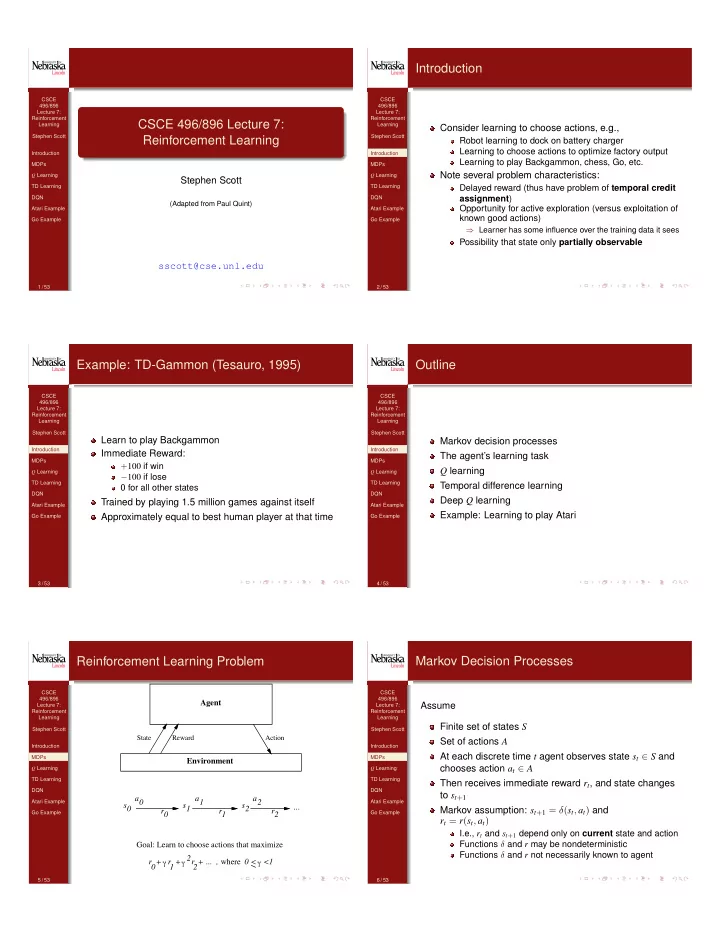
Reinforcement Learning Problem
Agent Environment
State Reward Action
r + γ γ r + r + ... , where γ <1 2 2 1 Goal: Learn to choose actions that maximize s 1 s 2 s a 1 a 2 a r 1 r 2 r ... <
5 / 53 CSCE 496/896 Lecture 7: Reinforcement Learning Stephen Scott Introduction MDPs Q Learning TD Learning DQN Atari Example Go Example
Markov Decision Processes
Assume Finite set of states S Set of actions A At each discrete time t agent observes state st 2 S and chooses action at 2 A Then receives immediate reward rt, and state changes to st+1 Markov assumption: st+1 = (st, at) and rt = r(st, at)
I.e., rt and st+1 depend only on current state and action Functions and r may be nondeterministic Functions and r not necessarily known to agent
6 / 53