Bitcoin Mining The Task of Bitcoin Miners Mining Hardware Energy - - PDF document

bitcoin mining
SMART_READER_LITE
LIVE PREVIEW

Bitcoin Mining The Task of Bitcoin Miners Mining Hardware Energy - - PDF document

Cryptocurrency Technologies Bitcoin Mining Bitcoin Mining The Task of Bitcoin Miners Mining Hardware Energy Consumption & Ecology Mining Pools Mining Incentives and Strategies Recap: Bitcoin Miners Bitcoin depends on


slide-1
SLIDE 1

Cryptocurrency Technologies Bitcoin Mining 1

Bitcoin Mining

  • The Task of Bitcoin Miners
  • Mining Hardware
  • Energy Consumption & Ecology
  • Mining Pools
  • Mining Incentives and Strategies

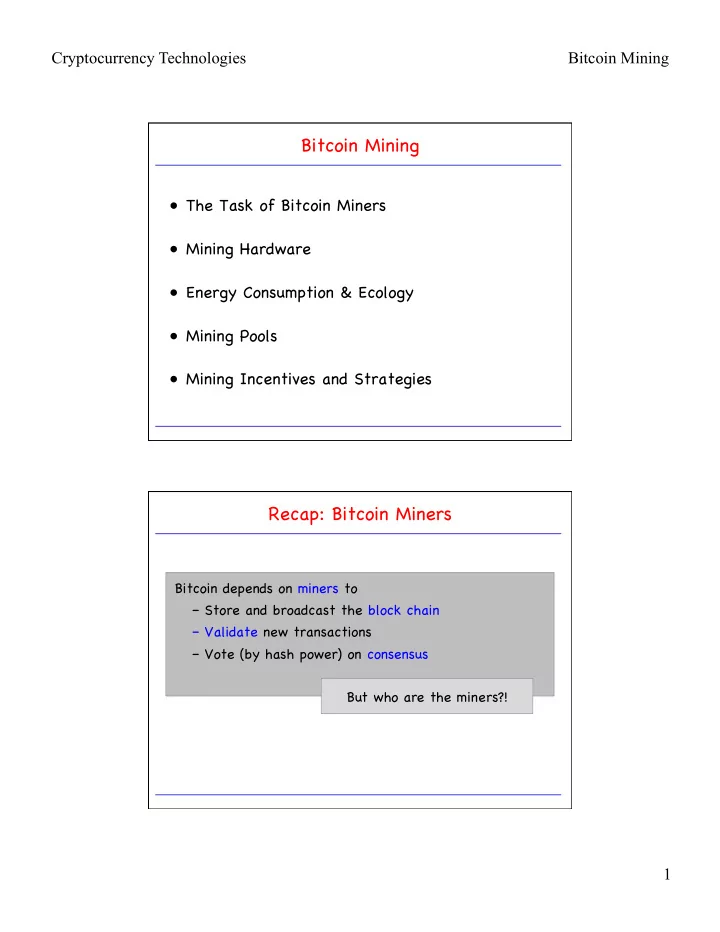
Recap: Bitcoin Miners

Bitcoin depends on miners to – Store and broadcast the block chain – Validate new transactions – Vote (by hash power) on consensus But who are the miners?!

slide-2
SLIDE 2

Cryptocurrency Technologies Bitcoin Mining 2

Bitcoin Mining

  • The Task of Bitcoin Miners
  • Mining Hardware
  • Energy Consumption & Ecology
  • Mining Pools
  • Mining Incentives and Strategies

So, you want to be a Miner?

Gold miners ascending the Chilkoot pass Klondike gold rush of 1898

slide-3
SLIDE 3

Cryptocurrency Technologies Bitcoin Mining 3

Mining Bitcoins in 6 Easy Steps

  • 1. Join the network, listen for transactions
  • a. Validate all proposed transactions
  • 2. Listen for new blocks, maintain block chain
  • a. When a new block is proposed, validate it
  • 3. Assemble a new valid block
  • 4. Find the nonce to make your block valid
  • 5. Hope everybody accepts your new block
  • 6. Profit!

Useful to Bitcoin network

Finding a valid Block

H( ) H( ) H( ) H( ) H( ) H( )

25.0→A coinbase: 0x0000...00 transaction transaction transaction

mrklroot: H( ) prev: H( ) mrklroot: H( ) hash: 0x0000 nonce: 0x7a83 prev: H( ) hash: hash: 0x3485... hash: 0x6a1f... nonce: 0x0000... nonce: 0x0001... hash: 0xc9c8... nonce: 0x0002... hash: 0x300c... nonce: 0xffff... hash: nonce: 0x0000...

25.0→A coinbase: 0x0000...01

All changed

hash: 0xd0c7 ... nonce: 0x0001... hash: 0x0224...

25.0→A coinbase: 0x3df5...65

hash: 0x0000... nonce: 0xf77e...
slide-4
SLIDE 4

Cryptocurrency Technologies Bitcoin Mining 4

Mining Difficulty “Target”

256 bit hash output 64+ leading zeroes required

difficulty Aug. 2014 = 266.2 =84,758,978,290,086,040,000

00000000000000003AAEA2000000000000000000000000000000000000000000

Setting Mining Difficulty

next_difficulty= previous_difficulty * (2 weeks)/(time to mine last 2016 blocks)

Expected number of blocks in 2 weeks at 10 minutes/block

Every two weeks, compute:

slide-5
SLIDE 5

Cryptocurrency Technologies Bitcoin Mining 5

Mining Difficulty over Time

bitcoinwisdom.com

Time to find a Block

bitcoinwisdom.com

slide-6
SLIDE 6

Cryptocurrency Technologies Bitcoin Mining 6

Bitcoin Mining

  • The Task of Bitcoin Miners
  • Mining Hardware
  • Energy Consumption & Ecology
  • Mining Pools
  • Mining Incentives and Strategies

SHA-256

  • General purpose hash function

– Part of SHA-2 family: SHA-256,SHA-384,SHA-512

  • Published in 2001
  • Designed by the NSA
  • Remains unbroken cryptographically

– Weaknesses known

  • SHA-3 (replacement) under standardization
slide-7
SLIDE 7

Cryptocurrency Technologies Bitcoin Mining 7

SHA-256: Details

wikipedia.org

Iterate through compression 64 times. Kt: constants of the algorithm Wt: computed from input string

CPU Mining

while (nonce < MAX){ if (SHA256(SHA256(block + nonce)) < target return nonce; nonce++; }

two hashes

139,461 years to find a block today!

Throughput on a high-end PC = 10-20 MHz ≈ 224

slide-8
SLIDE 8

Cryptocurrency Technologies Bitcoin Mining 8

GPU Mining

  • GPUs designed for high-performance graphics

– high parallelism – high throughput

  • First used for Bitcoin ca. October 2010
  • Implemented in OpenCL

– Later: hacks for specific cards

GPU Mining Advantages

  • 1. easily available, easy to set up
  • 2. parallel ALUs
  • 3. bit-specific instructions
  • 4. can drive many from 1 CPU
  • 5. can overclock!
slide-9
SLIDE 9

Cryptocurrency Technologies Bitcoin Mining 9

“Goodput”

  • Observation:

Some errors are okay. May miss a valid block, though.

  • Goodput: throughput × success rate
  • Worth over-clocking by 50% with 30% errors!

GPU Mining Rigs

Source: LeonardH, cryptocurrenciestalk.com

slide-10
SLIDE 10

Cryptocurrency Technologies Bitcoin Mining 10

GPU Mining Disadvantages

  • 1. Poor utilization of hardware
  • 2. Poor cooling
  • 3. Large power draw
  • 4. Few boards to hold multiple GPUs

Throughput on a good card = 20-200 MHz ≈ 227 ≈173 years to find a block w/100 cards!

FPGA Mining

  • FPGA: Field Programmable Gate Area
  • First used for Bitcoin ca. June 2011
  • Implemented in Verilog
slide-11
SLIDE 11

Cryptocurrency Technologies Bitcoin Mining 11

FPGA Mining Advantages

  • 1. Higher performance than GPUs
  • 2. Excellent performance on bitwise operations
  • 3. Better cooling
  • 4. Extensive customization, optimization

FPGA Mining Rigs

Bob Buskirk, thinkcomputers.org

slide-12
SLIDE 12

Cryptocurrency Technologies Bitcoin Mining 12

FPGA Mining Disadvantages

  • 1. Higher power draw than GPUs
  • 2. Poor optimization of 32-bit adds
  • 3. Fewer hobbyists with sufficient expertise
  • 4. More expensive than GPUs
  • 5. Marginal performance/cost advantage over GPUs

Throughput on a good card = 100-1000 MHz ≈ 230

25 years to find a block w/100 boards! Bitcoin ASICs

slide-13
SLIDE 13

Cryptocurrency Technologies Bitcoin Mining 13

Bitcoin ASICs

  • Special purpose
  • Approaching known limits on feature sizes

– Less than 10x performance improvement expected

  • Designed to be run constantly for life
  • Require significant expertise, long lead-times
  • Perhaps the fastest chip development ever!

Case Study: TerraMiner IV

  • First shipped Jan 2014
  • 2TH/s
  • Cost: US$6000

Still, 14 months to find a block!

slide-14
SLIDE 14

Cryptocurrency Technologies Bitcoin Mining 14

Professional Mining Centers

Needs: – cheap power – good network – cool climate

BitFury mining center, Republic of Georgia

Evolution of Mining

gold pan sluice box placer mining pit mining

slide-15
SLIDE 15

Cryptocurrency Technologies Bitcoin Mining 15

The Future

Q: Can small miners stay in the game? Q: Do ASICs violate the original Bitcoin vision? Q: Would we be better off without ASICs?

Bitcoin Mining

  • The Task of Bitcoin Miners
  • Mining Hardware
  • Energy Consumption & Ecology
  • Mining Pools
  • Mining Incentives and Strategies
slide-16
SLIDE 16

Cryptocurrency Technologies Bitcoin Mining 16

Thermodynamic Limits

SHA-256 is not reversible Landauer’ s Principle: Any non-reversible computation must consume a minimum amount of energy. Specifically, each bit changed requires (kT ln 2) joules. Energy consumption is inevitable!

Energy Aspects of Bitcoin Mining

  • Embodied Energy:

– used to manufacture mining chips & other equipment – should decrease over time – returns to scale

  • Electricity:

– used to perform computation – should increase over time – returns to scale

  • Cooling:

– required to protect equipment – costs more with increased scale!

slide-17
SLIDE 17

Cryptocurrency Technologies Bitcoin Mining 17

Estimating Energy Usage: top-down (2014)

  • Each block worth approximately US$15,000
  • Approximately $25/s generated
  • Industrial electricity (US): $0.03/MJ
  • $0.10/kWh

electricity consumed: 900 MJ/s = 900 MW

Estimating Energy Usage: top-down (2017)

  • Each block worth approximately US$28,500
  • Approximately $47.5/s generated
  • Industrial electricity (US): $0.10/kWh, or $0.03/MJ
  • Bitcoin miners could buy about 1580 MH/s

electricity consumed: 1580 MJ/s = 1580 MW

slide-18
SLIDE 18

Cryptocurrency Technologies Bitcoin Mining 18

Estimating Energy Usage: bottom-up (2014)

  • Best claimed efficiency: 1 W / GH/s

(excluding cooling, embodied energy)

  • Network hash rate: 150,000,000 GH/s (150 PH/s)

electricity consumed: 150 MW

  • Est. Energy Usage: bottom-up (early 2015)
  • Best claimed efficiency: 1/3 W / GH/s

(excluding cooling, embodied energy)

  • Network hash rate: 350,000,000 GH/s (350 PH/s)

electricity consumed: 117 MW

slide-19
SLIDE 19

Cryptocurrency Technologies Bitcoin Mining 19

  • Est. Energy Usage: bottom-up (2017)
  • Good claimed efficiency: 0.1 W/GH/s

(Artminer S9, excluding cooling, embodied energy)

  • Network hash rate: 3,200,000,000 GH/s (3.2 EH/s)

electricity consumed: 320 MW

How much is a MW?

Three Gorges Dam = 10,000 MW typical hydro plant ≈ 1,000 MW Kashiwazaki-Kariwa nuclear power plant = 7,000 MW typical nuclear plant ≈ 4,000 MW major coal-fired plant ≈ 2,000 MW

slide-20
SLIDE 20

Cryptocurrency Technologies Bitcoin Mining 20

All Payment Systems require Energy “Data Furnaces”

Observation: In the limit, computing devices produce heat almost as well as electric heaters!

  • Why not install mining rigs as home heaters?
  • Challenges:

– Ownership/maintenance model – Gas heaters still at least 10x more efficient – What happens in summer?

slide-21
SLIDE 21

Cryptocurrency Technologies Bitcoin Mining 21

Open Questions

  • Will Bitcoin drive out electricity subsidies?
  • Will Bitcoin require guarding power outlets?
  • Can we make a currency with no proof-of-work?

Bitcoin Mining

  • The Task of Bitcoin Miners
  • Mining Hardware
  • Energy Consumption & Ecology
  • Mining Pools
  • Mining Incentives and Strategies
slide-22
SLIDE 22

Cryptocurrency Technologies Bitcoin Mining 22

Economics of being a Small Miner

  • Example: Antminer S9
  • Cost: ~ US$ 3,000
  • Hash power: 14 TH/s
  • Fraction of total hash rate =

14/3,200,000 = 4.4 * 10-6

  • Expected time to find a block:

~4.3 years!

  • Expected revenue: $538/month
  • (assume no energy costs!)

Problem: Mining Uncertainty

Probability density 4.3 years Time to find first block # blocks found in one year probability (Poisson dist.)

79.3% 1 18.4% 2 2.1% 3+ 0.2%

slide-23
SLIDE 23

Cryptocurrency Technologies Bitcoin Mining 23

Idea: Could Small Miners pool Risk? Mining Pools

  • Goal: pool participants all attempt to mine a block with

the same coinbase recipient – send money to key owned by pool manager

  • Distribute revenues to members based on how much

work they have performed – minus a cut for pool manager Q: How do we know how much work members perform?

slide-24
SLIDE 24

Cryptocurrency Technologies Bitcoin Mining 24

Mining Shares

Idea: Prove work with “near-valid” blocks (shares)

4AA087F0A52ED2093FA816E53B9B6317F9B8C1227A61F9481AFED67301F2E3FB D3E51477DCAB108750A5BC9093F6510759CC880BB171A5B77FB4A34ACA27DEDD 00000000008534FF68B98935D090DF5669E3403BD16F1CDFD41CF17D6B474255 BB34ECA3DBB52EFF4B104EBBC0974841EF2F3A59EBBC4474A12F9F595EB81F4B 00000000002F891C1E232F687E41515637F7699EA0F462C2564233FE082BB0AF 0090488133779E7E98177AF1C765CF02D01AB4848DF555533B6C4CFCA201CBA1 460BEFA43B7083E502D36D9D08D64AFB99A100B3B80D4EA4F7B38E18174A0BFB 000000000000000078FB7E1F7E2E4854B8BC71412197EB1448911FA77BAE808A 652F374601D149AC47E01E7776138456181FA4F9D0EEDD8C4FDE3BEF6B1B7ECE 785526402143A291CFD60DA09CC80DD066BC723FD5FD20F9B50D614313529AF3 000000000041EE593434686000AF77F54CDE839A6CE30957B14EDEC10B15C9E5 9C20B06B01A0136F192BD48E0F372A4B9E6BA6ABC36F02FCED22FD9780026A8F

Mining Pools

0x00000000000490c6b00... 0x00000000000000003f89... 0x000000000001e8709ce... 0x0000000000007313f89... 0x0000000000045a1611f... 0x00000000000a877902e...

Pool manager

mrkl_root: H( )

coinbase: 25→pool

prev: H( ) nonce: hash: Hey folks! Here is

  • ur next block to

work on

$$$ $$ $

slide-25
SLIDE 25

Cryptocurrency Technologies Bitcoin Mining 25

Mining Pool Protocols

  • API for fetching blocks, submitting shares

– Stratum – Getwork – Getblockshare

  • Proposed for standardization with a Bitcoin

Improvement Proposal (BIP)

  • Increasingly important; some hardware support

Mining Pool Variations

Pay per share: flat reward per share – Typically minus a significant fee – What if miners never send in valid blocks? Proportional: typically since last block – Lower risk for pool manager – More work to verify “Luke-jr” approach: no management fee – Miners can only get paid out in whole BTC – Pool owner keeps spread

slide-26
SLIDE 26

Cryptocurrency Technologies Bitcoin Mining 26

Block-Withholding Attacks: Assumptions

Rules that govern pooled mining:

  • 1. A pool’s revenues are proportional to the number of

Bitcoin blocks that its members mine, measured as a fraction of the total blocks mined in that period.

  • 2. A miner’s rewards are proportional to the number
  • f “shares” submitted, as a fraction of the total

shares submitted by all members of that pool.

  • 3. Miners can easily create numerous pseudo-identities

(“sybils”), each contributing a very small amount of mining power. Therefore pools can’t easily detect if a miner is withholding valid blocks (and can’t punish a miner for doing so).

Block-Withholding Attacks: Example

Arvind Narayanan, “Bitcoin and game theory: we’re still scratching the surface”, March 31, 2015

slide-27
SLIDE 27

Cryptocurrency Technologies Bitcoin Mining 27

Mining Pools (Feb 2017) Are Mining Pools a good Thing?

Pros:

  • Make mining more predictable
  • Allow small miners to participate
  • More miners using updated validation software

Cons:

  • Lead to centralization
  • Discourage miners from running full nodes

Q: Can we prevent mining pools?

slide-28
SLIDE 28

Cryptocurrency Technologies Bitcoin Mining 28

Bitcoin Mining

  • The Task of Bitcoin Miners
  • Mining Hardware
  • Energy Consumption & Ecology
  • Mining Pools
  • Mining Incentives and Strategies

Game-Theoretical Analysis of Mining

Several strategic decisions

  • Which transactions to include in a block

– Default: any above minimum transaction fee

  • Which block to mine on top of

– Default: longest valid chain

  • How to choose between colliding blocks

– Default: first block heard

  • When to announce new blocks

– Default: immediately after finding them

slide-29
SLIDE 29

Cryptocurrency Technologies Bitcoin Mining 29

Game-Theoretical Analysis of Mining

Assume you control 0 < α < 1 of mining power. Q: Can you profit from non-default strategy? A: For some α yes, though analysis is ongoing!

Forking Attacks

M→M’ M→B M→M’ M→B

slide-30
SLIDE 30

Cryptocurrency Technologies Bitcoin Mining 30

Forking Attacks

  • Certainly possible if α > 0.5

– may be possible with less – avoid block collisions

  • Attack is detectable
  • Might be reversed
  • Might crash exchange rate

Goldfinger Attack? I expect you to die,

  • Mr. Bitcoin

Forking Attacks via Bribery

Idea: Building α > 0.5 is expensive. Why not rent it instead? Payment techniques:

  • 1. Out-of-band bribery
  • 2. Run a mining pool at a loss
  • 3. Insert large “tips” in the block chain

This is an open problem!

slide-31
SLIDE 31

Cryptocurrency Technologies Bitcoin Mining 31

Checkpoint Lockin

Default clients ship with built-in checkpoint

  • Once in a while, old block is hardcoded into Bitcoin

software.

  • Prevents DOS attacks that flood unusable chains.
  • Prevents attacks involving isolating nodes and giving fake

chains.

  • Also, optimizes initial blockchain download.

Temporary Block-withholding Attacks

Strategy: don’ t announce blocks right away. Try to get ahead! Secret Block Secret Block All other miners are wasting effort here!

“Selfish mining”

slide-32
SLIDE 32

Cryptocurrency Technologies Bitcoin Mining 32

Temporary Block-withholding Attacks (cont)

What happens if a block is announced when you’re ahead by 1? Secret Block The race is on!

Temporary Block-withholding Attacks

  • Improved strategy for any α if you can win every race

– Need ideal network position – Bribery?

  • With a 50% chance of winning races, improves over

default strategy for α > 0.25.

  • Not yet observed in practice!

Note: This is a surprising departure from previous assumptions!

slide-33
SLIDE 33

Cryptocurrency Technologies Bitcoin Mining 33

Punitive Forking

Suppose you want to blacklist transactions from address X. – Freeze an individual’s money forever Extreme strategy: Announce that you will refuse to mine

  • n any chain with a transaction from X.

With α< 0.5 you will soon fall behind the network.

Feather-forking Strategy

To blacklist transactions from X, announce that you will refuse to mine directly on any block with a transaction from X. – but you’ll concede after n confirming blocks The chance of pruning an offending block is α2. Punitive forking does not work without majority of hash power.

slide-34
SLIDE 34

Cryptocurrency Technologies Bitcoin Mining 34

Response to Feather Forking

For other miners, including a transaction from X induces an α2 chance of losing a block. So, it may be safer to join in on the blacklist! . . . Unless X is willing to compensate with appropriate transaction fee. Interesting: You can force a blacklist with α < 0.5 ! Depends on convincing other miners that you will fork.

What is Feather-forking good for?

For freezing individual Bitcoin owners: – ransom / extortion – law enforcement Or for Enforcing a minimum transaction fee . . . Example: Default policy:

priority = sum(input_value * input_age)/size_in_bytes

New: accept without fees only if

priority > 0.56789

slide-35
SLIDE 35

Cryptocurrency Technologies Bitcoin Mining 35

Summary

Miners are free to implement any strategy. Very little non-default behavior in the wild. No complete game-theoretic models exist.