Reinforcement Learning UMaine COS 470/570 Introduction to AI Why - - PDF document

reinforcement learning
SMART_READER_LITE
LIVE PREVIEW

Reinforcement Learning UMaine COS 470/570 Introduction to AI Why - - PDF document

Reinforcement Learning<br/><br/> 4/25/19, 8*06 PM Reinforcement Learning<br/><br/> 4/25/19, 8*06 PM Reinforcement Learning UMaine COS 470/570 Introduction to AI Why reinforcement learning? Spring 2019 Created:


slide-1
SLIDE 1

4/25/19, 8*06 PM Reinforcement Learning<br/><br/> Page 1 of 57 file:///Users/rmt/Classes/COS470/2019-Spring/Slides/RL19/rl19.html?print-pdf

Reinforcement Learning

UMaine COS 470/570 – Introduction to AI

Spring 2019

Created: 2019-04-23 Tue 13:56

1 4/25/19, 8*06 PM Reinforcement Learning<br/><br/> Page 2 of 57 file:///Users/rmt/Classes/COS470/2019-Spring/Slides/RL19/rl19.html?print-pdf

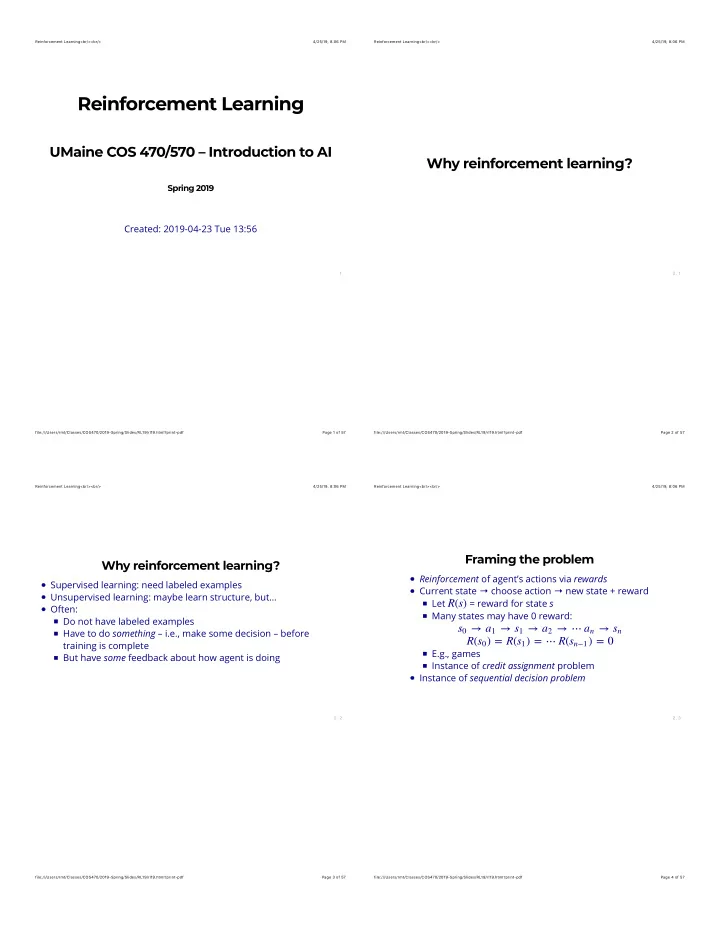
Why reinforcement learning?

2 . 1 4/25/19, 8*06 PM Reinforcement Learning<br/><br/> Page 3 of 57 file:///Users/rmt/Classes/COS470/2019-Spring/Slides/RL19/rl19.html?print-pdf

Why reinforcement learning?

Supervised learning: need labeled examples Unsupervised learning: maybe learn structure, but… Often: Do not have labeled examples Have to do something – i.e., make some decision – before training is complete But have some feedback about how agent is doing

2 . 2 4/25/19, 8*06 PM Reinforcement Learning<br/><br/> Page 4 of 57 file:///Users/rmt/Classes/COS470/2019-Spring/Slides/RL19/rl19.html?print-pdf

Framing the problem

Reinforcement of agent’s actions via rewards Current state → choose action → new state + reward Let = reward for state s Many states may have 0 reward: E.g., games Instance of credit assignment problem Instance of sequential decision problem

R(s) → → → → ⋯ → s0 a1 s1 a2 an sn R( ) = R( ) = ⋯ R( ) = 0 s0 s1 sn−1

2 . 3

slide-2
SLIDE 2

4/25/19, 8*06 PM Reinforcement Learning<br/><br/> Page 5 of 57 file:///Users/rmt/Classes/COS470/2019-Spring/Slides/RL19/rl19.html?print-pdf

Reinforcement learning

Rewards But no a priori knowledge of rewards, model (transition function) E.g.: Given an unfamiliar board and pieces, alternate moves with

  • pponent – only feedback is “you win” or “you lose”

Robot has to move around campus delivering mail, but doesn’t know anything about campus, or delivering mail, or people, or… feedback: “good robot”, “ouch!”, falls over, etc.

2 . 4 4/25/19, 8*06 PM Reinforcement Learning<br/><br/> Page 6 of 57 file:///Users/rmt/Classes/COS470/2019-Spring/Slides/RL19/rl19.html?print-pdf

Reinforcement learning

(From ) https://icml.cc/2016/tutorials/deep_rl_tutorial.pdf

2 . 5 4/25/19, 8*06 PM Reinforcement Learning<br/><br/> Page 7 of 57 file:///Users/rmt/Classes/COS470/2019-Spring/Slides/RL19/rl19.html?print-pdf

Learning approaches

Learn utilities of states Use to select action to maximize expected outcome utility Needs model of environment, though to know resulting from taking action in Policy learning (reflex agent): Directly learn : which action to take in , bypassing Q-learning: Learn an action-utility function Q is the value (utility) of action in state Model-less learning

s′ a s π(s) s U(s) Q(a, s) a s

2 . 6 4/25/19, 8*06 PM Reinforcement Learning<br/><br/> Page 8 of 57 file:///Users/rmt/Classes/COS470/2019-Spring/Slides/RL19/rl19.html?print-pdf

Learning approaches

Passive learning: Policy is fixed Task: learn (or utility of state-action pairs) Maybe learn model Active learning: Has to learn what to do May not even know what its actions do Involves exploration

U(s)

2 . 7

slide-3
SLIDE 3

4/25/19, 8*06 PM Reinforcement Learning<br/><br/> Page 9 of 57 file:///Users/rmt/Classes/COS470/2019-Spring/Slides/RL19/rl19.html?print-pdf

Passive reinforcement learning

3 . 1 4/25/19, 8*06 PM Reinforcement Learning<br/><br/> Page 10 of 57 file:///Users/rmt/Classes/COS470/2019-Spring/Slides/RL19/rl19.html?print-pdf

Passive reinforcement learning

Policy is fixed Task: See how good policy is by learning: Doesn’t know: transition model reward function

π(s) (s) = E [ R( )] U π ∑

t=0 ∞

γt st P( |s, a) s′ R(s)

3 . 2 4/25/19, 8*06 PM Reinforcement Learning<br/><br/> Page 11 of 57 file:///Users/rmt/Classes/COS470/2019-Spring/Slides/RL19/rl19.html?print-pdf

Passive reinforcement learning

Policy is fixed Task: See how good policy is by learning: Doesn’t know: transition model reward function Approach: Do series of trials Each: start at start, follow policy to terminal state Percepts ⇒ new state ,

π(s) (s) = E [ R( )] U π ∑

t=0 ∞

γt st P( |s, a) s′ R(s) s′ R( ) s′

3 . 2 4/25/19, 8*06 PM Reinforcement Learning<br/><br/> Page 12 of 57 file:///Users/rmt/Classes/COS470/2019-Spring/Slides/RL19/rl19.html?print-pdf

Passive reinforcement learning

Policy is fixed Task: See how good policy is by learning: Doesn’t know: transition model reward function Approach: Do series of trials Each: start at start, follow policy to terminal state Percepts ⇒ new state , Stochastic transitions ⇒ different histories from same

π(s) (s) = E [ R( )] U π ∑

t=0 ∞

γt st P( |s, a) s′ R(s) s′ R( ) s′ π

3 . 2

slide-4
SLIDE 4

4/25/19, 8*06 PM Reinforcement Learning<br/><br/> Page 13 of 57 file:///Users/rmt/Classes/COS470/2019-Spring/Slides/RL19/rl19.html?print-pdf

Direct estimation of

Woodrow & Huff (1960 – adaptive control theory = remaining reward = reward-to-go View: each trial ⇒ one sample of reward-to-go for each visited state Reduces reinforcement learning to supervised learning But although and are independent… … and are not independent – (cf. Bellman equation) Misses opportunities for learning – e.g., See for first time, it leads to known state that is known Bellman: tells us something about Direct estimation: only matters Hypothesis space > needs to be

(s) U π

U(s) R(s) R( ) s′ U(s) U( ) s′ s1 s2 U( ) s2 U( ) s1 R(s1)

3 . 3 4/25/19, 8*06 PM Reinforcement Learning<br/><br/> Page 14 of 57 file:///Users/rmt/Classes/COS470/2019-Spring/Slides/RL19/rl19.html?print-pdf

Adaptive dynamic programming

First learn model of transition function from trials Now you have an MDP Solve it as per sequential decision process Could use Bayesian approaches to make this better (see R&N, 21.2.2)

P( |s, a) s′

3 . 4 4/25/19, 8*06 PM Reinforcement Learning<br/><br/> Page 15 of 57 file:///Users/rmt/Classes/COS470/2019-Spring/Slides/RL19/rl19.html?print-pdf

Temporal difference learning

Use the Bellman equations directly: General idea: Start with no known Iterate: Take step to give If is unknown state, use as Use to adjust :

(s) = R(s) + γ (P( |s, π(s)) ( ) U π ∑

s ′

s′ U π s′ U(⋅) π(s) s′ s′ R( ) s′ U( ) s′ U( ) s′ U(s) (s) ← (s) + α(R(s) + γ ( ) − (s)) U π U π U π s′ U π

3 . 5 4/25/19, 8*06 PM Reinforcement Learning<br/><br/> Page 16 of 57 file:///Users/rmt/Classes/COS470/2019-Spring/Slides/RL19/rl19.html?print-pdf

Temporal difference RL algorithm

3 . 6

slide-5
SLIDE 5

4/25/19, 8*06 PM Reinforcement Learning<br/><br/> Page 17 of 57 file:///Users/rmt/Classes/COS470/2019-Spring/Slides/RL19/rl19.html?print-pdf

Active reinforcement learning

4 . 1 4/25/19, 8*06 PM Reinforcement Learning<br/><br/> Page 18 of 57 file:///Users/rmt/Classes/COS470/2019-Spring/Slides/RL19/rl19.html?print-pdf

Active reinforcement learning

4 . 2 4/25/19, 8*06 PM Reinforcement Learning<br/><br/> Page 19 of 57 file:///Users/rmt/Classes/COS470/2019-Spring/Slides/RL19/rl19.html?print-pdf

Active reinforcement learning

What if we not only don’t know: …also don’t know ?

P( |s, a) s′ R(s) π(s)

4 . 2 4/25/19, 8*06 PM Reinforcement Learning<br/><br/> Page 20 of 57 file:///Users/rmt/Classes/COS470/2019-Spring/Slides/RL19/rl19.html?print-pdf

Active reinforcement learning

What if we not only don’t know: …also don’t know ? One approach: use passive learning, but for all possible actions Use the adaptive dynamic programming agent, but for all at each state This gives the transition model Use value iteration or policy iteration ⇒

P( |s, a) s′ R(s) π(s) a ∈ A(s) U(s)

4 . 2

slide-6
SLIDE 6

4/25/19, 8*06 PM Reinforcement Learning<br/><br/> Page 21 of 57 file:///Users/rmt/Classes/COS470/2019-Spring/Slides/RL19/rl19.html?print-pdf

Active reinforcement learning

What if we not only don’t know: …also don’t know ? One approach: use passive learning, but for all possible actions Use the adaptive dynamic programming agent, but for all at each state This gives the transition model Use value iteration or policy iteration ⇒ Produces greedy agent: Once good terminal state found, tends to keep using policy that found it Seldom in practice converges to optimal policy !

P( |s, a) s′ R(s) π(s) a ∈ A(s) U(s) π∗

4 . 2 4/25/19, 8*06 PM Reinforcement Learning<br/><br/> Page 22 of 57 file:///Users/rmt/Classes/COS470/2019-Spring/Slides/RL19/rl19.html?print-pdf

Greedy agent

Why doesn’t greedy agent converge? Only exploits known path – assumes model is good But model created based on learned – leaves some states unexplored Actions leading to those states allow better learning of model Which allows better estimation of , Have to balance exploitation with exploration

π U(s) π∗

4 . 3 4/25/19, 8*06 PM Reinforcement Learning<br/><br/> Page 23 of 57 file:///Users/rmt/Classes/COS470/2019-Spring/Slides/RL19/rl19.html?print-pdf

Incorporating exploration

Using value iteration to get Now think of , the optimistic estimate of utility of Design an exploration function where:

  • expected utility of some new state
  • number of times action (expected to lead to

from ) has been tried in New iteration function for (optimistic) utility: where number of times has been tried in

U(s) (s) U + s f(u, n) u s′ n a s′ s s (s) ← R(s) + γ f ( P( |s, a) ( ), N(s, a)) U + max

a

s′

s′ U + s′ N(s, a) = s a

4 . 4 4/25/19, 8*06 PM Reinforcement Learning<br/><br/> Page 24 of 57 file:///Users/rmt/Classes/COS470/2019-Spring/Slides/RL19/rl19.html?print-pdf

Q-learning

Instead of learning utilities, learn : utility of action in Model-free: doesn’t have to know at all Could do this: A Bellman equation, but for \(\) pairs rather than Could use in adaptive dynamic programming as iteration method But this isn’t really model-free – need Instead, use temporal difference method:

Q(s, a) a s U(s) Q(s, a) = R(s) + γ P( |s, a) Q( , ) ∑

s′

s′ max

a′

s′ a′ s P( |s, a) s′ Q(s, a) ← Q(s, a) + α(R(s) + γ Q( , ) − Q(s, a) max

a′

s′ a′

4 . 5

slide-7
SLIDE 7

4/25/19, 8*06 PM Reinforcement Learning<br/><br/> Page 25 of 57 file:///Users/rmt/Classes/COS470/2019-Spring/Slides/RL19/rl19.html?print-pdf

Q-learning agent

4 . 6 4/25/19, 8*06 PM Reinforcement Learning<br/><br/> Page 26 of 57 file:///Users/rmt/Classes/COS470/2019-Spring/Slides/RL19/rl19.html?print-pdf

SARSA

State-action-reward-state-action (SARSA) - similar to Q-learning Here, is action actually taken in Q-learning: uses best action from Still model-free, but have some policy that leads to choosing Off-policy vs on-policy algorithms Off-policy algorithms pay no attention to any policy – e.g., Q- learning On-policy: actions with respect to some policy Off-policy more flexible… …but if policy is constrained by others (e.g.), may be better to go with realistic actions taken rather than best possible

Q(s, a) ← Q(s, a) + α(R(s) + γQ( , ) − Q(s, a) s′ a′ a′ s′ s′ a′ π

4 . 7 4/25/19, 8*06 PM Reinforcement Learning<br/><br/> Page 27 of 57 file:///Users/rmt/Classes/COS470/2019-Spring/Slides/RL19/rl19.html?print-pdf

So…Q-learning or model-learning?

R&N: “This is an issue at the foundations of artificial intelligence.” More generally: do we need models to behave intelligently, or not? Traditionally: model (most symbolic AI) Lately: model-free (e.g., neural networks)

4 . 8 4/25/19, 8*06 PM Reinforcement Learning<br/><br/> Page 28 of 57 file:///Users/rmt/Classes/COS470/2019-Spring/Slides/RL19/rl19.html?print-pdf

Generalized RL

5 . 1

slide-8
SLIDE 8

4/25/19, 8*06 PM Reinforcement Learning<br/><br/> Page 29 of 57 file:///Users/rmt/Classes/COS470/2019-Spring/Slides/RL19/rl19.html?print-pdf

Generalized RL

5 . 2 4/25/19, 8*06 PM Reinforcement Learning<br/><br/> Page 30 of 57 file:///Users/rmt/Classes/COS470/2019-Spring/Slides/RL19/rl19.html?print-pdf

Generalized RL

So far:

  • 1. Learn
  • 2. Learn

U(s) Q(s, a)

5 . 2 4/25/19, 8*06 PM Reinforcement Learning<br/><br/> Page 31 of 57 file:///Users/rmt/Classes/COS470/2019-Spring/Slides/RL19/rl19.html?print-pdf

Generalized RL

So far:

  • 1. Learn
  • 2. Learn

But what if state space is very large or infinite?

U(s) Q(s, a)

5 . 2 4/25/19, 8*06 PM Reinforcement Learning<br/><br/> Page 32 of 57 file:///Users/rmt/Classes/COS470/2019-Spring/Slides/RL19/rl19.html?print-pdf

Generalized RL

So far:

  • 1. Learn
  • 2. Learn

But what if state space is very large or infinite? Instead: Learn function approximating

  • r

  • r

U(s) Q(s, a) U(s) Q(s, a) (s) U ˆ (s, a) Q ˆ

5 . 2

slide-9
SLIDE 9

4/25/19, 8*06 PM Reinforcement Learning<br/><br/> Page 33 of 57 file:///Users/rmt/Classes/COS470/2019-Spring/Slides/RL19/rl19.html?print-pdf

Generalized RL

So far:

  • 1. Learn
  • 2. Learn

But what if state space is very large or infinite? Instead: Learn function approximating

  • r

  • r

E.g., approximate by linear combination of features Static eval for chess, etc. Just learn values For chess, states – now only learn values, where

U(s) Q(s, a) U(s) Q(s, a) (s) U ˆ (s, a) Q ˆ U(s) (s) = (s) + ⋯ (s) U ˆ θ1f1 θnfn θi > 1040 n n < < 1040

5 . 2 4/25/19, 8*06 PM Reinforcement Learning<br/><br/> Page 34 of 57 file:///Users/rmt/Classes/COS470/2019-Spring/Slides/RL19/rl19.html?print-pdf

Generalized RL

So far:

  • 1. Learn
  • 2. Learn

But what if state space is very large or infinite? Instead: Learn function approximating

  • r

  • r

E.g., approximate by linear combination of features Static eval for chess, etc. Just learn values For chess, states – now only learn values, where Not just save space: allows generalization

U(s) Q(s, a) U(s) Q(s, a) (s) U ˆ (s, a) Q ˆ U(s) (s) = (s) + ⋯ (s) U ˆ θ1f1 θnfn θi > 1040 n n < < 1040

5 . 2 4/25/19, 8*06 PM Reinforcement Learning<br/><br/> Page 35 of 57 file:///Users/rmt/Classes/COS470/2019-Spring/Slides/RL19/rl19.html?print-pdf

Generalized RL

So far:

  • 1. Learn
  • 2. Learn

But what if state space is very large or infinite? Instead: Learn function approximating

  • r

  • r

E.g., approximate by linear combination of features Static eval for chess, etc. Just learn values For chess, states – now only learn values, where Not just save space: allows generalization On the other hand: maybe we choose wrong hypothesis space

U(s) Q(s, a) U(s) Q(s, a) (s) U ˆ (s, a) Q ˆ U(s) (s) = (s) + ⋯ (s) U ˆ θ1f1 θnfn θi > 1040 n n < < 1040

5 . 2 4/25/19, 8*06 PM Reinforcement Learning<br/><br/> Page 36 of 57 file:///Users/rmt/Classes/COS470/2019-Spring/Slides/RL19/rl19.html?print-pdf

Generalized RL

So – how to approach? One way: Choose utility approximator Run a series of trials Find best fit of feature weights to data (min. squared error) ⇒ Supervised learning

5 . 3

slide-10
SLIDE 10

4/25/19, 8*06 PM Reinforcement Learning<br/><br/> Page 37 of 57 file:///Users/rmt/Classes/COS470/2019-Spring/Slides/RL19/rl19.html?print-pdf

Generalized RL

Better to use online algorithm for RL Estimate (random to start) Run trial Adjust $\widehat{U(s)} accordingly How to adjust? Compute gradient with respect to each parameter Move parameter down gradient Sound familiar?

(s) U ˆ

5 . 4 4/25/19, 8*06 PM Reinforcement Learning<br/><br/> Page 38 of 57 file:///Users/rmt/Classes/COS470/2019-Spring/Slides/RL19/rl19.html?print-pdf

Generalized RL: Delta rule

5 . 5 4/25/19, 8*06 PM Reinforcement Learning<br/><br/> Page 39 of 57 file:///Users/rmt/Classes/COS470/2019-Spring/Slides/RL19/rl19.html?print-pdf

Generalized RL: Delta rule

Widrow-Hoff rule (delta rule)

5 . 5 4/25/19, 8*06 PM Reinforcement Learning<br/><br/> Page 40 of 57 file:///Users/rmt/Classes/COS470/2019-Spring/Slides/RL19/rl19.html?print-pdf

Generalized RL: Delta rule

Widrow-Hoff rule (delta rule) For trial , observed utility , and parameters , let error: \begin{eqnarray*} Ej(s) &=& (\widehat{U}θ(s) - uj(s))2/2 ∇ Eθi &= & ∂ Ej/∂θi θi &←& θi - α\frac{\partial E_j(s)}{\partial \theta_i} &←& θi + α(uj(s) - \widehat{U}θ(s) ) \frac{∂ \widehat{U}θ(s)}{∂ θi}

j (s) uj θ

5 . 5

slide-11
SLIDE 11

4/25/19, 8*06 PM Reinforcement Learning<br/><br/> Page 41 of 57 file:///Users/rmt/Classes/COS470/2019-Spring/Slides/RL19/rl19.html?print-pdf

Generalized RL: Delta rule

Widrow-Hoff rule (delta rule) For trial , observed utility , and parameters , let error: \begin{eqnarray*} Ej(s) &=& (\widehat{U}θ(s) - uj(s))2/2 ∇ Eθi &= & ∂ Ej/∂θi θi &←& θi - α\frac{\partial E_j(s)}{\partial \theta_i} &←& θi + α(uj(s) - \widehat{U}θ(s) ) \frac{∂ \widehat{U}θ(s)}{∂ θi} The parameters can also be the weights in a neural network!

j (s) uj θ θ

5 . 5 4/25/19, 8*06 PM Reinforcement Learning<br/><br/> Page 42 of 57 file:///Users/rmt/Classes/COS470/2019-Spring/Slides/RL19/rl19.html?print-pdf

Deep reinforcement learning

6 . 1 4/25/19, 8*06 PM Reinforcement Learning<br/><br/> Page 43 of 57 file:///Users/rmt/Classes/COS470/2019-Spring/Slides/RL19/rl19.html?print-pdf

Deep reinforcement learning

In RL, we can learn: In generalized RL: learn parameters of functions approximating , , Inputs: percepts Outputs: actions Have to know form of function (hypothesis space) Deep learning: excels in learning nonlinear functions mapping inputs to outputs Maybe combine RL and DL ⇒ deep reinforcement learning

U(s) Q(s, a) π(s) θ U Q π

6 . 2 4/25/19, 8*06 PM Reinforcement Learning<br/><br/> Page 44 of 57 file:///Users/rmt/Classes/COS470/2019-Spring/Slides/RL19/rl19.html?print-pdf

Model learning

Need to learn , Either/both can be learned by DL DL is responsible for understanding what the state s is given percepts E.g., for : Weights Many trials Each trial: Compute the target value via Monte Carlo method Using policy, go from to end to find utility Average multiple trials Or use Bellman equation, with temporal difference Now, however: don’t store – adjust the NN’s weights

U(s) P( |s, a) s′ U(s) θ θ ← arg || ( ) − | min

θ

1 2 ∑

i

U π

θ si

yi |2 y s U(s)

6 . 3

slide-12
SLIDE 12

4/25/19, 8*06 PM Reinforcement Learning<br/><br/> Page 45 of 57 file:///Users/rmt/Classes/COS470/2019-Spring/Slides/RL19/rl19.html?print-pdf

Deep Q-learning

Can we use deep learning to do model-free Q-learning? Deep Q-network (DQN): Function approximating : Here, are the parameters: the weights of NN Problem: Can’t just treat as supervised learning problem Q-learning isn’t stable w/ DL Q-learning balances exploitation with exploration ⇒ Input space, actions – changing as we explore more As these change, target value for changes So net’s input space, output space changing rapidly as explore

(Some material from , also Mnih et al., 2013)

Q(s, a) Q(s, a; θ) θ Q

here

6 . 4 4/25/19, 8*06 PM Reinforcement Learning<br/><br/> Page 46 of 57 file:///Users/rmt/Classes/COS470/2019-Spring/Slides/RL19/rl19.html?print-pdf

DQN

Train by minimizing sequence of loss functions: where is the target: here is a sequence of states here (so not Markovian?) Expected value for based on probability function over sequences of states Target determined from emulator/world + previous Optimize loss function with parameters from previous iteration held fixed Target depends on weights – not like supervised learning Gradient Use stochastic gradient descent

( ) = E [( − Q(s, a; ) ] Li θi yi θi )2 yi = E [r + γ Q( , ; )|s, a] yi max

a′

s′ a′ θi−1 s L θ ( ) Li θi θi−1 ( ) = E [(r + γQ( , ; ) − Q(s, a; ) Q(s, a; )] ∇θiLi θi s′ a′ θi−1 θi ∇θi θi

6 . 5 4/25/19, 8*06 PM Reinforcement Learning<br/><br/> Page 47 of 57 file:///Users/rmt/Classes/COS470/2019-Spring/Slides/RL19/rl19.html?print-pdf

DQN

As implemented by Mnih et al. (2013) at DeepMind Use past experience, past weights to slow down changes in input,

  • utput space

Allows gradual learning of Experience replay: Keep last million or so < > in replay buffer Train using batches from here Target network: Use two networks Update one constantly Other (target net): synchronize with other occasionally Target network provides values instead of using the rapidly- changing one So: from old weights trains new weights, then new becomes

  • ld occasionally

Q s, a, r Q Q

6 . 6 4/25/19, 8*06 PM Reinforcement Learning<br/><br/> Page 48 of 57 file:///Users/rmt/Classes/COS470/2019-Spring/Slides/RL19/rl19.html?print-pdf

DQN algorithm

(From Mnih et al., 2013)

6 . 7

slide-13
SLIDE 13

4/25/19, 8*06 PM Reinforcement Learning<br/><br/> Page 49 of 57 file:///Users/rmt/Classes/COS470/2019-Spring/Slides/RL19/rl19.html?print-pdf

DQN results

DeepMind’s early work:Atari games Played most better than any other RL program, some better than humans Input: raw frames (201 × 160 pixels, 128 colors) Output: actions Pre-processing: convert to grayscale, downsample + crop to rough game area Convolutional neural network First layer: 16 8 × 8 filters, stride 4, ReLu Second layer: 32 4 × 4 filters, stride 2, ReLu Last hidden layer: fully-connected, 256 ReLu units Output: Fully connected linear layer, single output per valid action

6 . 8 4/25/19, 8*06 PM Reinforcement Learning<br/><br/> Page 50 of 57 file:///Users/rmt/Classes/COS470/2019-Spring/Slides/RL19/rl19.html?print-pdf

Example: ConvNetJS

From Karpathy @ Stanford’s Deep Learning in Your Browser site

6 . 9 4/25/19, 8*06 PM Reinforcement Learning<br/><br/> Page 51 of 57 file:///Users/rmt/Classes/COS470/2019-Spring/Slides/RL19/rl19.html?print-pdf

Double DQN

Q-learning problem: can be overly optimistic on value of due to approximation error Update function for Q-learning where: For DQN: portion: target weights select and evaluate best action it would take May not be action that online net selects ⇒ possible overestimate

(From van Hasselt et al. (2016): Deep Reinforcement Learning with Double Q-Learning, AAAI-16.)

Q = + α( − Q( , ; )) Q( , ; ) θt+1 θt Yt st at θt ∇θt st at θt ≡ R( ) + γ Q( , a; ) Yt st+1 max

a

st+1 θt ≡ R( ) + γ Q( , a, ) Yt st+1 max

a

st+1 θ−

t

maxa

6 . 10 4/25/19, 8*06 PM Reinforcement Learning<br/><br/> Page 52 of 57 file:///Users/rmt/Classes/COS470/2019-Spring/Slides/RL19/rl19.html?print-pdf

Double DQN

Best if “best action” is one online net would choose… …but estimated target is per target net ⇒ Double DQN target: Much better learning due to fewer overestimates

≡ R( + γQ( , arg Q( , a; ); ) Yt st+1 st+1 max

a

st+1 θt θ−

t

6 . 11

slide-14
SLIDE 14

4/25/19, 8*06 PM Reinforcement Learning<br/><br/> Page 53 of 57 file:///Users/rmt/Classes/COS470/2019-Spring/Slides/RL19/rl19.html?print-pdf

Dueling DQN

Sometimes: No action is necessary in a state; or It doesn’t matter much which action is done; or One action is better than another in a range of states. conflates assessing states and assessing values (as would , then picking action) What if split Value of state is basically Advantage of action in state is state-dependent action worth

(From )

Q(s, a) U(S) Q(s, a) = V(s) + A(s, a) s V(s) U(s) a s A(s, a)

Wang et al., Dueling network architectures for deep reinforcement learning, 2016

6 . 12 4/25/19, 8*06 PM Reinforcement Learning<br/><br/> Page 54 of 57 file:///Users/rmt/Classes/COS470/2019-Spring/Slides/RL19/rl19.html?print-pdf

Dueling DQN

Learn and separately, then recombine to give :

V(S) A(s, a) Q(s, a)

6 . 13 4/25/19, 8*06 PM Reinforcement Learning<br/><br/> Page 55 of 57 file:///Users/rmt/Classes/COS470/2019-Spring/Slides/RL19/rl19.html?print-pdf

Dueling DQN

6 . 14 4/25/19, 8*06 PM Reinforcement Learning<br/><br/> Page 56 of 57 file:///Users/rmt/Classes/COS470/2019-Spring/Slides/RL19/rl19.html?print-pdf

Dueling DQN advantage

Learn values of states when actions don’t matter Don’t worry about choosing an action when it doesn’t matter

(Source: .) here

slide-15
SLIDE 15

4/25/19, 8*06 PM Reinforcement Learning<br/><br/> Page 57 of 57 file:///Users/rmt/Classes/COS470/2019-Spring/Slides/RL19/rl19.html?print-pdf 6 . 15