Outline Inference in Bayes Nets Variable Elimination Bayes Nets - - PDF document

outline
SMART_READER_LITE
LIVE PREVIEW

Outline Inference in Bayes Nets Variable Elimination Bayes Nets - - PDF document

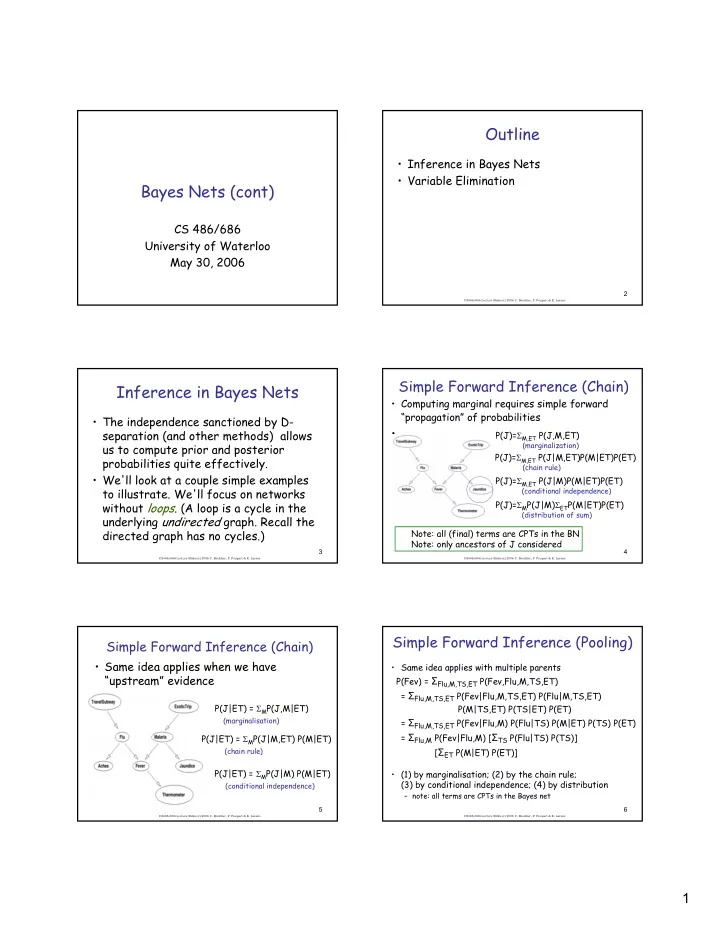
Outline Inference in Bayes Nets Variable Elimination Bayes Nets (cont) CS 486/686 University of Waterloo May 30, 2006 2 CS486/686 Lecture Slides (c) 2006 C. Boutilier, P. Poupart & K. Larson Simple Forward Inference (Chain)


slide-1
SLIDE 1

1

Bayes Nets (cont)

CS 486/686 University of Waterloo May 30, 2006

CS486/686 Lecture Slides (c) 2006 C. Boutilier, P. Poupart & K. Larson

2

Outline

  • Inference in Bayes Nets
  • Variable Elimination

CS486/686 Lecture Slides (c) 2006 C. Boutilier, P. Poupart & K. Larson

3

Inference in Bayes Nets

  • The independence sanctioned by D-

separation (and other methods) allows us to compute prior and posterior probabilities quite effectively.

  • We'll look at a couple simple examples

to illustrate. We'll focus on networks without loops. (A loop is a cycle in the underlying undirected graph. Recall the directed graph has no cycles.)

CS486/686 Lecture Slides (c) 2006 C. Boutilier, P. Poupart & K. Larson

4

Simple Forward Inference (Chain)

  • Computing marginal requires simple forward

“propagation” of probabilities

  • Note: all (final) terms are CPTs in the BN

Note: only ancestors of J considered P(J)=ΣM,ET P(J,M,ET)

(marginalization)

P(J)=ΣM,ET P(J|M)P(M|ET)P(ET)

(conditional independence)

P(J)=ΣMP(J|M)ΣETP(M|ET)P(ET)

(distribution of sum)

P(J)=ΣM,ET P(J|M,ET)P(M|ET)P(ET)

(chain rule)

CS486/686 Lecture Slides (c) 2006 C. Boutilier, P. Poupart & K. Larson

5

Simple Forward Inference (Chain)

  • Same idea applies when we have

“upstream” evidence

(chain rule)

P(J|ET) = ΣMP(J,M|ET)

(marginalisation)

P(J|ET) = ΣMP(J|M,ET) P(M|ET) P(J|ET) = ΣMP(J|M) P(M|ET)

(conditional independence)

CS486/686 Lecture Slides (c) 2006 C. Boutilier, P. Poupart & K. Larson

6

Simple Forward Inference (Pooling)

  • Same idea applies with multiple parents

P(Fev) = ΣFlu,M,TS,ET P(Fev,Flu,M,TS,ET) = ΣFlu,M,TS,ET P(Fev|Flu,M,TS,ET) P(Flu|M,TS,ET) P(M|TS,ET) P(TS|ET) P(ET) = ΣFlu,M,TS,ET P(Fev|Flu,M) P(Flu|TS) P(M|ET) P(TS) P(ET) = ΣFlu,M P(Fev|Flu,M) [ΣTS P(Flu|TS) P(TS)] [ΣET P(M|ET) P(ET)]

  • (1) by marginalisation; (2) by the chain rule;

(3) by conditional independence; (4) by distribution

– note: all terms are CPTs in the Bayes net

slide-2
SLIDE 2

2

CS486/686 Lecture Slides (c) 2006 C. Boutilier, P. Poupart & K. Larson

7

Simple Forward Inference (Pooling)

  • Same idea applies with evidence

P(Fev|ts,~m) = ΣFlu P(Fev,Flu|ts,~m) = ΣFlu P(Fev |Flu,ts,~m) P(Flu|ts,~m) = ΣFlu P(Fev|Flu,~m) P(Flu|ts)

CS486/686 Lecture Slides (c) 2006 C. Boutilier, P. Poupart & K. Larson

8

Simple Backward Inference

  • When evidence is downstream of query variable,

we must reason “backwards.” This requires the use of Bayes rule:

P(ET | j) = α P(j | ET) P(ET) = α ΣM P(j,M|ET) P(ET) = α ΣM P(j|M,ET) P(M|ET) P(ET) = α ΣM P(j|M) P(M|ET) P(ET)

  • First step is just Bayes rule

– normalizing constant α is 1/P(j); but we needn’t compute it explicitly if we compute P(ET | j) for each value of ET: we just add up terms P(j | ET) P(ET) for all values

  • f ET (they sum to P(j))

CS486/686 Lecture Slides (c) 2006 C. Boutilier, P. Poupart & K. Larson

9

Backward Inference (Pooling)

  • Same ideas when several pieces of

evidence lie “downstream”

P(ET|j,fev) =α P(j,fev|ET) P(ET) = α ΣM,Fl,TS P(j,fev,M,Fl,TS|ET) P(ET) = α ΣM,Fl,TS P(j|fev,M,Fl,TS,ET) P(fev|M,Fl,TS,ET) P(M|Fl,TS,ET) P(Fl|TS,ET) P(TS|ET) P(ET) = α P(ET) ΣM P(j|M) ΣFl P(fev|M,Fl) ΣTS P(Fl|TS) P(TS) – Same steps as before; but now we compute prob of both pieces of evidence given hypothesis ET and combine them. Note: they are independent given M; but not given ET.

CS486/686 Lecture Slides (c) 2006 C. Boutilier, P. Poupart & K. Larson

10

Variable Elimination

  • The intuitions in the above examples give us

a simple inference algorithm for networks without loops: the polytree algorithm.

  • Instead we'll look at a more general

algorithm that works for general BNs; but the polytree algorithm will be a special case.

  • The algorithm, variable elimination, simply

applies the summing out rule repeatedly.

– To keep computation simple, it exploits the independence in the network and the ability to distribute sums inward

CS486/686 Lecture Slides (c) 2006 C. Boutilier, P. Poupart & K. Larson

11

Factors

  • A function f(X1, X2,…, Xk) is also called a
  • factor. We can view this as a table of

numbers, one for each instantiation of the variables X1, X2,…, Xk.

– A tabular rep’n of a factor is exponential in k

  • Each CPT in a Bayes net is a factor:

– e.g., Pr(C|A,B) is a function of three variables, A, B, C

  • Notation: f(X,Y) denotes a factor over the

variables X ∪ Y. (Here X, Y are sets of variables.)

CS486/686 Lecture Slides (c) 2006 C. Boutilier, P. Poupart & K. Larson

12

The Product of Two Factors

  • Let f(X,Y) & g(Y,Z) be two factors with

variables Y in common

  • The product of f and g, denoted h = f x g

(or sometimes just h = fg), is defined: h(X,Y,Z) = f(X,Y) x g(Y,Z)

0.12 ~a~b~c 0.48 ~a~bc 0.2 ~b~c 0.6 ~a~b 0.12 ~ab~c 0.28 ~abc 0.8 ~bc 0.4 ~ab 0.02 a~b~c 0.08 a~bc 0.3 b~c 0.1 a~b 0.27 ab~c 0.63 abc 0.7 bc 0.9 ab

h(A,B,C) g(B,C) f(A,B)

slide-3
SLIDE 3

3

CS486/686 Lecture Slides (c) 2006 C. Boutilier, P. Poupart & K. Larson

13

Summing a Variable Out of a Factor

  • Let f(X,Y) be a factor with variable X (Y

is a set)

  • We sum out variable X from f to produce

a new factor h = ΣX f, which is defined: h(Y) = Σx∊Dom(X) f(x,Y)

0.6 ~a~b 0.4 ~ab 0.7 ~b 0.1 a~b 1.3 b 0.9 ab

h(B) f(A,B)

CS486/686 Lecture Slides (c) 2006 C. Boutilier, P. Poupart & K. Larson

14

Restricting a Factor

  • Let f(X,Y) be a factor with variable X (Y

is a set)

  • We restrict factor f to X=x by setting X

to the value x and “deleting”. Define h = fX=x as: h(Y) = f(x,Y)

0.6 ~a~b 0.4 ~ab 0.1 ~b 0.1 a~b 0.9 b 0.9 ab

h(B) = fA=a f(A,B)

CS486/686 Lecture Slides (c) 2006 C. Boutilier, P. Poupart & K. Larson

15

Variable Elimination: No Evidence

  • Computing prior probability of query var X

can be seen as applying these operations on factors

  • P(C) = ΣA,B P(C|B) P(B|A) P(A)

= ΣB P(C|B) ΣA P(B|A) P(A) = ΣB f3(B,C) ΣA f2(A,B) f1(A) = ΣB f3(B,C) f4(B) = f5(C) Define new factors: f4(B)= ΣA f2(A,B) f1(A) and f5(C)= ΣB f3(B,C) f4(B) B C A

f1(A) f2(A,B) f3(B,C)

CS486/686 Lecture Slides (c) 2006 C. Boutilier, P. Poupart & K. Larson

16

Variable Elimination: No Evidence

  • Here’s the example with some numbers

B C A

f1(A) f2(A,B) f3(B,C)

~c c

f5(C)

0.375 0.625 ~b b

f4(B)

0.15 0.85 0.1 0.9 ~a a

f1(A)

0.8 ~b~c 0.6 ~a~b 0.2 ~bc 0.4 ~ab 0.3 b~c 0.1 a~b 0.7 bc 0.9 ab

f3(B,C) f2(A,B)

CS486/686 Lecture Slides (c) 2006 C. Boutilier, P. Poupart & K. Larson

17

VE: No Evidence (Example 2)

P(D) = ΣA,B,C P(D|C) P(C|B,A) P(B) P(A) = ΣC P(D|C) ΣB P(B) ΣA P(C|B,A) P(A) = ΣC f4(C,D) ΣB f2(B) ΣA f3(A,B,C) f1(A) = ΣC f4(C,D) ΣB f2(B) f5(B,C) = ΣC f4(C,D) f6(C) = f7(D)

Define new factors: f5(B,C), f6(C), f7(D), in the obvious way C D A

f1(A) f3(A,B,C) f4(C,D)

B

f2(B)

CS486/686 Lecture Slides (c) 2006 C. Boutilier, P. Poupart & K. Larson

18

Variable Elimination: One View

  • One way to think of variable elimination:

– write out desired computation using the chain rule, exploiting the independence relations in the network – arrange the terms in a convenient fashion – distribute each sum (over each variable) in as far as it will go

  • i.e., the sum over variable X can be “pushed in” as

far as the “first” factor mentioning X

– apply operations “inside out”, repeatedly eliminating and creating new factors (note that each step/removal of a sum eliminates

  • ne variable)
slide-4
SLIDE 4

4

CS486/686 Lecture Slides (c) 2006 C. Boutilier, P. Poupart & K. Larson

19

Variable Elimination Algorithm

  • Given query var Q, remaining vars Z. Let

F be the set of factors corresponding to CPTs for {Q} ∪ Z.

  • 1. Choose an elimination ordering Z1, …, Zn of variables in Z.
  • 2. For each Zj -- in the order given -- eliminate Zj ∊ Z

as follows: (a) Compute new factor gj = ΣZj f1 x f2 x … x fk, where the fi are the factors in F that include Zj (b) Remove the factors fi (that mention Zj ) from F and add new factor gj to F

  • 3. The remaining factors refer only to the query variable Q.

Take their product and normalize to produce P(Q)

CS486/686 Lecture Slides (c) 2006 C. Boutilier, P. Poupart & K. Larson

20

VE: Example 2 again

Step 1: Add f5(B,C) = ΣA f3(A,B,C) f1(A) Remove: f1(A), f3(A,B,C) Step 2: Add f6(C)= ΣB f2(B) f5(B,C) Remove: f2(B) , f5(B,C) Step 3: Add f7(D) = ΣC f4(C,D) f6(C) Remove: f4(C,D), f6(C) Last factor f7(D) is (possibly unnormalized) probability P(D) Factors: f1(A) f2(B) f3(A,B,C) f4(C,D) Query: P(D)?

  • Elim. Order: A, B, C

C D A

f1(A) f3(A,B,C) f4(C,D)

B

f2(B)

CS486/686 Lecture Slides (c) 2006 C. Boutilier, P. Poupart & K. Larson

21

Variable Elimination: Evidence

  • Computing posterior of query variable given

evidence is similar; suppose we observe C=c: P(A|c) = α P(A) P(c|A) = α P(A) ΣB P(c|B) P(B|A) = α f1(A) ΣB f3(B,c) f2(A,B) = α f1(A) ΣB f4(B) f2(A,B) = α f1(A) f5(A) = α f6(A)

New factors: f4(B)= f3(B,c); f5(A)= ΣB f2(A,B) f4(B); f6(A)= f1(A) f5(A) B C A

f1(A) f2(A,B) f3(B,C)

CS486/686 Lecture Slides (c) 2006 C. Boutilier, P. Poupart & K. Larson

22

Variable Elimination with Evidence

Given query var Q, evidence vars E (observed to be e), remaining vars Z. Let F be set of factors involving CPTs for {Q} ∪ Z.

  • 1. Replace each factor f∊F that mentions a variable(s) in E

with its restriction fE=e (somewhat abusing notation)

  • 2. Choose an elimination ordering Z1, …, Zn of variables in Z.
  • 3. Run variable elimination as above.
  • 4. The remaining factors refer only to the query variable Q.

Take their product and normalize to produce P(Q)

CS486/686 Lecture Slides (c) 2006 C. Boutilier, P. Poupart & K. Larson

23

VE: Example 2 again with Evidence

Restriction: replace f4(C,D) with f5(C) = f4(C,d) Step 1: Add f6(A,B)= ΣC f5(C) f3(A,B,C) Remove: f3(A,B,C), f5(C) Step 2: Add f7(A) = ΣB f6(A,B) f2(B) Remove: f6(A,B), f2(B) Last factors: f7(A), f1(A). The product f1(A) x f7(A) is (possibly unnormalized) posterior. So… P(A|d) = α f1(A) x f7(A). Factors: f1(A) f2(B) f3(A,B,C) f4(C,D) Query: P(A)? Evidence: D = d

  • Elim. Order: C, B

C D A

f1(A) f3(A,B,C) f4(C,D)

B

f2(B)

CS486/686 Lecture Slides (c) 2006 C. Boutilier, P. Poupart & K. Larson

24

Some Notes on the VE Algorithm

  • After iteration j (elimination of Zj), factors remaining in

set F refer only to variables Xj+1, … Zn and Q. No factor mentions an evidence variable E after the initial restriction.

  • Number of iterations: linear in number of variables
  • Complexity is linear in number of vars and exponential in

size of the largest factor. – Recall each factor has exponential size in its number of variables – Can't do any better than size of BN (since its original factors are part of the factor set) – When we create new factors, we might make a set of variables larger.

slide-5
SLIDE 5

5

CS486/686 Lecture Slides (c) 2006 C. Boutilier, P. Poupart & K. Larson

25

Some Notes on the VE Algorithm

  • The size of the resulting factors is determined by

elimination ordering! (We’ll see this in detail)

  • For polytrees, easy to find good ordering (e.g.,

work outside in).

  • For general BNs, sometimes good orderings exist,

sometimes they don't (then inference is exponential in number of vars).

– Simply finding the optimal elimination ordering for general BNs is NP-hard. – Inference in general is NP-hard in general BNs

CS486/686 Lecture Slides (c) 2006 C. Boutilier, P. Poupart & K. Larson

26

Elimination Ordering: Polytrees

  • Inference is linear in size
  • f network

– ordering: eliminate only “singly-connected” nodes – e.g., in this network, eliminate D, A, C, X1,…; or eliminate X1,… Xk, D, A, C;

  • r mix up…

– result: no factor ever larger than original CPTs – eliminating B before these gives factors that include all of A,C, X1,… Xk !!!

CS486/686 Lecture Slides (c) 2006 C. Boutilier, P. Poupart & K. Larson

27

Effect of Different Orderings

  • Suppose query variable

is D. Consider different orderings for this network

– A,F,H,G,B,C,E:

  • good: why?

– E,C,A,B,G,H,F:

  • bad: why?
  • Which ordering

creates smallest factors?

– either max size or total

  • which creates largest

factors?

CS486/686 Lecture Slides (c) 2006 C. Boutilier, P. Poupart & K. Larson

28

Relevance

  • Certain variables have no impact on the

query.

– In ABC network, computing Pr(A) with no evidence requires elimination of B and C.

  • But when you sum out these vars, you compute a

trivial factor (whose value are all ones); for example:

  • eliminating C: f4(B) = ΣC f3(B,C) = ΣC Pr(C|B)
  • 1 for any value of B (e.g., Pr(c|b) + Pr(~c|b) = 1)
  • No need to think about B or C for this

query

B C A

CS486/686 Lecture Slides (c) 2006 C. Boutilier, P. Poupart & K. Larson

29

Relevance: A Sound Approximation

  • Can restrict attention to relevant
  • variables. Given query Q, evidence E:

– Q is relevant – if any node Z is relevant, its parents are relevant – if E∊E is a descendent of a relevant node, then E is relevant

  • We can restrict our attention to the

subnetwork comprising only relevant variables when evaluating a query Q

CS486/686 Lecture Slides (c) 2006 C. Boutilier, P. Poupart & K. Larson

30

Next Class

  • Decision making

– Utility Theory – Decision Trees

  • Russell & Norvig: Chapter 16