CS 331: Artificial Intelligence Introduction 1 What is AI? (4 - - PDF document

cs 331 artificial intelligence introduction
SMART_READER_LITE
LIVE PREVIEW

CS 331: Artificial Intelligence Introduction 1 What is AI? (4 - - PDF document

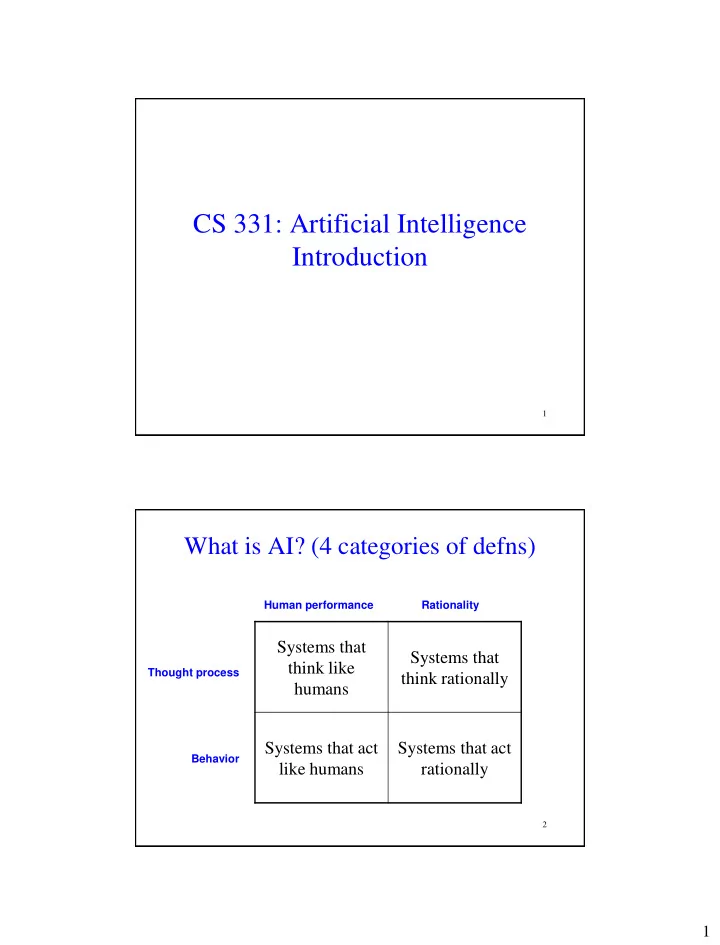
CS 331: Artificial Intelligence Introduction 1 What is AI? (4 categories of defns) Human performance Rationality Systems that Systems that think like Thought process think rationally humans Systems that act Systems that act Behavior


slide-1
SLIDE 1

1

1

CS 331: Artificial Intelligence Introduction

2

What is AI? (4 categories of defns)

Systems that think like humans Systems that think rationally Systems that act like humans Systems that act rationally

Thought process Behavior Human performance Rationality

slide-2
SLIDE 2

2

3

Acting like humans (Turing Test)

Can a human interrogator, after posing some written questions, tell if the responses come from a human being or a computer?

AI Computer

Requirements for computer: natural language processing, knowledge representation, automated reasoning, machine learning, vision and robotics (the last two are for the “total Turing Test”)

4

Problems with the Turing Test

  • Not reproducible
  • Can’t be analyzed mathematically
  • Tends to focus on human-like errors, linguistic

tricks, etc.

  • Does not produce useful computer programs

AI researchers believe it’s more important to study the underlying principles of intelligence than duplicating how humans act

slide-3
SLIDE 3

3

5

Thinking Humanly (Cognitive Modeling)

  • Models of the internal workings of the

human mind

  • Validation:

– Compare models with actual behavior of human subjects (cognitive science) – Compare models with neurological activity in the brain (cognitive neuroscience)

  • AI is now distinct from both cognitive

science and cognitive neuroscience

6

Thinking rationally (Laws of Thought)

  • Rational = conclusions are provable from inputs and prior

knowledge

  • Ensure all actions by a computer are justifiable (i.e.

“rational”) Facts and rules in formal logic Problems:

  • Hard to represent informal knowledge formally, especially

when not 100% certain

  • Computationally expensive

Theorem Prover

slide-4
SLIDE 4

4

7

Acting Rationally (Rational Agents)

  • “Agent”: something that acts
  • “Rational” means more than just logically
  • justified. It also means “doing the right

thing”

  • “Rational agent”: an agent that acts to

achieve the best outcome given its resources

8

Rational Agents

  • Adjust amount of reasoning according to

available resources and importance of the result

  • This is one thing that makes AI hard

very few resources lots of resources no thought “reflexes” Careful, deliberate reasoning limited, approximate reasoning

slide-5
SLIDE 5

5

9

AI Timeline

1943-1956 The gestation of AI 1956 The birth of AI 1952-1969 Early enthusiasm, great expectations 1966-1973 A dose of reality 1969-1979 Knowledge-based systems 1980-present AI becomes a successful industry 1986-present The return of neural networks 1987-present AI adopts the scientific method 1995-present The emergence of intelligent agents 2001 Big Data

10

AI Today

  • Deep Blue: first computer program to defeat

the world champion in chess (1996)

  • AlphaGo: master-level performance at Go

(2016)

  • NavLab: minivan drove itself across the US
  • n its own 98% of the time (1995)
  • Google’s self-driving cars
  • Proverb: crossword puzzle solver (1998)
slide-6
SLIDE 6

6

11

Other AI applications in the real world

  • Credit card fraud detection
  • Medical diagnosis programs
  • Computer-assisted surgery
  • Search engines
  • Personalized news sites
  • Collaborative filtering
  • Spam filtering
  • Disease outbreak detection
  • Opponents in video games

12

Surprises in AI Research

  • Tasks difficult for humans have turned out to be

“easy”

– Chess – Checkers, Othello, Backgammon – Logistics planning – Airline scheduling – Fraud detection – Sorting mail – Proving theorems – Crossword puzzles

slide-7
SLIDE 7

7

13

Surprises in AI Research

  • Tasks easy for humans have turned out to be hard.

– Speech recognition – Face recognition – Composing music/art – Autonomous navigation – Motor activities (walking) – Language understanding – Common sense reasoning (example: how many legs does a fish have?)

14

AI Courses at OSU

1. CS331: Introduction to AI (Spring quarter)

  • Search
  • Games
  • Knowledge Representation
  • Bayesian Networks

2. CS434: Machine Learning and Data Mining (Spring quarter)

  • Supervised Learning
  • Unsupervised Learning
  • Reinforcement Learning
slide-8
SLIDE 8

8

15

  • 1. Search

8-puzzle: Beginning with the start state, slide tiles horizontally or vertically until you get to the goal state.

  • 1. Search

7 2 4 5 6 8 3 1 7 4 5 2 6 8 3 1 7 2 4 5 6 8 3 1 7 2 4 5 3 6 8 1 7 2 4 5 6 8 3 1 7 4 5 2 6 8 3 1 7 4 5 2 6 8 3 1 7 2 5 6 4 8 3 1 7 2 4 5 6 1 8 3 7 2 4 5 3 6 8 1 7 2 4 5 3 6 8 1 2 4 7 5 6 8 3 1 7 2 4 8 5 6 3 1

We will discuss: Uninformed search Informed search Local search

slide-9
SLIDE 9

9

17

  • 2. Games (Fully observable)
  • How do you

create a program to play tic-tac- toe intelligently?

  • What about

chess?

18

  • 3. Knowledge Representation

From this knowledge base, can we derive the following?

  • Your professor is a

Packer fan

  • You will have a difficult

midterm

  • Your professor does not

like cheese

Knowledge Base

Everyone from Wisconsin is a Packer fan All Packer fans like cheese Everyone from Wisconsin is evil Your professor is from Wisconsin Evil professors have difficult midterms

slide-10
SLIDE 10

10

  • 4. Bayesian Networks

Private And Confidential Dear Friend, It is with heart of hope that I write to seek your help in the context below. I am Mrs. Jumai Asfatu Abacha, the second wife of the former Nigeria head of state who died on the 8th of June, 1998. Having gotten your address through the internet, I have no doubt on your goodwill to assist us in receiving into your custody (For Safety) the sum of Forty-Eight Million, Five Hundred Thousand United States Dollars (US$48.5M) willed and deposited in my favour by my Late husband… Professor Hutchinson, I tried to hand in homework 1 electronically but the handin script was broken. I’ve attached my homework in this email…

P(Spam) = 0.88 P(Spam) = 0.28

Example: Learning to classify emails as spam or not spam