CSCI 446 ARTIFICIAL INTELLIGENCE EXAM 1 STUDY OUTLINE Introduction - - PDF document

csci 446 artificial intelligence exam 1 study outline
SMART_READER_LITE
LIVE PREVIEW

CSCI 446 ARTIFICIAL INTELLIGENCE EXAM 1 STUDY OUTLINE Introduction - - PDF document

CSCI 446 ARTIFICIAL INTELLIGENCE EXAM 1 STUDY OUTLINE Introduction to Artificial Intelligence I. Definitions of Artificial Intelligence A. Acting Like Humans -- Turing Test B. Thinking Like Humans -- Cognitive Modeling C. Thinking Rationally


slide-1
SLIDE 1

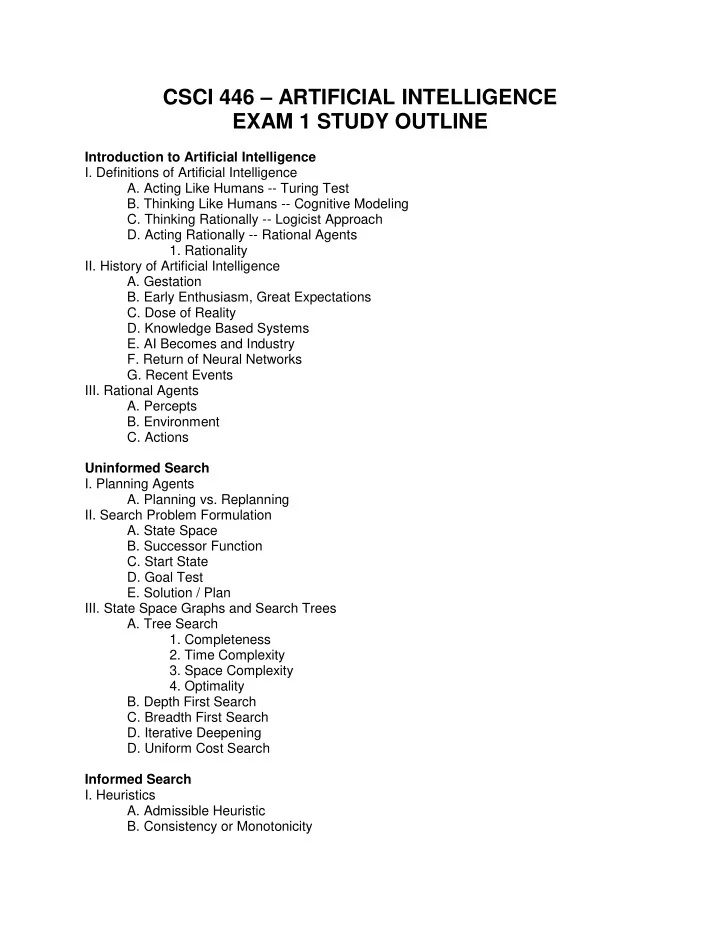
CSCI 446 – ARTIFICIAL INTELLIGENCE EXAM 1 STUDY OUTLINE

Introduction to Artificial Intelligence

  • I. Definitions of Artificial Intelligence
  • A. Acting Like Humans -- Turing Test
  • B. Thinking Like Humans -- Cognitive Modeling
  • C. Thinking Rationally -- Logicist Approach
  • D. Acting Rationally -- Rational Agents
  • 1. Rationality
  • II. History of Artificial Intelligence
  • A. Gestation
  • B. Early Enthusiasm, Great Expectations
  • C. Dose of Reality
  • D. Knowledge Based Systems
  • E. AI Becomes and Industry
  • F. Return of Neural Networks
  • G. Recent Events
  • III. Rational Agents
  • A. Percepts
  • B. Environment
  • C. Actions

Uninformed Search

  • I. Planning Agents
  • A. Planning vs. Replanning
  • II. Search Problem Formulation
  • A. State Space
  • B. Successor Function
  • C. Start State
  • D. Goal Test
  • E. Solution / Plan
  • III. State Space Graphs and Search Trees
  • A. Tree Search
  • 1. Completeness
  • 2. Time Complexity
  • 3. Space Complexity
  • 4. Optimality
  • B. Depth First Search
  • C. Breadth First Search
  • D. Iterative Deepening
  • D. Uniform Cost Search

Informed Search

  • I. Heuristics
  • A. Admissible Heuristic
  • B. Consistency or Monotonicity
slide-2
SLIDE 2
  • C. Dominance
  • D. Creating Heuristics – Relaxed Problems
  • II. Greedy Search
  • A. Heuristic h(n)
  • III. A* Search
  • A. Actual Cost to Current Node + Heuristic -- g(n) + h(n)
  • IV. Graph Search
  • A. Consistency of Heuristic

Constraint Satisfaction Problems (CSPs)

  • I. CSP Problem Formulation
  • II. Using Search in CSPs
  • III. Improving Search
  • A. Backtracking Search
  • B. Filtering
  • 1. Forward Checking
  • 2. Constraint Propagation
  • C. Arc Consistency
  • C. Ordering

1, Minimum Remaining Values

  • 1. Least Constraining Value
  • D. Problem Structure
  • IV. Problem Structure and Decomposition
  • A. Independent Sub-problems
  • B. Tree-Structured CSPs
  • C. Nearly Tree Structured CSPs
  • 1. Cutset Conditioning
  • V. Local Search
  • A. Iterative Improvement
  • B. Hill Climbing
  • C. Genetic Algorithms

Games (Adversarial Search)

  • I. Overview
  • A. Deterministic Games
  • B. Zero-Sum Games
  • II. Adversarial Search – Minimax (Perfect Play)
  • III. Resource Limits
  • A. Evaluation Functions
  • III. α-β Pruning

Expectimax Search and Utilities

  • I. Uncertain Outcomes
  • II. Expectimax
  • III. Optimism vs. Pessimism
  • IV. Utilities and Preferences
  • A. Lotteries
  • B. Rational Preferences
  • C. MEU Principles
slide-3
SLIDE 3
  • D. Human Utilities
  • 1. Micromorts
  • 2. QALYs
  • 3. Money – not really a utility

Markov Decision Processes

  • I. Non-deterministic Search
  • A. MDP Formulation
  • B. Policies
  • C. MDP Search Trees
  • II. Utilities of Sequences
  • A. Discounting (γ)
  • III. Solving MDPs
  • A. Optimal Quantities
  • 1. V*(s)
  • 2. Q*(s,a)
  • 3. π*(s)
  • B. Bellman Equations
  • IV. Value Iteration
  • V. Policy Methods
  • 1. Policy Evaluation
  • 2. Policy Extraction
  • 3. Policy Iteration

Reinforcement Learning

  • I. Offline (MDPs) vs. Online (Reinforcement Learning)
  • A. Model-Based Learning
  • 1. Learn empirical MDP model
  • 2. Solve the learned MDP
  • B. Model-Free Learning
  • C. Passive Reinforcement Learning
  • 1. Policy Evaluation vs. Direct Evaluation
  • D. Temporal Difference Learning
  • D. Active Reinforcement Learning
  • II. Exploration vs. Exploitation
  • A. ε-Greedy
  • B. Exploration Functions
  • C. Regret
  • III. Approximate Q-Learning
  • A. Generalizing Across States – Feature Based Representations
  • IV. Relationship to Least Squares
  • A. Minimizing Error
  • B. Overfitting
  • V. Policy Search