CSCI 446: Artificial Intelligence Perceptrons Instructor: Michele - - PowerPoint PPT Presentation

csci 446 artificial intelligence
SMART_READER_LITE
LIVE PREVIEW

CSCI 446: Artificial Intelligence Perceptrons Instructor: Michele - - PowerPoint PPT Presentation

CSCI 446: Artificial Intelligence Perceptrons Instructor: Michele Van Dyne [These slides were created by Dan Klein and Pieter Abbeel for CS188 Intro to AI at UC Berkeley. All CS188 materials are available at http://ai.berkeley.edu.] Outline


slide-1
SLIDE 1

CSCI 446: Artificial Intelligence

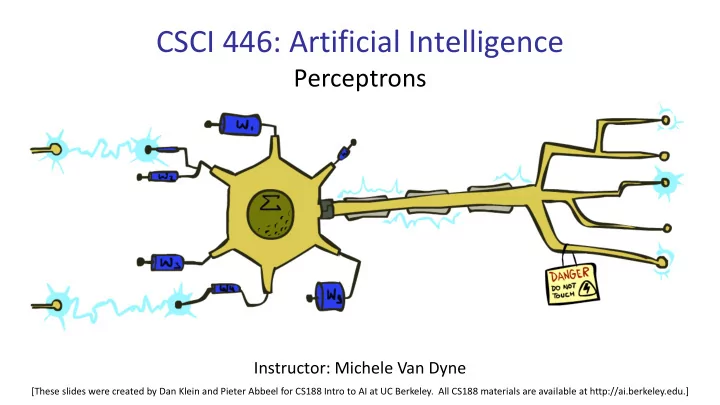
Perceptrons

Instructor: Michele Van Dyne

[These slides were created by Dan Klein and Pieter Abbeel for CS188 Intro to AI at UC Berkeley. All CS188 materials are available at http://ai.berkeley.edu.]
slide-2
SLIDE 2

Outline

  • Error Driven Classification
  • Linear Classifiers
  • Weight Updates
  • Improving the Perceptron
slide-3
SLIDE 3

Error-Driven Classification

slide-4
SLIDE 4

Errors, and What to Do

  • Examples of errors

Dear GlobalSCAPE Customer, GlobalSCAPE has partnered with ScanSoft to offer you the latest version of OmniPage Pro, for just $99.99* - the regular list price is $499! The most common question we've received about this offer is - Is this genuine? We would like to assure you that this offer is authorized by ScanSoft, is genuine and

  • valid. You can get the . . .

. . . To receive your $30 Amazon.com promotional certificate, click through to http://www.amazon.com/apparel and see the prominent link for the $30 offer. All details are

  • there. We hope you enjoyed receiving this message. However, if

you'd rather not receive future e-mails announcing new store launches, please click . . .

slide-5
SLIDE 5

What to Do About Errors

  • Problem: there’s still spam in your inbox
  • Need more features – words aren’t enough!
  • Have you emailed the sender before?
  • Have 1M other people just gotten the same email?
  • Is the sending information consistent?
  • Is the email in ALL CAPS?
  • Do inline URLs point where they say they point?
  • Does the email address you by (your) name?
  • Naïve Bayes models can incorporate a variety of features, but tend to do

best in homogeneous cases (e.g. all features are word occurrences)

slide-6
SLIDE 6

Later On…

Web Search Decision Problems

slide-7
SLIDE 7

Linear Classifiers

slide-8
SLIDE 8

Feature Vectors

Hello, Do you want free printr cartriges? Why pay more when you can get them ABSOLUTELY FREE! Just # free : 2 YOUR_NAME : 0 MISSPELLED : 2 FROM_FRIEND : 0 ...

SPAM

  • r

+

PIXEL-7,12 : 1 PIXEL-7,13 : 0 ... NUM_LOOPS : 1 ...

“2”

slide-9
SLIDE 9

Some (Simplified) Biology

  • Very loose inspiration: human neurons
slide-10
SLIDE 10

Linear Classifiers

  • Inputs are feature values
  • Each feature has a weight
  • Sum is the activation
  • If the activation is:
  • Positive, output +1
  • Negative, output -1

f1 f2 f3 w1 w2 w3

>0?

slide-11
SLIDE 11

Weights

  • Binary case: compare features to a weight vector
  • Learning: figure out the weight vector from examples

# free : 2 YOUR_NAME : 0 MISSPELLED : 2 FROM_FRIEND : 0 ... # free : 4 YOUR_NAME :-1 MISSPELLED : 1 FROM_FRIEND :-3 ... # free : 0 YOUR_NAME : 1 MISSPELLED : 1 FROM_FRIEND : 1 ...

Dot product positive means the positive class

slide-12
SLIDE 12

Decision Rules

slide-13
SLIDE 13

Binary Decision Rule

  • In the space of feature vectors
  • Examples are points
  • Any weight vector is a hyperplane
  • One side corresponds to Y=+1
  • Other corresponds to Y=-1

BIAS : -3 free : 4 money : 2 ... 1 1 2 free money +1 = SPAM

  • 1 = HAM
slide-14
SLIDE 14

Weight Updates

slide-15
SLIDE 15

Learning: Binary Perceptron

  • Start with weights = 0
  • For each training instance:
  • Classify with current weights
  • If correct (i.e., y=y*), no change!
  • If wrong: adjust the weight vector
slide-16
SLIDE 16

Learning: Binary Perceptron

  • Start with weights = 0
  • For each training instance:
  • Classify with current weights
  • If correct (i.e., y=y*), no change!
  • If wrong: adjust the weight vector by

adding or subtracting the feature

  • vector. Subtract if y* is -1.
slide-17
SLIDE 17

Examples: Perceptron

  • Separable Case
slide-18
SLIDE 18

Multiclass Decision Rule

  • If we have multiple classes:
  • A weight vector for each class:
  • Score (activation) of a class y:
  • Prediction highest score wins

Binary = multiclass where the negative class has weight zero

slide-19
SLIDE 19

Learning: Multiclass Perceptron

  • Start with all weights = 0
  • Pick up training examples one by one
  • Predict with current weights
  • If correct, no change!
  • If wrong: lower score of wrong answer,

raise score of right answer

slide-20
SLIDE 20

Example: Multiclass Perceptron

BIAS : 1 win : 0 game : 0 vote : 0 the : 0 ... BIAS : 0 win : 0 game : 0 vote : 0 the : 0 ... BIAS : 0 win : 0 game : 0 vote : 0 the : 0 ...

“win the vote” “win the election” “win the game”

slide-21
SLIDE 21

Properties of Perceptrons

  • Separability: true if some parameters get the training set

perfectly correct

  • Convergence: if the training is separable, perceptron will

eventually converge (binary case)

  • Mistake Bound: the maximum number of mistakes (binary

case) related to the margin or degree of separability Separable Non-Separable

slide-22
SLIDE 22

Examples: Perceptron

  • Non-Separable Case
slide-23
SLIDE 23

Improving the Perceptron

slide-24
SLIDE 24

Problems with the Perceptron

  • Noise: if the data isn’t separable,

weights might thrash

  • Averaging weight vectors over time

can help (averaged perceptron)

  • Mediocre generalization: finds a

“barely” separating solution

  • Overtraining: test / held-out

accuracy usually rises, then falls

  • Overtraining is a kind of overfitting
slide-25
SLIDE 25

Fixing the Perceptron

  • Idea: adjust the weight update to mitigate these effects
  • MIRA*: choose an update size that fixes the current

mistake…

  • … but, minimizes the change to w
  • The +1 helps to generalize

* Margin Infused Relaxed Algorithm

slide-26
SLIDE 26

Minimum Correcting Update

min not =0, or would not have made an error, so min will be where equality holds

slide-27
SLIDE 27

Maximum Step Size

  • In practice, it’s also bad to make updates that are too large
  • Example may be labeled incorrectly
  • You may not have enough features
  • Solution: cap the maximum possible value of  with some

constant C

  • Corresponds to an optimization that assumes non-separable data
  • Usually converges faster than perceptron
  • Usually better, especially on noisy data
slide-28
SLIDE 28

Linear Separators

  • Which of these linear separators is optimal?
slide-29
SLIDE 29

Support Vector Machines

  • Maximizing the margin: good according to intuition, theory, practice
  • Only support vectors matter; other training examples are ignorable
  • Support vector machines (SVMs) find the separator with max margin
  • Basically, SVMs are MIRA where you optimize over all examples at once

MIRA SVM

slide-30
SLIDE 30

Classification: Comparison

  • Naïve Bayes
  • Builds a model training data
  • Gives prediction probabilities
  • Strong assumptions about feature independence
  • One pass through data (counting)
  • Perceptrons / MIRA:
  • Makes less assumptions about data
  • Mistake-driven learning
  • Multiple passes through data (prediction)
  • Often more accurate
slide-31
SLIDE 31

Web Search

slide-32
SLIDE 32

Extension: Web Search

  • Information retrieval:
  • Given information needs, produce information
  • Includes, e.g. web search, question answering,

and classic IR

  • Web search: not exactly classification, but

rather ranking

x = “Apple Computers”

slide-33
SLIDE 33

Feature-Based Ranking

x = “Apple Computer” x, x,

slide-34
SLIDE 34

Perceptron for Ranking

  • Inputs
  • Candidates
  • Many feature vectors:
  • One weight vector:
  • Prediction:
  • Update (if wrong):
slide-35
SLIDE 35

Apprenticeship

slide-36
SLIDE 36

Pacman Apprenticeship!

  • Examples are states s
  • Candidates are pairs (s,a)
  • “Correct” actions: those taken by expert
  • Features defined over (s,a) pairs: f(s,a)
  • Score of a q-state (s,a) given by:
  • How is this VERY different from reinforcement learning?

“correct” action a* [Demo: Pacman Apprentice (L22D1,2,3)]

slide-37
SLIDE 37

Summary

  • Error Driven Classification
  • Linear Classifiers
  • Weight Updates
  • Improving the Perceptron