COVID-19 Overview for Radon Mitigators Anne-Marie Nicol, MES PhD - - PowerPoint PPT Presentation

covid 19 overview for radon mitigators
SMART_READER_LITE
LIVE PREVIEW

COVID-19 Overview for Radon Mitigators Anne-Marie Nicol, MES PhD - - PowerPoint PPT Presentation

COVID-19 Overview for Radon Mitigators Anne-Marie Nicol, MES PhD Associate Professor of Professional Practice Faculty of Health Sciences, Simon Fraser University 2020-05-25 1 A disclaimer: Our societys understanding of COVID-19 is

slide-1
SLIDE 1

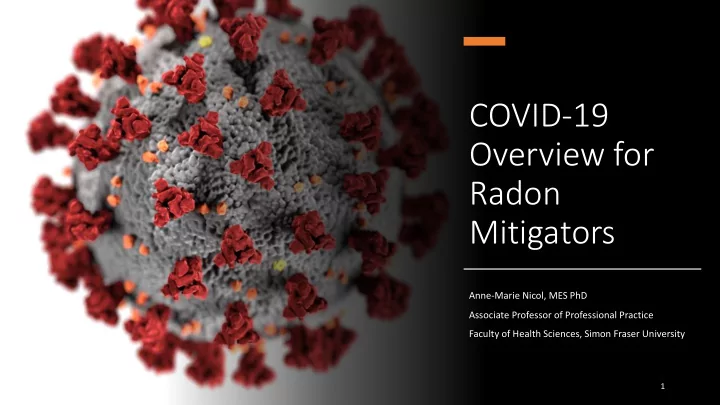
COVID-19 Overview for Radon Mitigators

Anne-Marie Nicol, MES PhD Associate Professor of Professional Practice Faculty of Health Sciences, Simon Fraser University

2020-05-25 1

slide-2
SLIDE 2

A disclaimer: Our society’s understanding of COVID-19 is constantly

  • changing. Many things remain

uncertain and unknown.

Transmission electron microscopy of an isolate from the first US COVID-19 patient, US CDC 2020

2020-05-25 2

slide-3
SLIDE 3

What is a Coronavirus?

  • Single strand RNA virus
  • Member of the Coronaviridae family of viruses that

includes:

  • SARS CoV (2003)
  • MERS CoV (2015)
  • 229E
  • Virions covered by a “halo” or corona of viral spikes
  • These help the virus attach to a host cell

2020-05-25 3

slide-4
SLIDE 4

COVID-19 naming and structure

  • Coronavirus Disease 2019 = COVID-19
  • Virus that causes the disease has been

named SARS-CoV-2

  • SARS= “Severe acute respiratory

syndrome”

  • Virus surrounded by a lipid membrane
  • Attaches to human ACE2 receptor cells
  • Found mostly in the Lungs and

Trachea

  • Some receptors in GI tract

2020-05-25 4

slide-5
SLIDE 5

2020-05-25 5

slide-6
SLIDE 6

We do we know about COVID-19 origins?

  • Many animals are coronavirus hosts

and intermediate hosts

  • Origins and “patient(s)” zero still

unknown

  • Potentially exposure through bat

guano or exhalation from an intermediate host

  • Forensic analyses of samples
  • France and China had cases as early as

mid-November

  • Many stored samples around the world

could be tested

Alfonso J. Rodriguez-Morales, pre-print 2020

2020-05-25 6

slide-7
SLIDE 7

What do we know about transmission?

  • Primary transmission through droplet

exposure

  • Coughing or sneezing
  • Talking
  • Laughing and Singing
  • Sharing a meal
  • Restaurant research
  • Limited patrons
  • Air conditioned, no windows
  • Patient A was presymptomatic

COVID-19 Outbreak Associated with Air Conditioning in Restaurant, Guangzhou, China, 2020, Lu et al. Research Letter SARS-Cov-2 COVID-19 Research

2020-05-25 7

slide-8
SLIDE 8

Mt Vernon Choir (n=61)

Washington State outbreak with clearly identified contact tracing No physical contact 2.5 hours of singing Shared cookies and tea Stacked chairs Symptoms evolved 1-12 days later 87% developed COVID-19, 2 died to date.

2020-05-25 8

slide-9
SLIDE 9

Early German company transmission chain

Index Patient from Asia had very mild symptoms (headache) for which she took a headache. Had visited parents from Wuhan. Attended meeting In Munich (Webasto- German auto supplier) Employee had meetings and ate lunch in the cafeteria One person was infected after Patient zero passed them a shaker of salt.

2020-05-25 9

slide-10
SLIDE 10

Aerosol and fecal transmission routes

  • Aerosol transmission has not been

ruled out

  • Research shows that the virus can

be aerosolized

  • Toilet plumes can aerosolize viruses
  • Finding evidence of aerosol

transmission is currently difficult

2020-05-25 10

slide-11
SLIDE 11

Feces, urine and transmission

Fecal and urine transmission

  • Virus found in these fluids,

no evidence of cause are primary outbreaks, yet... Concern may be for “Toilet Plumes”

  • Aerosolized droplets made

from flushing with lid up SARS (2003) did have one major fecal tranmission outbreak.

2020-05-25 11

slide-12
SLIDE 12

Lessons learned from SARS Cov-1 research Amoy Gardens Index SARS case had diarrhea 321 people were infected total in the buildings 42 died of SARS At least 4 towers impacted Wong et al. Scientific Models in the SARS Research and Biology SARS 2003 outbreak

2020-05-25 12

slide-13
SLIDE 13

Contaminated surfaces (aka Fomite transmission)

Stephens et al. 2019 https://link

  • springer-

com.proxy.l ib.sfu.ca/ar ticle/10.10 07/s40726- 019-00123- 6/figures/1

2020-05-25 13

slide-14
SLIDE 14

Fomite transmission varies by viral persistence

Surface Persistence of virus on surface Paper/Cardboard Paper and tissue: up to three hours Cardboard: up to 24 hours Stainless Steel 3-4 days Copper and Aluminum Up to 4 hours Plastic At least 3-4 days* - could be longer Wood Up to 2 days Glass Up to 4 days Cloth Up to 2 days Non-porous and and less conductive surfaces allow virus remain longer

2020-05-25 14

slide-15
SLIDE 15

What are the symptoms of COVID-19?

Most well established- Cough, shortness of breath fatigue, muscle aches, fever >39.4 Other known symptoms:

  • Headaches
  • Loss of smell
  • Diarhhea/nausea, loss of appetite
  • “COVID toes” –in children
  • Runny nose
  • Sore throat
  • Chills

Other issues

  • Stroke (in younger people)
  • Cardiac involvement
  • Rashes

2020-05-25 15

slide-16
SLIDE 16

Asymptomatic and Pre-symptomatic Transmission possible

  • Evidence exists of transmission BEFORE more severe symptoms develop
  • Estimates suggest 44% or more transmissions may occur PRIOR to onset of

symptoms

  • Preliminary research only, from different countries with small sample sizes
  • Younger people generally have milder symptoms
  • Bottom Line: you don’t need to be sick to transmit the virus to someone

else

  • Transmission more likely and successful when people are symptomatic

2020-05-25 16

slide-17
SLIDE 17

Preventing viral transmission

Handwashing with soap works really well, why?

  • Enveloped virus with a fatty lipid layer around the
  • utside
  • Soap degrades lipid layer, breaking up the virus
  • Needs time though- hence the “at least 20

seconds”

  • Rinse broken down viral particles down the drain

2020-05-25 17

slide-18
SLIDE 18

Preventing transmission continued

Staying at home works really well

  • staying away from others reduce risk considerably

Social distancing works really well

  • Staying at least 6 feet away keeps to avoid droplets
  • Aerosol transmission still unclear- research on-going

Besides sneezing and coughing, laughing, eating, singing- all generate droplets, Image from: NYT https://www.nytimes.com/interactive/20 20/04/14/science/coronavirus- transmission-cough-6-feet-ar-ul.html

2020-05-25 18

slide-19
SLIDE 19

Cleaning and Disinfection

  • Bleach solutions work very well
  • Alcohol >60% useful
  • Surfaces in bathrooms should be sanitized frequently if used by

people who are going out

  • Shared objects important
  • Phones
  • Pens
  • Touch screens

2020-05-25 19

slide-20
SLIDE 20

Check your disinfecting products here, many common products are NOT approved for COVID

2020-05-25 20

slide-21
SLIDE 21

https://www.canada.ca/en/public-health/services/diseases/2019-novel-coronavirus- infection.html?topic=tilelink

2020-05-25 21

slide-22
SLIDE 22

Thank-you! Any questions?

2020-05-25 22