1 Radiation Dose Radon Health Effects Radon Progeny attach to - - PDF document

1
SMART_READER_LITE
LIVE PREVIEW

1 Radiation Dose Radon Health Effects Radon Progeny attach to - - PDF document

Webinar Purpose Radon in High Water Use Facilities To introduce people to the potential hazards Webinar of radon gas, in facilities which utilize a high volume of water 2 June 21, 2017 In this Webinar... Radon What radon is Radon


slide-1
SLIDE 1

1

Radon in High Water Use Facilities Webinar

June 21, 2017

Webinar Purpose

  • To introduce people to the potential hazards
  • f radon gas, in facilities which utilize a high

volume of water

2

In this Webinar...

  • What radon is
  • Potential health hazards
  • How radon gets into our workplace air
  • How to measure radon levels
  • Radon radiation protection guidelines and

regulations for radon

  • Measures to reduce radon exposure
3

Radon

  • Radon is an odourless, colourless radioactive

gas that is formed naturally by the breakdown

  • f uranium in soil, rock and water

– Alpha emitter – Half life of 3.8 days – Inert gas (non-reactive) – Water soluble – Somewhat more dense than air – Accumulates in enclosed spaces

4

Radon

Atomic Number: 86 Atomic Mass: 222

Radon Progeny

  • Radon progeny are the radioactive daughters
  • f radon gas

– For health-effects, only the short-lived progeny are considered – Are solids – Attach to dust particles in the environment – When inhaled, tend to remain in the lungs – Two high-energy alpha emitters

5

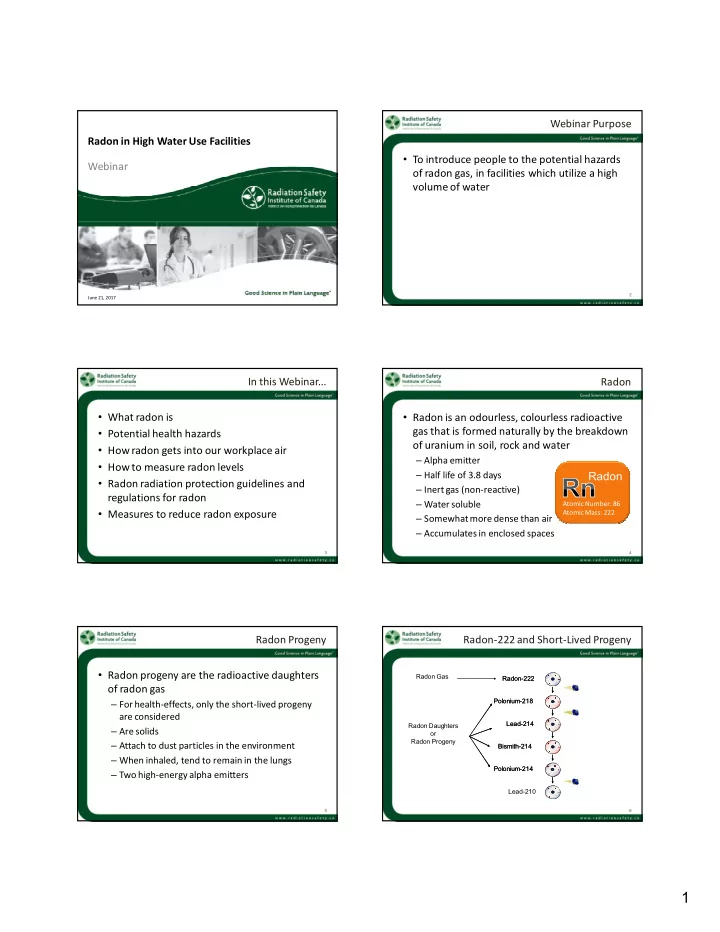
Radon-222 and Short-Lived Progeny

6

Radon-222 Polonium-218 Lead-214 Bismith-214 Polonium-214 Radon Daughters

  • r

Radon Progeny Radon-222 Polonium-218 Lead-214 Bismith-214 Polonium-214 Lead-210 Radon Gas

slide-2
SLIDE 2

2

Radiation Dose

  • The effects of radiation depend on the

amount of energy the radiation transfers to your body.

7
  • This transfer of

energy results in a radiation dose. Radon – Health Effects

  • Radon Progeny attach to dust particles in the air
  • When we breath in air, these radioactive aerosols

enter into our lungs

  • As these decay in the lung, they

emit alpha radiation which transfers energy to the cells

  • This radiation can damage lung cells

– No immediate symptoms – Mutations are possible

  • This cell damage leads to an increased risk of

developing lung cancer

8

Radon – Health Effects

  • Development of lung cancer due to radon

exposure is probabilistic

– Not everyone exposed to elevated levels of radon will develop lung cancer – There is no lower threshold below which the exposure presents no risk

  • The more dose received due to radon

exposure, the higher the risk of developing lung cancer

9

Radon – Health Effects

  • The risk of getting lung cancer from radon

depends on:

– How much radon is in your workplace and home – The occupancy time in these areas – Whether you are a smoker or have ever smoked

10

Radon Measurement Units

  • Radon gas is measured as an activity

concentration (Bq/m3)

– To calculate dose, must know/assume the relative amounts of radon gas and its progeny – Canadian NORM Guidelines: Exposure to 200 Bq/m3 for 2000 hours results in 1.4 mSv

  • f Effective Dose
  • Radon progeny is traditionally measured

in Working Levels (WL)

– Being exposed to 1 WL for 170 hours results in 1 WLM exposure, equivalent to 5 mSv of Effective Dose

11

Radon Sources – Building Entry

  • How does radon enter a building?

– Entry where building is in contact with soil

  • Cracks in the slab/walls in contact with soil
  • Gaps at floor-wall joints
  • Open sump pits
  • Openings around utility penetrations
  • Floor drains with no traps
  • Etc.

– Emission from water

  • Particularly ground/well water

– Through natural gas

slide-3
SLIDE 3

3

Radon Sources – Water Emission

  • Radon in water

– Radon can dissolve in water which passes through a radon source (rocks and soil with some uranium) – Radon escapes from the water into the air

  • More radon escapes from water into air

when the water is agitated in air (e.g., splashing, spraying, etc.)

  • How easily radon transfers to air depends
  • n the temperature of the air and water

and the amount of agitation

13

Radon Sources – Water Emission

  • Facilities that use large amounts of ground

water may have significantly higher radon concentrations

– Fish culture, water treatment facilities, etc.

14

Indoor Radon Concentration

  • Radon concentration indoors is affected by

– Amount of uranium in soil and building materials – Soil characteristics – Radon concentration in water – Amount of water used – Heating, ventilation and air conditioning – Occupancy patterns (doors/windows open or closed)

Indoor Radon Concentration

  • Radon concentration indoors is also affected

by external environmental conditions

– Temperature – Barometric pressure – Precipitation – Humidity – Wind speed

How to Detect Radon

  • Radon progeny

– Causes the most dose – Due to the very short half lives, can be complicated to measure

  • Radon gas

– Generally radon gas concentration is measured – Radon gas is much easier to detect – To convert to dose, an assumption is made about the relative amounts of radon progeny and radon gas (the equilibrium factor)

17

How to Detect Radon

  • Radon gas can be measured in many ways

– Short term (not recommended)

  • Grab Sample
  • Charcoal Canister

– Long term (recommended)

  • Electret Monitor (E-PERM)
  • Alpha Track Monitor

– Continuous (a good option but can be expensive)

  • Electronic Monitor

– NOTE: Must be calibrated regularly

18
slide-4
SLIDE 4

4

How to Detect Radon

  • Long term (electret or alpha track monitors)

– 3 to 12 months in duration – Don’t usually require power – Sent away for analysis at the laboratory – Much better indication of long-term average concentration – Relatively inexpensive – Recommended by Health Canada

19

Regulation of Radon in Workplaces

  • Federal

– Federally regulated workplaces – Workplaces regulated under the Nuclear Safety and Control Act

  • Uranium mines, nuclear power, radiation sources, etc.
  • Radiation protection regulations require dose from radon to

be monitored and reported

  • Provincial

– Workplaces under provincial regulation – Occupational Health and Safety Regulations – Mine Safety Regulations

20

Ontario Regulations

  • Ontario’s Occupational Health and Safety Act

– Employer has a duty to protect the health and safety

  • f the employee
  • “Take every precaution reasonable in the circumstances for

the protection of a worker”

– Regulation is not explicit on how to do so for radon or

  • ther naturally occurring radioactive materials

– Ontario Ministry of Labour staff have indicated that they expect employers to follow the safety measures documented in Health Canada’s Canadian Guidelines for the Management of Naturally Occurring Radioactive Material (NORM)

21

Canadian NORM Guidelines

  • Recommends all workplaces be assessed for

radon concentration since it can “vary significantly”

  • Provides occupational dose limits for exposure to

radon in workplaces that are not uranium mines (federally regulated) based on worker type

– Occupationally Exposed Workers, Incidentally Exposed Workers, Members of the Public – Limits are consistent with ICRP recommendations (and Canadian federal regulation limits)

22

Canadian NORM Guidelines

  • Provides dose conversion factors based on

measured radon or radon progeny concentration

  • Provides classifications based on radon

concentration

– Indicates actions to be taken to protect the workers

23

Canadian NORM Guidelines

Exposure Annual Dose NORM Classification < 200 Bq/m3 (0.25 WLM) 1.4 mSv Unrestricted 200 Bq/m3 – 800Bq/m3 (0.25–1 WLM) 1.4 – 5 mSv Norm Management

  • Application of an ALARA program which may

include changes in work practices, changes to work procedures, and introduction of access controls for members of the public and incidentally exposed workers

  • Should reduce radon levels to below 200 Bq/m3.

> 800Bq/m3 (1 WLM) > 5 mSv Radiation Protection Management

  • A Radiation Protection Management should be

implemented (radiation protection program, dosimetry for workers, provide protective equipment).

  • The program should include steps to reduce the

radon levels to below 200 Bq/m3.

24
slide-5
SLIDE 5

5

Canadian NORM Guidelines

25

Group Annual Effective Dose Limit (mSv)(a) Five Year Cumulative Dose Limit (mSv) Members of the Public and Incidentally Exposed Workers 1 5 Occupationally Exposed Workers 50 100 Pregnant Occupationally Exposed Workers 4 (for the balance of pregnancy)

These limits exclude natural background and medical exposures.

Dose Limits Radon in Water Guidelines

  • The health risk from ingesting radon-

contaminated drinking water is considered negligible.

– Majority of the radon escapes when radon is agitated, leaving only minimal amounts in the water itself.

  • However, radon in water can significantly

increase the airborne radon.

  • Canada currently has no guidelines for radon

concentrations in drinking water.

26

Radon in Homes

  • There are no Canadian regulations governing

radon levels in dwellings

  • Health Canada has a guideline

– Take remedial measures in a dwelling whenever the average annual radon concentration exceeds 200 Bq/m3 in the normal occupancy area. – The higher the radon concentration, the sooner remedial measures should be undertaken.

  • If > 600 Bq/m3, remediate within 1 year
  • If 200 Bq/m3 – 600 Bq/m3, remediate within 2 years
27

Radon in Homes

  • Health Canada guideline, cont’d

– Remedial action should aim to reduce radon to a value as low as practical. – The construction of new dwellings should employ techniques that will minimize radon entry and facilitate post-construction radon removal

28

Control of Radon Hazards

  • Prevent radon entry into the building – radon

from soil gas

– Find and seal entry points (cracks, gaps, sump pits, utility penetrations, etc.) – Maintain positive air pressure (vs. soil gas pressure) – Sub-slab depressurization

  • Remove air from under floor slab, continuously
  • Radon is removed before it can enter the building

Control of Radon Hazards

  • Prevent radon entry into the building – radon

from water

– Reduce unnecessary water entry – Aeration of water prior to entry

30
slide-6
SLIDE 6

6

Control of Radon Hazards

  • Prevent radon entry into the workplace air

– Limit aeration of radon-bearing water in facility

  • Reduce agitation, splashing, etc.
  • Use radon-reduced water for spraying, etc.

– If aeration is required (e.g., to add oxygen), separate this from the workplace air

  • Aeration columns in separate room or outside

– Separate breathing air from air near agitated water

  • Install covers over waste water channels
31

Control of Radon Hazards

  • Example water agitation/aeration prevention:
32

Before After

Control of Radon Hazards

  • Ventilation

– Remove air at water aeration and/or disturbance – Separate ventilation for indoor aeration chambers – Separate breathing air from air where aeration and disturbance cannot be prevented

  • Cover waste-water channels, etc.

– Temperature control

  • Cool air takes up less radon than warm air

– Control air flow path in facility from low to high radon areas

33

Control of Radon Hazards

  • Combine Aeration and Ventilation

– Studies show that

  • Radon removal from source water (aeration) alone is

not always enough

  • Ventilation alone is not always enough

– Often the two must be combined for effective radon control in high water use facilities

34

Control of Radon Hazards

  • Protective equipment

– In areas where radon entry prevention and ventilation are either insufficient

  • r not practical, so that a high radon

area exists, Personal Protective Equipment can be considered – Properly fitted particulate respirators prevent most dust particles (and thus most radon progeny) from being inhaled, thus reducing the dose – This option should be the last choice – the prevention

  • f elevated radon is preferred
35

Control of Radon Hazards

  • Employer must inform workers of the radon

levels in the workplace

  • Procedures can be put in place to limit time in

elevated radon areas

  • Employees have responsibilities to follow

procedures provided

36
slide-7
SLIDE 7

7

Control of Radon Hazards

  • The only way to know the level of radon in a

workplace or in a home is to test for it!

– Long term tests of 3 to 12 months are recommended – For workplaces, must obtain the average annual concentration to compare to the Canadian NORM Guideline

37

Contact Us www.radiationsafety.ca 1-800-263-5803 info@radiationsafety.ca

38