Radon- Resistant New Construction - Basics for Code Officials - - PowerPoint PPT Presentation

radon resistant new construction basics for code officials
SMART_READER_LITE
LIVE PREVIEW

Radon- Resistant New Construction - Basics for Code Officials - - PowerPoint PPT Presentation

Radon- Resistant New Construction - Basics for Code Officials Engineering Extension Radon Programs Radon is a Serious National Health Problem American Lung Association American Medical Association Environmental


slide-1
SLIDE 1

Engineering Extension Radon Programs
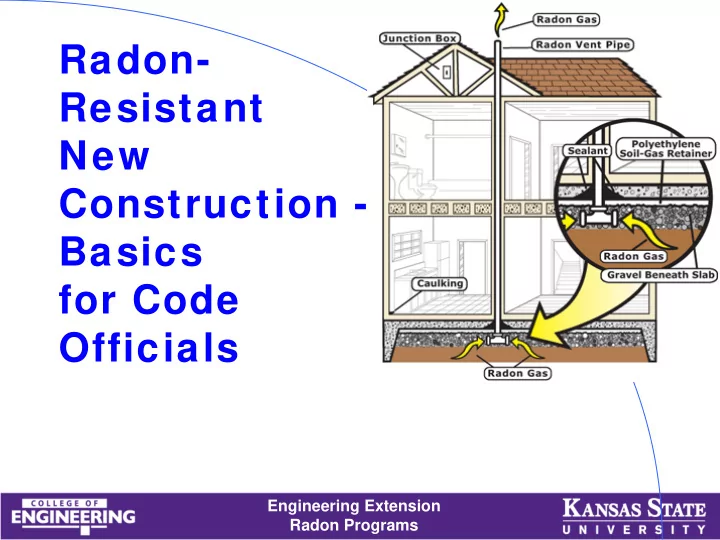
Radon- Resistant New Construction - Basics for Code Officials

slide-2
SLIDE 2

Engineering Extension Radon Programs

“Radon is a Serious National Health Problem”

  • American Lung Association
  • American Medical Association
  • Environmental Protection

Agency

  • National Academy of Sciences
  • National Council on Radiation

Protection and Measurement

  • U.S. Surgeon General
  • World Health Organization
slide-3
SLIDE 3

Engineering Extension Radon Programs

Radon Exposure in Homes Is Significant

  • Radon 222 - Naturally

Occurring Radioactive Gas Element

  • Not Detected by

Human Senses

  • Indoor

concentrations are created by the w ay w e design, build, and operate buildings w here w e live, learn, and w ork

2006

All Medical 48%

Radon 37%

Average annual radiation source exposures for US citizens

slide-4
SLIDE 4

Engineering Extension Radon Programs

Basic Facts

  • Radon is Everyw here!
  • The only w ay to know the radon

level is to test – it can’t be predicted

  • Your house may be low , your

neighbor’s may be high

  • 95-99 out of 100 high homes

can be fixed w ith fan pow ered soil suction systems

slide-5
SLIDE 5

Engineering Extension Radon Programs

Radon Entry and Common Concentrations

Radium Radon Uranium 1.3 pCi/L* U.S. annual average indoors in homes (living areas) – 0.4 pCi/L *U.S. annual average

  • utdoors

– EPA Action Level 4.0 pCi/L The EPA’s action level of 4.0 pCi/L is not a health based numbe 1.3 pCi/L* U.S. annual average indoors in homes (living areas) – 0.4 pCi/L *U.S. annual average

  • utdoors

– EPA Action Level 4.0 pCi/L The EPA’s action level of 4.0 pCi/L is not a health based number. EPA recommends mitigation at levels between 2.0 pCi/L and 3.9 pCi/L 1.3 pCi/L ‐ U.S. annual average indoors in homes (living areas) – 0.4 pCi/L ‐ U.S. annual average

  • utdoors

slide-6
SLIDE 6

Engineering Extension Radon Programs

The Concentration of Radon in a Building Depends Upon:

  • Source of radon and its strength

Source of radon and its strength

  • Air pressure differences

Air pressure differences

  • Air pathw ays in soil and through

Air pathw ays in soil and through foundation foundation

  • Air changes per hour

Air changes per hour – – ventilation rate ventilation rate

slide-7
SLIDE 7

Engineering Extension Radon Programs

How Radon Enters Your Home How Radon Enters Your Home

slide-8
SLIDE 8

Engineering Extension Radon Programs

Air Pressure Variables

slide-9
SLIDE 9

Engineering Extension Radon Programs

Effect of Ventilation Rates on Indoor Radon Concentrations

  • Just because a house is leaky or tight does

Just because a house is leaky or tight does not mean it w ill have low or high radon levels not mean it w ill have low or high radon levels

  • In part, the indoor radon concentrations depend

In part, the indoor radon concentrations depend upon: upon:

  • the percentage of air infiltrating that is soil gas

the percentage of air infiltrating that is soil gas (w hich can range from 1 (w hich can range from 1 -

  • 20% of total infiltration)

20% of total infiltration)

  • the radon source strength in that soil gas, and

the radon source strength in that soil gas, and

  • the overall air change rate of the structure

the overall air change rate of the structure

  • Making homes tighter can increase the radon

Making homes tighter can increase the radon concentration due to decreased dilution from concentration due to decreased dilution from

  • utdoor air
  • utdoor air
slide-10
SLIDE 10

Engineering Extension Radon Programs

What Does It Take to Build the House Radon Resistant?

  • Foundation gas

collection system

  • Pipe to convey

gas through roof

  • A closed barrier

betw een soil gas and indoor air

  • Provision to add

fan if needed

slide-11
SLIDE 11

Engineering Extension Radon Programs

  • It is designed to vent radon

from beneath the structure by use of a vent pipe routed through the conditioned space of a building, connecting the sub-slab area w ith outdoor air.

  • When air in the pipe is

more buoyant that outside air, the air escaping the pipe creates a slight vacuum (pressure differential) to pull soil gas tow ards the outside

  • Know n as Passive Soil

Depressurization - PSD 55 degrees 70 degrees

How Is the System Supposed to Work?

slide-12
SLIDE 12

Engineering Extension Radon Programs

12

Tw o Major Reasons Passive Soil Depressurization is Used

  • 1. To reduce indoor radon concentrations
  • In general, about 50% reduction over the

course of a year is expected if properly installed

  • 2. To make the house easy to fix if

further radon reduction is needed

  • By activation w ith a fan
  • Stack must easily accessible outside

conditioned space for fan installation

  • Pow er must be available near fan
  • Major openings betw een soil and occupied

space must be sealed

slide-13
SLIDE 13

Engineering Extension Radon Programs

Typical Slab System Sump Pit System

slide-14
SLIDE 14

Engineering Extension Radon Programs

Draintile System Crawl Space with Membrane System

slide-15
SLIDE 15

Engineering Extension Radon Programs

15

International Residential Code (IRC) Appendix F: RRNC

(Initially intended for Zone 1)

  • Adoption is

Adoption is encouraged for all encouraged for all zones as risk has zones as risk has increased since increased since 1993 1993

  • EPA Radon Zones

EPA Radon Zones

  • Red = High potential

Red = High potential Zone 1 > 4.0 ave. Zone 1 > 4.0 ave.

  • Orange = Medium

Orange = Medium potential potential Zone 2, 2.0 to 4.0 Zone 2, 2.0 to 4.0 ave. ave.

  • Yellow = Low

Yellow = Low potential potential Zone 3 < 2.0 ave. Zone 3 < 2.0 ave.

1993 EPA Radon Zone Map

slide-16
SLIDE 16

Engineering Extension Radon Programs

at the State Level

RRNC Adoptions at the State Level

Statewide RRNC Code State-Level RRNC Code (Not All Zones) Local Option, State Prescribed Code

slide-17
SLIDE 17

Engineering Extension Radon Programs

17

Jurisdictions w ith Radon Control Building Code Requirements

  • States (statew ide or zone 1
  • nly)
  • Illinois (statew ide)
  • Maryland
  • Michigan
  • New Jersey
  • Washington
  • Oregon
  • Minnesota(statew ide)
  • Massachusetts
  • States (statew ide but need

local adoption)

  • Florida
  • Maine
  • Rhode Island
  • Virginia
  • States (w here local jurisdictions

have adopted)

  • Alabama
  • Colorado
  • Georgia
  • Idaho
  • Iow a
  • Kansas
  • Montana
  • Maryland
  • Nebraska
  • New Mexico
  • New York
  • Ohio
  • Oklahoma
  • Pennsylvania
  • South Carolina
  • Tennessee
  • West Virginia
  • Wisconsin
  • Wyoming
slide-18
SLIDE 18

Engineering Extension Radon Programs

18

IRC Appendix F: Section 103 Requirements (Overview ) IRC Appendix F: Section 103 Requirements (Overview )

  • 1. General
  • 2. Subfloor Preparation
  • 3. Soil-Gas Retarder
  • 4. Entry Routes
  • 5. Passive

Submembrane Depressurization (PSD) Systems: Craw lspace

  • 6. PSD Systems:

Basements and Craw lspace

  • 7. Vent Pipe

Drainage

  • 8. Vent Pipe Access
  • 9. Vent Pipe

Identification 10. Combination Foundations 11. Building Depressurization 12.Pow er Source

slide-19
SLIDE 19

Engineering Extension Radon Programs

19

Summary of PSD Effectiveness Testing

Study # Homes Average Rn Capped Average Rn Uncapped Average % Rn Reduced Comments NAHB 1994 45 5.9 2.5

57%

Most built ~ EPA standards, some no poly, some no sealing; inspected during construction East Moline, IL 1998 21 9.2 3.7

59%

Built ~ EPA standards but un‐finished basements w/o poly; inspected during construction Monroe Co., NY 2002 20 2.9 2.5

12%

Vent stacks NOT through conditioned space, no poly under slab Muscatine, IA 2002 13 9.3 7.5

20%

12 homes had sub‐slab sand NOT permeable layer, 1 home with sub‐ slab gravel had 51% radon reduction Dane Co., WI 2003 7 11.1 4.7

42%

Built ~ EPA standards and inspected during construction; 1 house at 12 pCi/L with PSD had large leaks Manhattan, KS 2002‐2005 19

31 ‐ 37%

Unsealed sump pits, vent stack NOT through conditioned space (1)

slide-20
SLIDE 20

Engineering Extension Radon Programs

20

PSD Can Work But … It Needs To Be Done Correctly PSD Can Work But … It Needs To Be Done Correctly

  • If not done correctly . . .
  • May not provide much, if any, radon

reduction

  • Can make future activation, if needed,

difficult, impractical, or impossible

  • It is highly important to test all new

homes for radon, even those w ith PSD

  • PSD does not guarantee < 4 pCi/l but . . .
  • It does reduce indoor radon and it

provides a system ready for activation if needed

slide-21
SLIDE 21

Engineering Extension Radon Programs

Testing Reveals Performance!

  • Installing RRNC properly enhances

the potential that radon levels w ill be low .

  • The only w ay to know if the system

is successful is to test.

  • Testing can occur w hen ready for
  • ccupancy.
  • If the house tests above 4 pCi/L the

system should be activated w ith a fan and system pressure indicator added to the pipe.

slide-22
SLIDE 22

Engineering Extension Radon Programs

Liability Concerns

  • This is a life safety system
  • Buyer commonly assumes

performance is assured just by presence of a system

  • Untrained contractors doing w ork –

no one to assume liability

  • Law suits against builders for

incorrectly installed systems

slide-23
SLIDE 23

Engineering Extension Radon Programs

Costs and Cost Saving

  • No RRNC can lead to systems being

installed on the exterior

  • Poor installation means redoing the w ork
  • Poor installation means poor performance

leading to more activations

  • Electrical costs are less w hen run during

construction

  • Poor performance means more testing to

clear the property

  • Failed tests can delay closing on the

property

slide-24
SLIDE 24

Engineering Extension Radon Programs

Performance Issues

  • Pipes Blocked by Construction

Debris

  • Pipes Blocked by Soil
  • Stack Pipe too Small
  • Pipe Routed Through Unheated

Space

  • Pipe does not Discharge Above

Roof

slide-25
SLIDE 25

Engineering Extension Radon Programs

Performance Issues

  • Pipe Joints Note Sealed
  • Pipe installed at 45 degree angle

in attic. No room for fan

  • Pipe installed directly next to

truss member not allow ing space for fan

  • System Labels Lacking
  • Radon Performance Tests not

Done

slide-26
SLIDE 26

Engineering Extension Radon Programs

Mitigator Comments About Activating Builder Installed PSD

  • My experience has been that about 25% of

activations of builder installed systems w ork fine, and 75% must be altered or abandoned.

  • The most common fixes needed are

cleaning out the suction pit, correcting the pitch of the piping, filling holes under tubs and sealing w all/floor joints, altering piping to allow room for a fan, completing roof penetrations, and installing electrical service.

slide-27
SLIDE 27

Engineering Extension Radon Programs

Why Build Using Radon Resistant Techniques

  • Radon-resistant new construction

(RRNC) typically costs a builder betw een $250 and $750.

  • RRNC could cost less than $250 if the

builder already uses some of the same techniques for moisture control.

  • Energy and moisture reduction

benefits

  • To reduce incidence of lung cancer
  • To reduce potential liability
slide-28
SLIDE 28

Engineering Extension Radon Programs

RRNC RRNC – – Barriers to Adoption Barriers to Adoption

Technical Issues

  • Appendix F not credible
  • Radon & Building

professionals

  • Appendix F inept
  • Pipe connection
  • Space for fan
  • Submembrane sealing
  • Duplicative of some code

provisions

  • Overall clarity
  • Builders need

training/guidance

  • Plumbers need direction
  • Plumbing code?

Systems Issues

  • ICC Paralysis
  • Code updates occur

place by place

  • Appendix tradition
  • Local “can opt” to save

lives

  • NAHB opposed to

requirement

  • Zone map tradition
  • Environmental issues

ban (ICC)

  • Not incremental cost
slide-29
SLIDE 29

Engineering Extension Radon Programs

Status of Changes to IRC Status of Changes to IRC Appendix F Appendix F

  • AARST team
  • Proposed changes to clarify
  • Connection, discharge, fan installation
  • Eliminate duplicate code provisions
  • Delete control joint sealingrequirement
  • Support from NAHB staff
  • Proposed new section in code (still
  • ptional)
  • AARST w ithdrew its support as compromise
  • Lost at hearing due to unrelated

w ording issue

  • Future talks w ill ensure Appendix F

cleanup

  • Changes can be promoted w /new

adoptions

  • Update to CCAH under consideration
  • Training
slide-30
SLIDE 30

Engineering Extension Radon Programs

RRNC Landscape RRNC Landscape

  • State and local codes can require RRNC

for homes in high radon-prone areas - but most don’t

  • IBC needs an RRNC appendix
  • IRC needs a better RRNC appendix
  • Everyone w ho touches housing –

homeow ners, tenants, realtors, builders, code officials, radon professionals – has a self interest in RRNC done right the first time

slide-31
SLIDE 31

Engineering Extension Radon Programs

Questions/Discussion

slide-32
SLIDE 32

Engineering Extension Radon Programs

Resources/ Handout for You

http://sosradon.org/rrnc

Radon Resistant New Construction (RRNC)

  • Why Consider RRNC?
  • Installing Radon-Resistant Features
  • RRNC What Do I Give My Builder? - RRNC Codes and Standards
  • RRNC Fact Sheets

https://www.epa.gov/radon/building-codes-radon-resistant- new-construction-rrnc http://www.nehacert.org/CDPHE/ColoRRNCVideo.html

slide-33
SLIDE 33

Engineering Extension Radon Programs

Contacts

  • Bruce Snead, Kansas State

University, Manhattan, KS bsnead@ ksu.edu

  • Gary Hodgden, Executive

Stakeholder Chair for the ANSI/AARST Consortium on National Radon Standards gary@ aair.com