Costs Andr DeHon <andre@cs.caltech.edu> Wednesday, June 19, - - PDF document

costs
SMART_READER_LITE
LIVE PREVIEW

Costs Andr DeHon <andre@cs.caltech.edu> Wednesday, June 19, - - PDF document

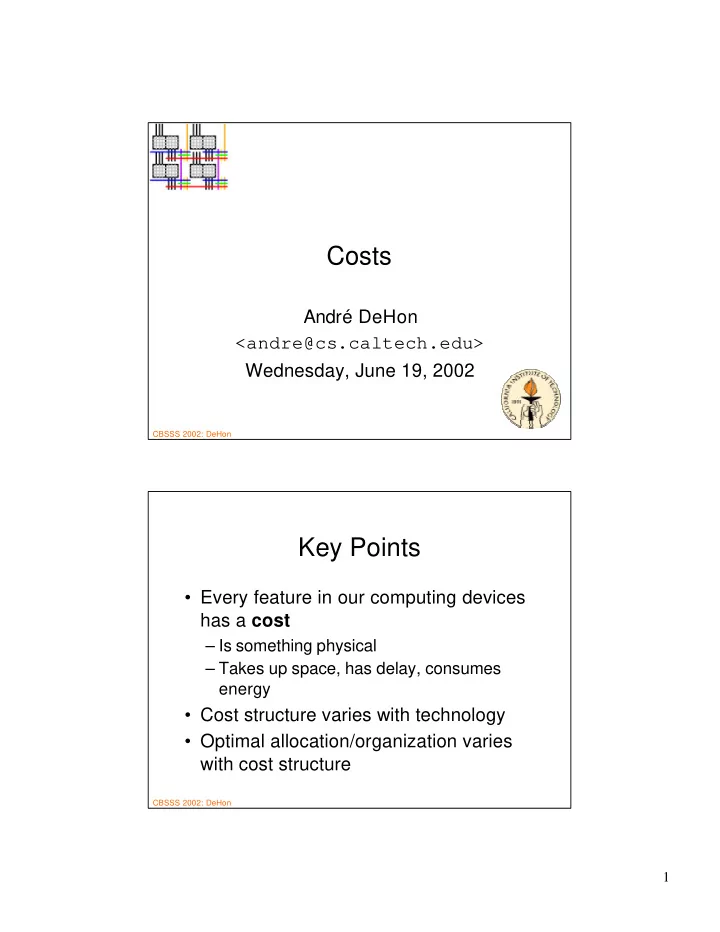
Costs Andr DeHon <andre@cs.caltech.edu> Wednesday, June 19, 2002 CBSSS 2002: DeHon Key Points Every feature in our computing devices has a cost Is something physical Takes up space, has delay, consumes energy Cost


slide-1
SLIDE 1

1

CBSSS 2002: DeHon

Costs

André DeHon <andre@cs.caltech.edu> Wednesday, June 19, 2002

CBSSS 2002: DeHon

Key Points

  • Every feature in our computing devices

has a cost

– Is something physical – Takes up space, has delay, consumes energy

  • Cost structure varies with technology
  • Optimal allocation/organization varies

with cost structure

slide-2
SLIDE 2

2

CBSSS 2002: DeHon

Costs

CBSSS 2002: DeHon

Physical Entities

  • Idea: Computations take up space

– Bigger/smaller computations – How fit into limited space? – Sizeresourcescost – Sizedistancedelay

slide-3
SLIDE 3

3

CBSSS 2002: DeHon

Comment

  • Experience from VLSI

– Primarily 2D substrate

  • Will want to generalize as appropriate

for other substrate

– Use concretes from VLSI

CBSSS 2002: DeHon

Area Components

  • Gates -- compute
  • Memory Cells -- state
  • Wires -- interconnect
slide-4
SLIDE 4

4

CBSSS 2002: DeHon

Typical VLSI

  • Wires – normalizer – pitch 1 unit
  • 2-input gate – maybe 4 x 5 units
  • Memory Cells – maybe 4 x 3 units

CBSSS 2002: DeHon

Structure Area

  • Example: nor2-crossbar

architecture

– Crosspoint: about 2x memory cell

  • 5x5 units
slide-5
SLIDE 5

5

CBSSS 2002: DeHon

nor2-crossbar

  • N tall

– Two crosspoints per NOR gate – Height/gate~10

  • N wide

– Width/xpoint~5

  • Area=50xN2

CBSSS 2002: DeHon

Structure Area

  • Example 2: nor2-processors
slide-6
SLIDE 6

6

CBSSS 2002: DeHon

Components

  • Gate: 1
  • Data Memory:

– 2N memory cells – (underestimate)

  • Instruction Memory:

– 3 log2(N) x N memory cells

  • Counter:

– log2(N) x 5 gates/bit

CBSSS 2002: DeHon

Components

  • Gate: 1
  • Data Memory:

– 2N memory cells – (underestimate)

  • Instruction Memory:

– 3 log2(N) x N memory cells

  • Counter:

– log2(N) x 5 gates/bit

slide-7
SLIDE 7

7

CBSSS 2002: DeHon

nor2-processors

  • Area:

– 12(2N+3 log2(N) N) + 20(5 log2(N) ) – 100 log2(N) + 24N + 36 log2(N) N

CBSSS 2002: DeHon

Area Compare

  • crossbar processor
  • 10: 5000

2080

  • 100: 500,000

30,000

  • 1000: 50M 380,000
  • 10,000: 5G 15M
  • (processor does Nx less calculations at

a time)

slide-8
SLIDE 8

8

CBSSS 2002: DeHon

Area Comments

  • When need to fit in limited area

– Processor (temporal) version beneficial – Why processors preferred in early VLSI (pre-VLSI)

  • Physical space limited
  • Problems large
  • In VLSI

– State/description smaller than active

  • Largely because of compact memory

CBSSS 2002: DeHon

Area Comments

  • Can do better than crossbar for

interconnect

– …next time

slide-9
SLIDE 9

9

CBSSS 2002: DeHon

Key Costs

  • In VLSI:

– Area, delay, energy

  • Often, not simultaneously optimized

– Give rise to tradeoffs

  • Previous is crude example of area-delay

CBSSS 2002: DeHon

Costs Vary

slide-10
SLIDE 10

10

CBSSS 2002: DeHon

VLSI World

  • Technology largely defined by precision

in fabrication

– Minimum feature size – A physical limit

  • On our ability to build and transfer patterning
  • Do so precisely

CBSSS 2002: DeHon

Feature Size

λ is half the minimum feature size in a VLSI process [minimum feature usually channel width]

slide-11
SLIDE 11

11

CBSSS 2002: DeHon

Predictable Variation

  • Feature Sizes have been shrinking

– As we get control over physical dimensions

  • Feature Size shrink

– Changes size limits – Shifts costs

CBSSS 2002: DeHon

Scaling

  • Channel Length (L) λ
  • Channel Width (W) λ
  • Oxide Thickness (Tox) λ
  • Doping (Na) 1/λ
  • Voltage (V) λ
slide-12
SLIDE 12

12

CBSSS 2002: DeHon

Area Perspective

[2000 tech.] 18mm×18mm 0.18µm 60G λ2

CBSSS 2002: DeHon

Capacity Growth

  • Things which were not feasible a 5—10

years ago

– Very feasible now

  • Designs which must be done one way

(e.g. temporal)…

– now have many new options

slide-13
SLIDE 13

13

CBSSS 2002: DeHon

Effects of Ideal Scaling?

  • Area 1/κ2
  • Capacitance 1/κ
  • Resistance κ
  • Threshold (Vth) 1/κ
  • Current (Id) 1/κ
  • Gate Delay (τgd) 1/κ
  • Wire Delay (τwire) 1
  • Power 1/κ2−> 1/κ3
  • Delay shifts from

gates to wires – Distance becomes a bigger factor in delay than gates

CBSSS 2002: DeHon

VLSI Scaling Forward

  • Can’t scale forward forever
  • Depend on bulk effects, large numbers
  • f atoms

– …but approaching atomic scale

  • Conventional VLSI feeling this pain
  • Andrew Kahng will share the industry

roadmap with us tonight

slide-14
SLIDE 14

14

CBSSS 2002: DeHon

Beyond VLSI

  • Even w/in VLSI Scaling

– Changing costs effect our designs

  • Effect more pronounced moving

between substrates

– Memory not compact? – Memory and switches in 1x1 wire pitches? – Unit resistance wires? – Three dimensional wiring? – Three dimensional active device layout?

CBSSS 2002: DeHon

Beyond Silicon

  • Don’t know what the key costs and limits

are

– Unique/identifiable proteins or match addresses? – Length of binding domains? – Number of qbits?

  • But, understanding them

– Will be key to understanding how to engineer efficient structures

slide-15
SLIDE 15

15

CBSSS 2002: DeHon

Cost Optimization Example

LUT Size

CBSSS 2002: DeHon

From Last Time

  • Could build a large Lookup-Table

– But grows exponentially in inputs

  • Could interconnect a collection of

programmable gates

– How much does interconnect cost?

  • How complex (big) should the gates be?
slide-16
SLIDE 16

16

CBSSS 2002: DeHon

LUTs with Interconnect

Alternative to one big LUT

CBSSS 2002: DeHon

Question Restated

  • How large of a LUT should we use as

the basic building blocking in a set of programmably interconnected gates?

slide-17
SLIDE 17

17

CBSSS 2002: DeHon

Qualitative Effects

  • Larger LUTs

– Reduce the number needed – Capture local interconnect, maybe cheaper than paying interconnect between them – Are less and less efficient for certain functions

  • E.g. xor and addition mentioned last time

CBSSS 2002: DeHon

Qualitative Effects

  • Smaller LUTs:

– Pay large interconnect overhead – Overhead per gate less than exponential – Some functions take small numbers of gates – …but other functions still require exponential gates (net loss)

slide-18
SLIDE 18

18

CBSSS 2002: DeHon

Memories and 4-LUTs

  • For the most complex functions an M-

LUT has ~2M-4 4-LUTs

  • SRAM 32Kx8 λ=0.6µm

– 170Mλ2 (21ns latency) – 8*211 =16K 4-LUTs

  • XC3042 λ=0.6µm

– 180Mλ2 (13ns delay per CLB) – 288 4-LUTs

  • Memory is 50+x denser than FPGA

– …and faster

CBSSS 2002: DeHon

Memory and 4-LUTs

  • For “regular” functions?
  • 15-bit parity

– entire 32Kx8 SRAM – 5 4-LUTs

  • (2% of XC3042 ~ 3.2Mλ2~1/50th

Memory)

  • 7b Add

– entire 32Kx8 SRAM – 14 4-LUTs

  • (5% of XC3042, 8.8Mλ2~1/20th Memory)
slide-19
SLIDE 19

19

CBSSS 2002: DeHon

Empirical Approach

  • Look at trends across benchmark set of

“typical” designs

– Partially a question about typical regularity – Much of computer “architecture” is about understanding the structure of problems

  • Use algorithm for covering with small LUTs
  • How many need?
  • How much area do they take up with

interconnect?

CBSSS 2002: DeHon

Toronto Experiments

  • Pick benchmark set
  • Map to K-LUTs

– Vary K

  • Route the K-LUTs
  • Develop area/cost model
  • Compute net area

– Minimum?

[Rose et. al. JSSC v25n5p1217]

slide-20
SLIDE 20

20

CBSSS 2002: DeHon

LUT Count vs. base LUT size

CBSSS 2002: DeHon

LUT vs. K

  • DES MCNC Benchmark

– moderately irregular

slide-21
SLIDE 21

21

CBSSS 2002: DeHon

Toronto FPGA Model

Connect FPGAs In Mesh (hopefully, less than crossbar)

CBSSS 2002: DeHon

Toronto LUT Size

  • Map to K-LUT

– use Chortle

  • Route to determine wiring tracks

– global route – different channel width W for each benchmark

  • Area Model for K and W
slide-22
SLIDE 22

22

CBSSS 2002: DeHon

LUT Area

  • K-LUT: c+ memcell * 2K
  • Switches: linear in W

– E.g. Area=12 x W x switches – How does W grow with N?

  • (for next time)
  • Interconnect in fixed layers:

– W2 x pitch2 – (but assume switched dominate)

CBSSS 2002: DeHon

LUT Area vs. K

  • Routing Area roughly linear in K
slide-23
SLIDE 23

23

CBSSS 2002: DeHon

Mapped LUT Area

  • Compose Mapped LUTs and Area

Model

CBSSS 2002: DeHon

Mapped Area vs. LUT K

N.B. unusual case minimum area at K=3

slide-24
SLIDE 24

24

CBSSS 2002: DeHon

Toronto Result

  • Minimum LUT Area

– at K=4 – Important to note minimum on previous slides based on particular cost model – robust for range of switch sizes

CBSSS 2002: DeHon

Implications

  • For this cost model,

– Efficient to interconnect small LUTs – Even though it may mean most of the area in wiring

  • Need wiring to exploit structure of problems
slide-25
SLIDE 25

25

CBSSS 2002: DeHon

General Result

  • This kind of result typical

– Understand competing factors

  • Cost (area per K-LUT)
  • Utility (unit reduction w/ K-LUT)

– Understand variations – Find minimum for cost and variation model

CBSSS 2002: DeHon

Wrapup

slide-26
SLIDE 26

26

CBSSS 2002: DeHon

Key Points

  • Every feature in our computing devices

has a cost

– Is something physical – Takes up space, has delay, consumes energy

  • Cost structure varies with technology
  • Optimal allocation/organization varies

with cost structure

CBSSS 2002: DeHon

Coming Attractions

  • Change and limits in VLSI

– Andrew Kahng, this afternoon (4:30pm)

  • Interconnect requirements and
  • ptimization

– Tomorrow

  • No 10:30am lecture today