1-port Thvenins theorem Apply a voltage and measure the current. - - PowerPoint PPT Presentation

1 port th venin s theorem
SMART_READER_LITE
LIVE PREVIEW

1-port Thvenins theorem Apply a voltage and measure the current. - - PowerPoint PPT Presentation

Coping with complexity in Coping with complexity in engineering design: engineering design: Computer language models Circuit language models Primitives Primitives primitive data, primitive procedures resistor, voltage source


slide-1
SLIDE 1

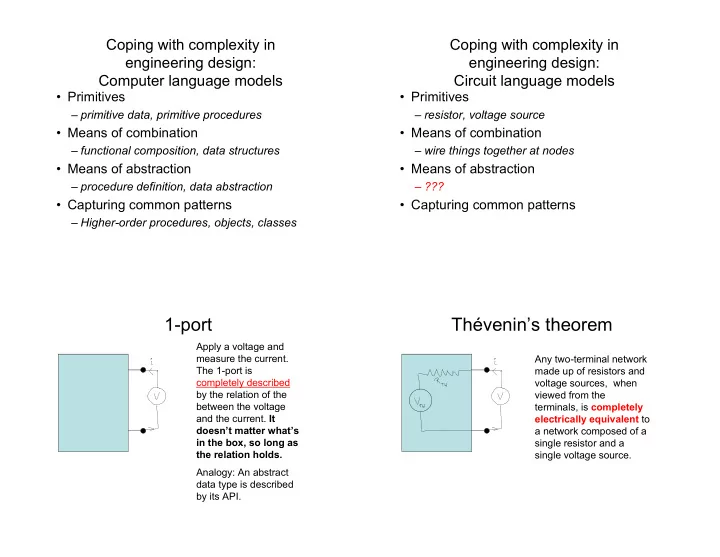
Coping with complexity in engineering design: Computer language models

  • Primitives

– primitive data, primitive procedures

  • Means of combination

– functional composition, data structures

  • Means of abstraction

– procedure definition, data abstraction

  • Capturing common patterns

– Higher-order procedures, objects, classes

Coping with complexity in engineering design: Circuit language models

  • Primitives

– resistor, voltage source

  • Means of combination

– wire things together at nodes

  • Means of abstraction

– ???

  • Capturing common patterns

1-port

Apply a voltage and measure the current. The 1-port is completely described by the relation of the between the voltage and the current. It doesn’t matter what’s in the box, so long as the relation holds. Analogy: An abstract data type is described by its API.

Thévenin’s theorem

Any two-terminal network made up of resistors and voltage sources, when viewed from the terminals, is completely electrically equivalent to a network composed of a single resistor and a single voltage source.

slide-2
SLIDE 2

Example: From the Wikipedia Step 1: The voltage VTH is the voltage we’d see at the terminals The voltage at the terminals is 7.5V, so VTH is 7.5V Step 2: The resistance RTH is the resistance we’d see at the terminals (when we set the independent source to zero).

slide-3
SLIDE 3

The resistance seen from the terminals is 2k, so RTH is 2k

Coping with complexity in engineering design: Circuit language models

  • Primitives

– resistor, voltage source

  • Means of combination

– wire things together at nodes

  • Means of abstraction

– 1-ports (Thévenin equivalence)

  • Capturing common patterns

1-port 2-port … and in general, n-ports

Ideal op-amp model

K might be around 10,000

slide-4
SLIDE 4

Ideal op-amp model

K might be around 10,000

Non-inverting amplifier

Coping with complexity in engineering design: Circuit language models

  • Primitives

– resistor, voltage source

  • Means of combination

– wire things together at nodes

  • Means of abstraction

– 1-ports (Thévenin equivalence), n-ports

  • Some common patterns

– feedback