
SLIDE 1
Spring 2018: Week 08 ASTR/PHYS 4080: Introduction to Cosmology
Cosmic Microwave Background
1
ASTR/PHYS 4080: Intro to Cosmology Week 8
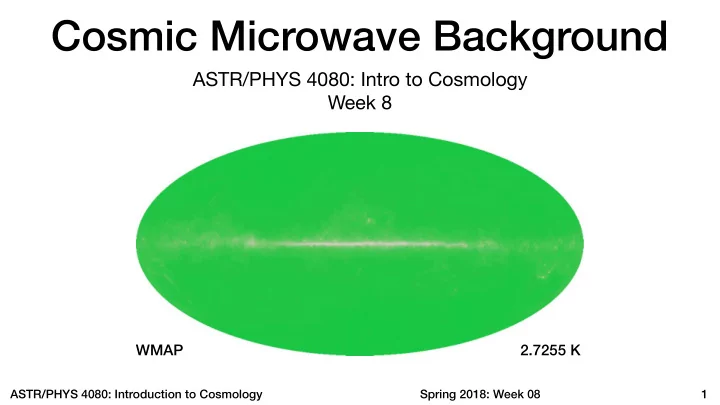
WMAP 2.7255 K
Cosmic Microwave Background ASTR/PHYS 4080: Intro to Cosmology Week - - PowerPoint PPT Presentation
Cosmic Microwave Background ASTR/PHYS 4080: Intro to Cosmology Week 8 WMAP 2.7255 K ASTR/PHYS 4080: Introduction to Cosmology Spring 2018: Week 08 1 Brief History 1934 (Richard Tolman) blackbody radiation in an expanding universe cools
Spring 2018: Week 08 ASTR/PHYS 4080: Introduction to Cosmology
1
ASTR/PHYS 4080: Intro to Cosmology Week 8
WMAP 2.7255 K
Spring 2018: Week 08 ASTR/PHYS 4080: Introduction to Cosmology
2
thermal distribution and remains a blackbody
temperature of space of ~2.3K
early universe (high expansion rate, assume matter domination)
universe; the existence of CMB
calculations based on previous ideas
temperature should be ~5K (close! but largely a coincidence; incorrect assumptions - neutron dominated initial state); no mention of the observability.
Spring 2018: Week 08 ASTR/PHYS 4080: Introduction to Cosmology
3
emission background 4±3K, independent of time and direction
from helium abundance; realize Bell Labs telescope can constrain
longer pure neutron initial state; weak interaction for neutron vs proton)
thermal background; build detector to search; then they hear about its discovery
careful experiment (e.g., shooed away pigeons roosted in the antenna; cleaned up “the usual white dielectric” generated by pigeons); explanation could be that of Dicke et al.
Spring 2018: Week 08 ASTR/PHYS 4080: Introduction to Cosmology
4
with Penzias & Wilson for blackbody spectrum; isotropic to 10%
suggestion by Woolf]) independently show that the excitation of interstellar CN is caused by CMB (McKellar’s 1941 observation explained!)
isotropic blackbody and discovers the anisotropies.
then the launches of WMAP (2001) and Planck (2009)
Spring 2018: Week 08 ASTR/PHYS 4080: Introduction to Cosmology
5
dT/T ~ 10-3
Spring 2018: Week 08 ASTR/PHYS 4080: Introduction to Cosmology
6
dT > 3 mK dT ~ 3.353 mK dT ~ 0.018 mK
Spring 2018: Week 08 ASTR/PHYS 4080: Introduction to Cosmology
7
https://fineartamerica.com/featured/cosmic-microwave-background-radiation-carlos-clarivan.html COBE 1990 Planck 2013 WMAP 2003
Spring 2018: Week 08 ASTR/PHYS 4080: Introduction to Cosmology
8
Spring 2018: Week 08 ASTR/PHYS 4080: Introduction to Cosmology
9
Spring 2018: Week 08 ASTR/PHYS 4080: Introduction to Cosmology
10
In the early universe, many interactions between particles (just like at the LHC) quarks, electrons, photons, neutrinos all transform into each other As universe expands, densities decrease and protons/electrons/photons dominate baryon soup Eventually, electrons can be captured by protons to form atoms that are not immediately broken up by energetic photons —> recombination Soon thereafter, the density of free electrons is too low to scatter photons, and the universe becomes transparent —> photon decoupling As the universe expands further, a time comes when a CMB photon scatters off an electron for
—> last scattering
Spring 2018: Week 08 ASTR/PHYS 4080: Introduction to Cosmology
11
Spring 2018: Week 08 ASTR/PHYS 4080: Introduction to Cosmology
12
Implies T~60,000 K —> much too high: BB spectrum has a tail
Spring 2018: Week 08 ASTR/PHYS 4080: Introduction to Cosmology
13
(minus for bosons, plus for fermions) g —> 2 (for non-nucleons, gH=4) chemical potential of photons = 0 Saha Equation
Spring 2018: Week 08 ASTR/PHYS 4080: Introduction to Cosmology
14
Defined as when protons and H atoms are equal: = 1/2 , (set by current baryon/photon density)
Spring 2018: Week 08 ASTR/PHYS 4080: Introduction to Cosmology
15
~70,000 yr recombination: z = 1380 when T = 3760K tage = 250,000 yr decoupling: when expansion rate surpasses scattering rate: z ~ 1090 (incl. non-eq. effects) last scattering: when the optical depth is ~1 redshift same as decoupling
Spring 2018: Week 08 ASTR/PHYS 4080: Introduction to Cosmology
16
z=1090
Spring 2018: Week 08 ASTR/PHYS 4080: Introduction to Cosmology
17
l 1 2 3 4 m 0 1 2 3 4 Power Spectrum Represent function in terms of spherical harmonics sum Y over m, get Legendre polynomials
Spring 2018: Week 08 ASTR/PHYS 4080: Introduction to Cosmology
18
Spring 2018: Week 08 ASTR/PHYS 4080: Introduction to Cosmology
19
At last scattering, universe evolves as if there’s only radiation and matter, so we can easily calculate the horizon distance By definition, the angular scale this occurs at is given by the angular diameter distance First, let’s define the scale at which pieces of the universe could be in causal contact
Spring 2018: Week 08 ASTR/PHYS 4080: Introduction to Cosmology
20
causal contact initial conditions
Spring 2018: Week 08 ASTR/PHYS 4080: Introduction to Cosmology
21
causal contact initial conditions first peak third peak second peak etc peaks size scale of a DM potential well where baryon collapse reaches turnaround due to its pressure
Spring 2018: Week 08 ASTR/PHYS 4080: Introduction to Cosmology
22
Spring 2018: Week 08 ASTR/PHYS 4080: Introduction to Cosmology
23
causal contact initial conditions first peak third peak second peak etc peaks Amplitudes give baryon density
Spring 2018: Week 08 ASTR/PHYS 4080: Introduction to Cosmology
24
causal contact initial conditions first peak third peak second peak etc peaks First peak: spatially flat Second peak: existence of “dark baryons” Third peak: amount of dark matter Damping tail: photons can cross entire grav. fluct., wipes out signal damping tail
Spring 2018: Week 08 ASTR/PHYS 4080: Introduction to Cosmology
25
Spring 2018: Week 08 ASTR/PHYS 4080: Introduction to Cosmology
26