CORONAVIRUS PANDEMIC L I V E IMPACT ON SPACE UTILIZATION AND - - PowerPoint PPT Presentation

coronavirus pandemic
SMART_READER_LITE
LIVE PREVIEW

CORONAVIRUS PANDEMIC L I V E IMPACT ON SPACE UTILIZATION AND - - PowerPoint PPT Presentation

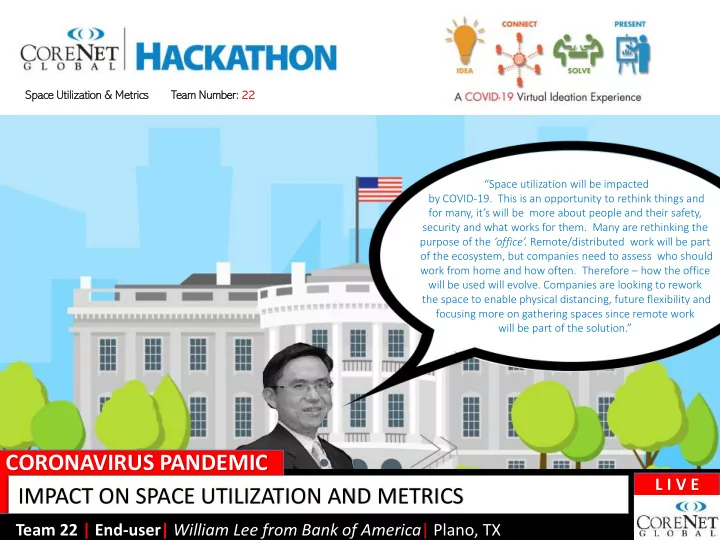
Spa pace Util iliz ization & Metric Metrics Team Num umber: : 22 22 Space utilization will be impacted by COVID-19. This is an opportunity to rethink things and for many, its will be more about people and their safety,


slide-1
SLIDE 1

Spa pace Util iliz ization & Metric Metrics Team Num umber: : 22 22 “Space utilization will be impacted by COVID-19. This is an opportunity to rethink things and for many, it’s will be more about people and their safety, security and what works for them. Many are rethinking the purpose of the ‘office’. Remote/distributed work will be part

  • f the ecosystem, but companies need to assess who should

work from home and how often. Therefore – how the office will be used will evolve. Companies are looking to rework the space to enable physical distancing, future flexibility and focusing more on gathering spaces since remote work will be part of the solution.”

CORONAVIRUS PANDEMIC IMPACT ON SPACE UTILIZATION AND METRICS

L I V E Team 22 | End-user| William Lee from Bank of America| Plano, TX

slide-2
SLIDE 2

CORONAVIRUS PANDEMIC IMPACT ON SPACE UTILIZATION AND METRICS

L I V E Team 22 | End-user | AnnLouise White from Verisk| Boston, MA

“We value our people, and their health and safety is

  • ur #1 concern. We strive to strike the right balance between being

fiscally responsible while insuring we are creating a great workplace experience across the board. Without specific targets and metrics this becomes more difficult, but one size does not fit all. It’s more important to us to be flexible so we can accommodate and address the unique needs

  • f each group, and nuances of each market, rather than

applying a blanket approach across the organization.”

Reporter: : “This Pandemic started to hit us all hard mid-March. What did you do with the time you had to address how space utilization and metrics will be impacted going forward? What do we really value?”

slide-3
SLIDE 3

CORONAVIRUS PANDEMIC IMPACT ON SPACE UTILIZATION AND METRICS

L I V E Team 22 | A&D | Bryon Sutherly from Hixson, Inc. and Kay Sargent from HOK

“An opportunity exists to amend the trend and focus more on the ‘outcomes’ and how the design enables higher value(s) for the organization. Cost will be a factor, but it will also be more about the behaviors the space will create, both from a performance and health

  • perspective. The desire to provide physical distancing will result in a

reduction of densification in the workplace, but we will likely see an increase in remote working as well. So, while the square footage per work point will likely increase; the square footage per employee might stay the same because there is likely to be fewer of them in the office at any given time. I think we need some new definition of how we measure space use as well.

Static UR, Utilization Rate – square feet / work points assigned to the space Dynamic UR, Utilization Rate – square feet / people assigned to the space

Reporter: : “How will space be used going forward? Will COVID-19 reverse the trend of reducing square footage per employee?”

slide-4
SLIDE 4

CORONAVIRUS PANDEMIC IMPACT ON SPACE UTILIZATION AND METRICS

L I V E

“You can’t manage it if you can’t measure it.”

Reporter: : “Are metrics important and if so, why?”

Team 22 | Project Manager | Chris Joyner from Fischer | Dallas, TX

slide-5
SLIDE 5

CORONAVIRUS PANDEMIC IMPACT ON SPACE UTILIZATION AND METRICS

L I V E Team 22 | Architect| Bryon Sutherly from Hixson, Inc. | Cincinnati, OH

“CRE metrics are mostly related to square foot/person and

  • density. Focus has shifted to the occupants. Design tools

including the WELL Building Standard & the Leeman Index help answer questions about how buildings, systems and space get designed and safely support people and what they are there to do. Clients desire a positive assessment & honest reflection of what they value These metrics are becoming a bit more people-centric.”

Reporter: : “What metrics has your company (or your clients) used to determine the status and success of your real estate and your space? And how does that relate to your company’s mission

  • r values?”
  • Safe & Healthy

workplace with an

  • Engaging workplace

design that

  • Promotes the Corporate

culture and reflects

  • Corporate initiatives

(Environmental sustainability, Diversity, Gender Equity, etc.).

slide-6
SLIDE 6

CORONAVIRUS PANDEMIC IMPACT ON SPACE UTILIZATION AND METRICS

L I V E Team 22 | Service Provider | Doug Sharp from Sharp Advisors | Sullivan’s Island, SC

“Cost-centric metrics for managing space typically assume that space is a

  • liability. But once we can move beyond that we can start

to assess the value side of workforce abilities where space becomes an asset and a powerful business tool which enables people. We have an opportunity to do both AND hold both at an EQUAL level. CRE is BOTH an expense and an investment (in innovation,

  • pportunity & growth).”

Reporter: : “Do you believe those metrics are still relevant and/or how do you think they will shift?”

slide-7
SLIDE 7

CORONAVIRUS PANDEMIC IMPACT ON SPACE UTILIZATION AND METRICS

L I V E Team 22 | Designer | Kay Sargent from HOK | Washington, DC

  • Ability to successfully conduct activities the

business values

  • Ability to work creativity and ideate as a team

/ Ability to share ideas

  • Ability to achieve preferred work profiles,

solo, in pairs, teams

  • Productivity / Revenue per person

and…

  • Retention and Attraction / Absenteeism /

Presenteeism

  • Ability to access needed spaces – just-in-time
  • Proud of place / Preferred workplace and meeting

location

  • User satisfaction / Customer satisfaction rating
  • Energized Environment / Ability to control distractions

and interruptions

  • Ability to work seamlessly connect anywhere
  • Speed of decision making / Time to market for new

products

  • Ability to access space that fosters ad hoc interaction
  • Ability to find and access teammates and influencers
  • Awareness of what others are doing
  • Social cohesion / Trust / Perceived supervisory

support

  • Wellbeing
  • Having options and choices to determine where to

work that best suits the task at hand and your personal preferences.

  • Employee engagement
  • Pride of place
  • Ability to work productively
  • Enjoyable environment to work in
  • Contributes to a sense of community at work

Reporter: : “What things should be measured if we want to focus

  • n Human-centric factors?”
slide-8
SLIDE 8

CORONAVIRUS PANDEMIC IMPACT ON SPACE UTILIZATION AND METRICS

L I V E Team 22 | Designer | Ben Waber from Humanyze | Boston, MA

“Let me tag in here… This will mostly be behavior based. A short selection here: ▪ Focus minutes/workday (15 minutes or longer

  • f uninterrupted, individual work)

▪ Core collaborators per square foot (pairs of people who interact on average more than

  • ne hour a week over a yearlong period)

▪ and…

  • Significant collaborators per square foot (pairs of

people who interact on average 15 minutes to one hour a week over a yearlong period)

  • Loose collaborators per square foot (pairs of people

who interact on average between 5 and 15 minutes per week over a yearlong period)

  • Communication concentration – percent of time

average employees spend with their top 5 collaborators

  • Transition minutes/workday – how much people are

interrupted on an average day

  • Workday length
  • Response time – on average how long does it take

people to respond to messages

  • Average time employees spend with direct

manager/week

  • Average time employees spend with people in other

hierarchical levels

  • Percent of time people spend in meetings
  • Average distance between core collaborators
  • Average distance from meeting rooms weighted by

usage of specific person

  • Network flexibility – what percent of an individual’s

network changes on a weekly basis

  • Cohesion – what percent of possible connections

between employees in a space actually exist?
slide-9
SLIDE 9

CORONAVIRUS PANDEMIC IMPACT ON SPACE UTILIZATION AND METRICS

L I V E

“Cost is always a factor, especially given the challenging economic times that lie ahead. But COVID-19 may be a catalyst to shift the POV to the people who occupy

  • ur CRE. The focus is on “the safety of our associates”

right now. ADD the attraction and retention issues (that may only get more complicated), the need to continue to invest (educated, certify, etc.), etc. the scale MAY be tipping to a more shared-focus response.

Team 22 | Project Manager | Chris Joyner from Fischer | Dallas, TX

It’s about creating a balance between creating an effective work environment and maintaining cost efficiency. a balance between HR and CFO. Upward focus

  • vs. crisis mode. But for the foreseeable future

health and performance will rank ahead of cost and that might continue beyond the coming months if organizations can prove ROI.”

Reporter: : “COVID-19 and the shut-down has hit the economy hard. Will companies place greater priority

  • n reducing expenses?”
slide-10
SLIDE 10

CORONAVIRUS PANDEMIC IMPACT ON SPACE UTILIZATION AND METRICS

L I V E Team 22 | End-user| William Lee from Bank of America| Plano, TX

“As companies continue to focus on their employees’ health and wellness, their leasing strategies will change as they realign their real estate portfolio with their employees’ and clients’ changing business and space needs. With an uptick in remote work, some may look to right-size their real estate portfolio while others may focus more on optimizing their labor market footprint. Although it is even harder today to do long term planning, the upward trend towards using co-working space may pause, while companies explore alternative serviced office offerings such as opting for a furniture “membership model.” All these changes will increase the agility of companies to react to future pandemics. Though business impact from COVID-19 remain negative at an aggregate level, real estate leaders can enhance their portfolio agility by reviewing their footprint needs and ownership/leasing strategies in lock step with their companies’ evolving business needs in 2021 and beyond.”

Reporter: : “Will the significant business disruptions and prolonged uncertainty ushered in by COVID-19 bring transformational change in companies’ leasing strategies?”