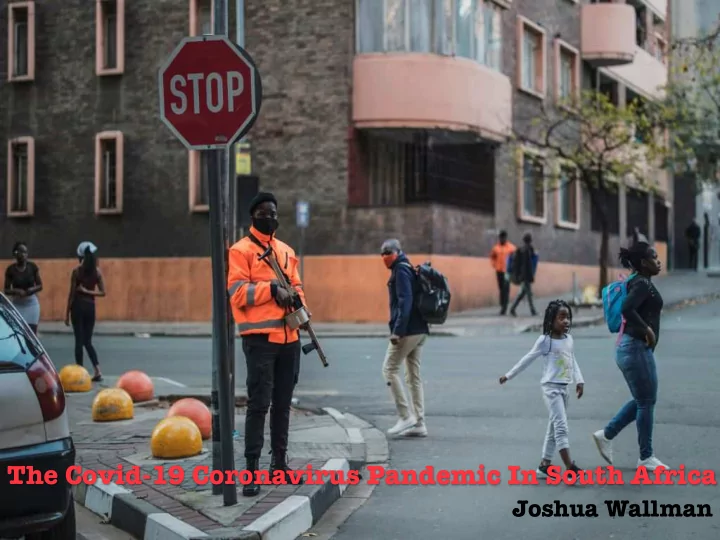
The Covid-19 Coronavirus Pandemic In South Africa Joshua Wallman - - PowerPoint PPT Presentation
The Covid-19 Coronavirus Pandemic In South Africa Joshua Wallman The Covid-19 Coronavirus Pandemic In South Africa Joshua Wallman Professor Nina Khrushcheva Media, Culture & Global Politics Spring 2020 April 28, 2020 3 The current state
The Covid-19 Coronavirus Pandemic In South Africa
Joshua Wallman Professor Nina Khrushcheva Media, Culture & Global Politics Spring 2020 April 28, 2020
The current state of the pandemic in South Africa
- Hi
Highest number of confirmed Covid-19 19 Cases in in Afr fric ica- ove
- ver 4793 con
confirmed ca case ses s an and 90 deat aths hs as as of April 28, 2020.
- Wh
While e th the e number er of new ew cases es have e dropped ed grea eatl tly, hea ealth th ex exper erts ts fea ear th that t a new ew wa wave of infections will arrive along with the southern hemisphere’s winter.
- Cu
Currently conducting approximately 10,000 tests per day, particularly in the to town
- wnships. The
e hope e is th that t a focus on tes testi ting wi will allow w an ea easing of th the e lockdown wn so so that those
- se most
- st effect
cted ca can return to
- wor
- rk.
- Th
This proactive approach, combining widespread testing and public temperature ch check cks s from
- m the st
start (ove
- ver 47,000 peop
- ple tes
tested ted an and 67 7 drive-th through sites tes crea eated ted in th the e first t week week alone) e), outp tpaced ed mo most t oth ther er countr tries es around th the e wo world.
- Al
Along with a heavy po police pr presence nationwide, 2,280 troops ps were depl ployed at the st start of
- f the lock
- ckdow
- wn. Presi
sident Ramaphosa
- sa has
s now
- w mobi
- bilized all 73,,000 membe
bers s
- f
- f the armed for
- rce
ces.
- s. As
s of
- f April 22nd
nd, o
, over 1 118,000 p ,000 people h have b been c charged w with br breaking the lock
- ckdow
- wn rest
strict ction
- ns.
s.
- A
A compl plete loss of income for millions coupl pled with limited access to necessities have le led d to in increased d cla lashes wit ith polic lice and d soldie ldiers in in the township ips, is is what are bein ing ca called riot
- ts.
s.
- Th
The initial national lockdown, while enacted in an of
- ften ruthless
ss fa fashio ion, appears to ha have lar argely been effective, as as it considerab ably slowed the he explosion of cas ases the he cou country face ced at the st start of
- f the cr
crisi sis. s.
- Pr
President Ramaphosa an announ unced th this past t week week th that, t, wh while e he e plans on a gradual re reopening of the economy, thousands of additional tro roops will be deployed.
- A
A 26 26 billion dollar ec economi mic rel elief ef fund was also announced ed, to tota taling 10% of th the e cou countries s GDP, to
- primarily aid bu
busi sinesse sses, s, and se secon condarily three million
- n wor
- rkers
s wh who have e lost t all income. me.
- Th
There has been a notable increase in confirmed cases among essential workers in re recent weeks, leading to concern rns that opening the economy will lead an explosion of in infe fectio ions among this is la large de demographic ic.
3
Fertile ground for a national health & economic emergency
VAST SYSTEMA TIC INEQUALITY & A WEAKENED INFASTRUCTURE
- South Africa is considered the most “developed” nation on the African continent, with a more
industrialized and diversified economy than any other country. However, this wealthy and resource-rich nation of 57 million is grappling with deep inequality and poverty. In 2019, the World Bank declared South Africa to be the most economically unequal country on earth.
- 26 years after apartheid there is still deeply entrenched systematic racism, and increasingly
classism, in every facet of society.
- Basic health care is provided by the government, but it has been stretched thin and millions
lack full access to it. The townships in particular have few essential local health services.
- The impoverished townships, where a third of the nation’s 57 million people live, lack the
necessities available to those in the cities and suburbs. Residents also contend with high unemployment, lack of access to food and medicine, as well as no running water or toilets.
- While the ANC has made efforts for years to build housing, provide basic services and rebuild
the country’s infrastructure, millions still live with no electricity or sanitation and minimal schooling or healthcare.
4
A FRAGILE ECONOMY , HIGH UNEMPLOYMENT & A LACK OF RESOURCES
- South Africa has an estimated 1 million domestic workers whose rights have historically been violated by
- employers. This is only being exacerbated by the pandemic. Many essential workers in wealthy urban
and suburban areas are forced to travel long distances using public transportation in order to work, which had lead to this population becoming highly at risk.
- Millions depend on work in the informal economy for survival. This system has been completely
interrupted, leading to widespread concerns about a vast rise in hunger and lack of necessities.
- Street violence, including what some officials are publicly labeling “burglary, looting, and vandalism” is
- n the rise as people run out of food and supplies.
- There is a very large at-risk and vulnerable homeless population of over 200,000 living on the streets as
well as in large encampments across the country. CORRUPTION & ONE PARTY RULE
- With one party rule essentially intact since the end apartheid, the ANC has controlled the country for a
quarter century while having to contend with party corruption, power struggles and inner turmoil. Many critics believe this has impeded the party’s ability to function effectively, particularly at this perilous moment.
- A recent BBC article blamed “cronyism, corruption and economic stagnation” for the decade long
hollowing out of key institutions. Austerity measures, like in so many part so of the world, has aggravated this situation.
5
The media reacts:
6
- Fig. 1
- Fig. 2
- Fig. 1
Patient zero & the arrival of the Coronavirus
- Cov
Covid-19 became national news when 114 4 South African exchange st students s were st stranded in Wuhan, China at the st start of the lock ckdown th
- there. Heavy
y media coverage and a debate te arose regarding th their safe re return rn to the country ry, and the possibility of the viru rus arri rriving with th
- them. They
y were able to to leave China and immediate tely y ente tered qu quara rantine upon entry ry to South Afri rica.
- De
Despit ite a a nat atio ional al co controve versy that at erupted, the fir irst cas cases we were not re related to China. Rather . the firs rst confirm rmed case in the country ry on Ma March ch 5th
th wa
was of a 38 year old who had recently returned from Italy.
- Ch
China, w with v very d deep e econ
- nom
- mic t
ties t to S
- S.A., w
went on
- n a
a p public r relation
- ns
ca campaign gn to co counter any nega gative ve media co cove verage ge or publ blic c se sentiment ti tied to to th the Wuhan incident t and public percepti tion blaming China for th the pandemic.
- As
As the first case was announced, ami mid rapidly growing fear amo mong th the public, President t Ramaphosa promised adequate te preparati tions, cl clear gu guidelines s and maximum transp sparency cy rega garding g the vi virus’ s’s s sp
- spread. He admitted that the eco
conomy would su suffer gr greatly due to the cr crisi sis s bu but that the death rate would not explode as s many warned it mig might.
- The
The Media tappe pped into thi his fear and only exacerbated the he frenzy, wh whic ich in increas ased pressure on the governme ment to ac act swif wiftly ly an and st strongl gly.
7
The government response
8
- Fig. 4
- Fig. 5
- Fig. 6
- Fig. 7
- So
South Africa has ben enef efitted ed from its dec ecades es long ex exper erien ence e dea ealing with HIV an and tuberculosis. Bas ased on this, the government ac acted ag aggressively y an and ear arly. A A major focus on widespread testing from the start, one of the highest rates pe per capi pita ta in the the world, d, combined d with th pu public te tempe peratu ture che hecks ks and d dr draconian enfo forcement t measures in “at t risk” k” areas, appe ppear to to ha have pa paid d off ff fo for the the ti time being. But, t, the there are concerns about t anothe ther surge in the the near fu futu ture.
- As
As the number of domestic cases reached 1,000, a national lockdown was an announced an and beginning on Mar arch 27th
th on
- nly essential service prov
- viders
we were allowe wed to continue ue wo working.
- Pa
Particularly strong g restrictions on citizens have included no outside exercise, no no sale of alco cohol or ci cigarettes, no no dog walking ng and nd no no leavi ving ng home unl nless the there is a clear emergency.
- Al
Along with enacting some of the strictest lockdown restrictions in the world, the the government t is uti tilizing some of f the the ha harshe hest t metho thods ds to to enfo force the them as we
- well. This often brut
utal implementation, wh which has been met wi with international cr critici cism, has focu cused on n impove verished towns nships and nd inne nner ci city ne neighborhoods.
- Th
The e Pres esiden ent, along with Hea ealth Minister er Zw Zweli Mk Mkhize, , have largely been la lauded in in the lo local l me media ia for what is is bein ing touted as a very no-no nons nsens nse, di direct, t, ho honest t and d sober pu public appr pproach h to to the the pa pande
- demic. Due to
to hi his very pu public role, Ministe ter Mk Mkhize ha has tu turned d into to a “Dr . Fo Fouci” ” like e figure e to many in in South Afric ica.
- Con
Controv
- versially,
, widespread phon
- ne-ba
base sed c contact t tra racing w was e s enacted e earl rly i in Ap April, raising concerns among civil and human rights activists.
9
- Fig. 8
- Fig. 9
T
- wnships and inner-city neighborhoods face a lockdown by gun:
10
- Fig. 10
- Fig. 11
- Fig. 12
- Fig. 13
The brutality of South Africa’s lockdown gains international coverage
11
- Fig. 14
- Fig. 15
Violence & oppression as a method of compliance:
- Pu
Public canings gs, beatings gs, shootings gs, and even blu bludgeoning ning a young ng man n to death wit ith a hammer , , have ve al all b been een t tac actics u used ed b by t the p e police an e and m military ary ag agai ainst th the public wh when loc
- ckdown
- wn rules have been disob
- beyed in
th the town townships.
- De
Deep systematic inequality based d on
- n race and
d class have be been n particu icula larly ly visible visible due to the lo lock ckdown.
- n. The
vi violen ent t tact ctics u cs utilized zed a against st t the p e poor h have been ve been a absen bsent in in whit ite ne neig ighbo borhoods s and nd su subu burbs, bs, as s well ll as s in in pr prospe perous black enclaves.
- Al
Along with public health and safety, officials insist insist th that t a ri rise in cri rime necessitat ate a a “show of forc rce to get people
- ff
- ff th
the str treets ts.”
- De
Despite wi wide despread d criticism and d con
- nde
demnation
- n, the
pr president ext xtended the lockdown until May y 1st
st an
and dou doubled d down down on
- n his methods
- ds, addi
dding growi
- wing numbers
- f
- f tr
troop
- ops to
to th the security ty for forces ov
- verseeing th
the public.
12
The crackdown:
13
- Fig. 16
- Fig. 17
- Fig. 18
- Fig. 19
Long lines and machine guns in a township: Hand sanitizer, free parking & full shelves in a prosperous suburb :
14
- Fig. 20
- Fig. 21
- Fig. 22
- Fig. 23
Is a victory in sight?
15
- Fig. 24
- Fig. 25
- Fig. 26
The crisis continues. A massive homeless population of 200,000 are currently at great risk:
16
- Fig. 27
- Fig. 28
- Fig. 29
How will South Africa fare moving forward?
- While testing will be ramped up, an easing of the national lockdown from a level 5 (the
highest) to a level 4 on May 1st was announced two weeks ago. However, the health minister stated on April 28th that, due to the increasing rate of infection among essential workers, this easing may be postponed. A major outbreak among vulnerable populations like the homeless is also a major concern.
- The $26 billion economic package announced on April 21st will help to a degree, but far
more aid is needed. Millions will fall through the cracks under the present plan. President Ramaphosa has acknowledged that further action must be taken.
- An increasingly desperate population, growing angry at an extended national lockdown,
work shutdowns, violent tactics by the military and police and a lack of necessities have lead to food riots, “looting” and violent clashes with security forces. Unless drastic action is taken, this will likely only become more common.
- Contagious disease experts worry that, along with an increase in cases due to reopening
the economy, the coming winter may also bring a wave of new cases to the country.
17
Questions
- If South Africa ends up with far fewer cases or deaths than was initially feared
while neighboring countries fare far worse, leading to the S.A. government claiming vindication for its brutal and militaristic approach to enforcing the lockdown, could this lead to further acceptance and normalization of such tactics both domestically and abroad?
- What parallels or similarities are there between the societal and systematic
issues being faced by South Africa and the U.S. during this crisis?
- In a recent national speech on the holiday of Freedom Day, President
Ramaphosa acknowledged that the pandemic has exposed and exacerbated the vast inequalities still present in the country. This is true in many other nations as well. Can systematic reforms be expected in the near future as a result of this inequity being laid bare for the world to see?
18
Photo Credits
Cover- time.com Figure 1- timeslive.co.za Figure 2- aljazeera.com Figure 3- bbc.com Figure 4- pri.org Figure 5- vice.com Figure 6- scmp.com Figure 7- bbc.com Figure 8- cnbc.com Figure 9- news24.com Figure 10- rfi.fr Figure 11- wsj.com Figure 12- weforum.org Figure 13- theguardian.com Figure 14- ft.com Figure 15- vice.com
19
Photo Credits (continued)
Figure 16- bbc.com Figure 17- straitstimes.com Figure 18- bbc.com Figure 19- bangkokpost.com Figure 20- npr.org Figure 21- theguardian.com Figure 22- npr .org Figure 23- npr .org Figure 24- bbc.com Figure 25- sciencemag.org Figure 26- npr.org Figure 27- cnn.com Figure 28- npr .org Figure 29- npr .org
20