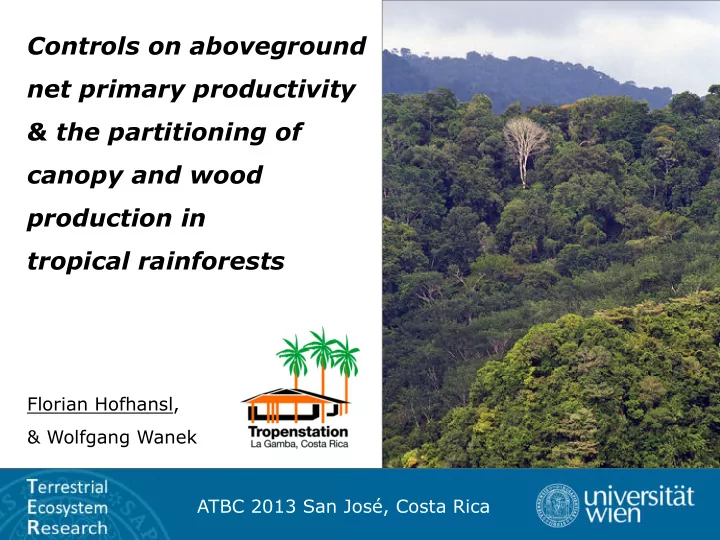
SLIDE 1
Controls on aboveground net primary productivity & the partitioning of canopy and wood production in tropical rainforests
Florian Hofhansl, & Wolfgang Wanek ATBC 2013 San José, Costa Rica
SLIDE 2 Potential net primary production (NPP)
Introduction – Global carbon cycle Climatic Controls
Source: Schuur, E. Productivity and global climate revisited: The sensitivity of tropical forest growth to precipitation. Ecology, 84, 1165–1170.
Tropical Forests: 12%
25%
40%
SLIDE 3 Temperature Precipitation
Introduction – Global carbon cycle Climatic Controls
Source: Schuur, E. Productivity and global climate revisited: The sensitivity of tropical forest growth to precipitation. Ecology, 84, 1165–1170.
Climatic drivers: Mean annual temperature (MAT) Mean annual precipitation (MAP)
SLIDE 4 Introduction – Global carbon cycle
Source: IPCC - Climate Change 2007: Working Group I: The Physical Science Basis
Climate Projections
Expected changes: Drought frequency Precipitation intensity à à Temperature
SLIDE 5 Net primary production (NPP): Aboveground NPP Belowground NPP Net primary production (NPP):
- Canopy production (47%)
- Wood production (53%)
Source: Malhi, Y..et al. (2011). The allocation of ecosystem net primary productivity in tropical forests. Philosophical Transactions of the Royal Society B: Biological Sciences, 366, 3225–3245.
Methodology
SLIDE 6 Methodology
Net primary production (NPP): Aboveground NPP
- Stem increment (ABI)
- Litter fall (LF)
Relationship explained ABI ~ 60% LF ~ 40% à à about 50% undetermined
SLIDE 7 Source: ISI webofknowledge.com
Methodology
< 1% measured both !!! Number of studies (ISI):
- Net primary production
- Stem increment
- Litter fall
- Stem increment &
Litter fall
23,116 8,474 6,833 30
SLIDE 8 Local Study
Tropical Field Station La Gamba: (since 2005) Topographic positions:
Stem increment (DBH>10 cm) Litter fall (n=15 per site) www.univie.ac.at/bdef
SLIDE 9 Introduction – Global carbon cycle Local Controls
Source: Hofhansl et al. (2013) Climatic controls on aboveground net primary productivity and the partitioning between canopy and wood production (in preparation).
Climatic controls: ANPP No sign. effect Stem increment (ABI) Precipitation Litter fall (LF) Drought and Temperature à à à à à à Different Controls ABI / LF
SLIDE 10
Global Study
>100 sites, S-America (62), Asia (26), Hawaii (12), Africa (3), Australia (2) Parameters: MAT, MAP, DSL, CLD, Soil N:P, Litter N:P, Foliar N:P
SLIDE 11 Introduction – Global carbon cycle Global Controls
Classification Tree (CART): MAT All forest sites (n=105) MAP Lowland Sites (>21.65°C) Soil N:P ratio Montane Sites (<21.65°C)
Source: Hofhansl et al. (2013) Climatic controls on aboveground net primary productivity and the partitioning between canopy and wood production (in preparation).
SLIDE 12 Introduction – Global carbon cycle Global Controls
Structural equation model (SEM): Overall Model Lowland Model Montane Model
Source: Hofhansl et al. (2013) Climatic controls on aboveground net primary productivity and the partitioning between canopy and wood production (in preparation).
ABI ABI ABI LF LF LF
ANPP ANPP ANPP
SLIDE 13
Introduction – Global carbon cycle Temperature
Effect Overall Lowland Montane ANPP
+ +
% WP
+
MAT
SLIDE 14
Introduction – Global carbon cycle Precipitation
Effect Overall Lowland Montane ANPP
+
% WP
+ +
MAP
SLIDE 15 Introduction – Global carbon cycle Soil N:P ratio
Effect Overall Lowland Montane ANPP
SLIDE 16 Conclusion
- Local Controls on ANPP differ for canopy & wood production
- Global Controls on tropical ANPP:
MAT à (+) overall and montane ANPP, overall %WP MAP à (+) lowland ANPP, lowland & overall %WP Soil N:P à (−) overall and montane ANPP and %WP
MAT à enhance productivity of montane forests MAP à alter C-sequestration potential of lowland forests Soil N:P à N-deposition might decrease tropical productivity
Conclusion
SLIDE 17
Team of the Tropical Research Station La Gamba: Victor Cruz-Garcia, Luis Sanchez-Jimenez, Eduardo Arauz- Suarez Co-Workers: Sigrid Drage, Nina Hinko, Eva-Maria Pölz, Daniel Schaber Supervisors: Wolfgang Wanek, Andreas Richter, Roland Albert, Veronika Mayer, Anton Weissenhofer, Werner Huber Ministerio de Costa Rica: MINAE (Ministerio Nacional de Ambiente y Energia)
Acknowledgements
www.univie.ac.at/bdef