Construction Project Soo-Youl Oh, Young-Ki Kim, and Sangik Wu - - PowerPoint PPT Presentation

construction project
SMART_READER_LITE
LIVE PREVIEW

Construction Project Soo-Youl Oh, Young-Ki Kim, and Sangik Wu - - PowerPoint PPT Presentation

18 th IGORR, 3-7 Dec. 2017, Sydney, Australia Completion of Jordan Research and Training Reactor Construction Project Soo-Youl Oh, Young-Ki Kim, and Sangik Wu Talking Points Reporting the completion of JRTR construction Chronology of


slide-1
SLIDE 1

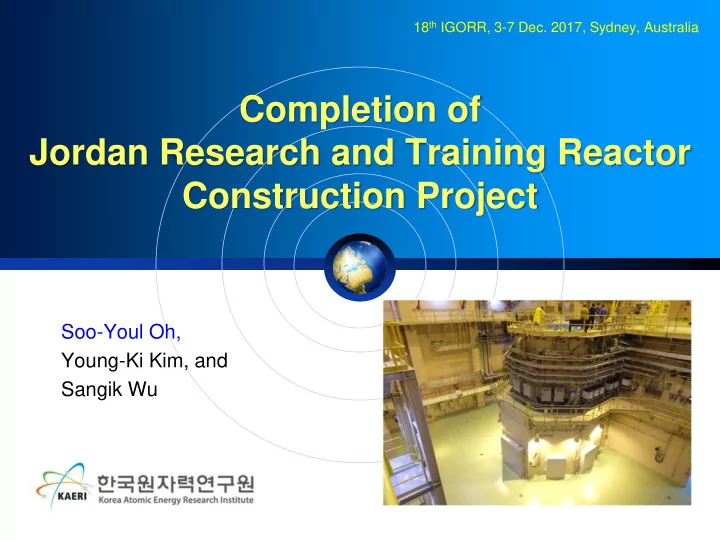
Completion of Jordan Research and Training Reactor Construction Project

Soo-Youl Oh, Young-Ki Kim, and Sangik Wu

18th IGORR, 3-7 Dec. 2017, Sydney, Australia
slide-2
SLIDE 2

2

Talking Points

 Reporting the completion of JRTR construction  Chronology of the project  Focal points and issues at each construction stage

slide-3
SLIDE 3

3

  • 1. Overview

JRTR Project at a glance

Project Name Jordan Research and Training Reactor (JRTR) Project Owner Jordan Atomic Energy Commission (JAEC) Contractor Consortium of KAERI and Daewoo E&C (KDC) Contract Type Turnkey EPC Contract Project Period 1 Aug. 2010 to 15 June 2017 (82.5 months) Site Campus of Jordan U of Science and Technology (Ramtha, Jordan) Scope of Supply ▪ Design and Construction of JRTR

(Reactor and buildings, RI Production Facility, Radwaste Treatment Facility, and Training Center)

▪ Education and Training of Jordanian Staff

slide-4
SLIDE 4

4

  • 1. Overview

JRTR Project – cont.

 Philosophy in defining the scope of supply

  • At taking-over, JRTR would be operable by Jordanian
  • perators and ready for NAA and production of I-131, Ir-

192 and Mo-99.

  • JAEC was supposed to install later on the beam instruments,

CNS, and so on.

slide-5
SLIDE 5

5

  • 1. Overview

Milestones

Commencement (1 August 2010) Construction Permit (15 August 2013) Start of CATs (1 July 2015) First Criticality (25 April 2016) Taking-Over

(15 June 2017) 36 months

23 10 14 Design Construction Commissioning

slide-6
SLIDE 6

6

  • 1. Overview

Involved Entities

KINS EMRC JAEC KDC KINAC KOSTI

Consultant Consultant Export Control Co-review Co-Inspection

IAEA KAERI Daewoo

Subcontractors

Major Systems Design Training

EPC

 Multi-national  Harmonization of different bases of knowledge and experiences was important.

slide-7
SLIDE 7

7

  • 2. Design Issues (1/3) - Licensing

 Licensing in two steps

  • Construction Permit (CP) & Operating License (OL)
  • Temporal permits such as Limited Work

Authorization (LWA) for excavation before CP

 Regulatory bases

  • Laws and decrees of Jordan if available
  • IAEA, “Safety of RRs” (NS-R-4)
  • NUREG 1537 of US NRC
  • Korean regulatory practices including NSSC Notices
slide-8
SLIDE 8

8

  • 2. Design Issues (2/3)

 Classification of SSCs

  • Kinds of classification: Safety Class, Seismic Categories,

Quality Class, and classification of electrical and I&C systems

  • ANSI/ANS-51.1 for criteria on Safety Class

 Validation of computer codes and design concept

  • Benchmark tests of neutronics code,
  • Experiments on CHF, siphon breaker,
  • Factory Acceptance Tests as usual; Special attention to

the performance tests of CRDMs

slide-9
SLIDE 9

9

  • 2. Design Issues (3/3)

 Upgradability from 5 to 10 MW

  • 10 MW was assumed for permanent SSCs such as

radiation shielding structures, pipes of cooling systems, and decay tank

  • Core reserves space for extra fuel assemblies.
  • Relatively light equipment such as pumps and HXs

will be replaced.

 Impact of Fukushima accident

  • New systems such as Automatic Seismic Trip System

and Air Discharge System

  • Upgrade of Quality Class of some systems
slide-10
SLIDE 10

10

  • 3. Construction Focal Points

 Well-staffed site office

  • 50 Engineers and 500 workers
  • Headquarters of KAERI and Daewoo dispatched

engineers and supervisors.

 Safety First: Human-Safety-Environment Program

  • No accident recorded for 4.8 million man-hours by

the end of 2016.

 Fostering Jordanian operators and engineers

  • More than 10 engineers received Master degrees in

Nuclear Eng. in Korea since 2011.

  • More than 20 operator-candidates trained in Korea in

2014-2105 and on the site later.

slide-11
SLIDE 11

11

  • 4. Commissioning Organization
slide-12
SLIDE 12

12

  • 4. Commissioning Work Flow

Stage Test Category (No of procedures) A1 Construction Acceptance Tests (67) A2.1 Flushing (15) A2.2 System Performance Tests (44) A3 Integrated System Tests (3) B1 Fuel Loading and Initial Criticality (11) B2 Low Power Tests (10) C Power Ascension and Full Power Tests (17)

 First criticality on 25th April 2016  Full power on 15th September 2016

slide-13
SLIDE 13

13

  • 4. Commissioning Initial Operation Tests

 IOT is very unique in JRTR.

  • Right after all the commissioning tests
  • Re-do most of the tests in Stages B and C for six

months; completed in Oct 2017

  • By Jordanians
  • In order to provide Jordanian operators with

intensive on-the-job training and re-confirm the results of commissioning tests

  • Resulted in satisfactory qualification of operators
slide-14
SLIDE 14

14

  • 5. Collaboration after Hand-over

 JAEC and KAERI made an Agreement in

  • Oct. 2017.
  • To strengthen technical cooperation for safe

and confident operation as well as full utilization of JRTR

  • In the areas of RI production, material

irradiation including NTD, fuel management, emergency planning, radiation protection, maintenance, etc.

  • Will be further developed towards two sister

centers, Jordan Nuclear Research Center and HANARO

slide-15
SLIDE 15

15

Remarks

 The goals of JAEC and KDC were the same.  Supply on Time, Support Forever!