
SLIDE 1
Connective tissue stains
Prepared by: Ms. BR Tsauses Anatomical Pathology 2A (ANP611S) April 2020
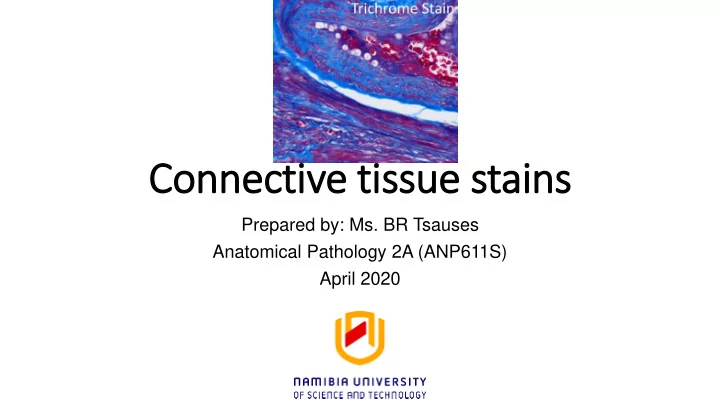
Connective tissue stains Prepared by: Ms. BR Tsauses Anatomical - - PowerPoint PPT Presentation
Connective tissue stains Prepared by: Ms. BR Tsauses Anatomical Pathology 2A (ANP611S) April 2020 Learning objective Describe and apply appropriate staining techniques for connective tissue in histology. Pre-learning Quiz Please take
Prepared by: Ms. BR Tsauses Anatomical Pathology 2A (ANP611S) April 2020
connective tissue in histology.
presentation.
demonstration of: muscle, collagen fibers, fibrin and erythrocytes.
specific applications, but all are suited for distinguishing cells from surrounding connective tissue.
muscle, collagen fibers, fibrin, and erythrocytes.
are colored by the smallest dye molecule; whenever a dye of large molecular size is able to penetrate, it will always do so at the expense
Biebrich Scarlet, which binds with the acidophilic tissue components.
components retain the red, while the red is pulled out of the collagen. At the same time causing a link with the collagen to bind with the aniline blue.
dyes
smooth muscle in tumors and to demonstrate the increase of collagen in diseases.
differential binding by tissue components.
the relative size of the dye molecules, differences in the physical structure of the tissue, and differences in the amino acid composition
simplest method of differential staining of Collagen and other Connective Tissue.
small molecules of picric acid penetrate all of the tissues rapidly, but are only firmly retained in the close textured, red blood cells and muscle.
collagen fibres, which have larger pores, and allow the larger molecules to enter.
must be treated with potassium permanganate to produce sensitized sites on the fibres where silver deposition can be initiated.
(diamine silver solution)
reducing agent, formalin, causes deposition of silver in the form of
treating with hypo. Gold chloride treatment renders the preparation permanent and produces a neutral black colour of high intensity
(2013),Bancroft’s Theory and Practice of Histological Techniques,7thEdition, Elsevier, China
5thEdition, Scion, UK