Common details: blood vessels, nerve trunks, ganglions, adipose - - PDF document

common details blood vessels nerve trunks ganglions
SMART_READER_LITE
LIVE PREVIEW

Common details: blood vessels, nerve trunks, ganglions, adipose - - PDF document

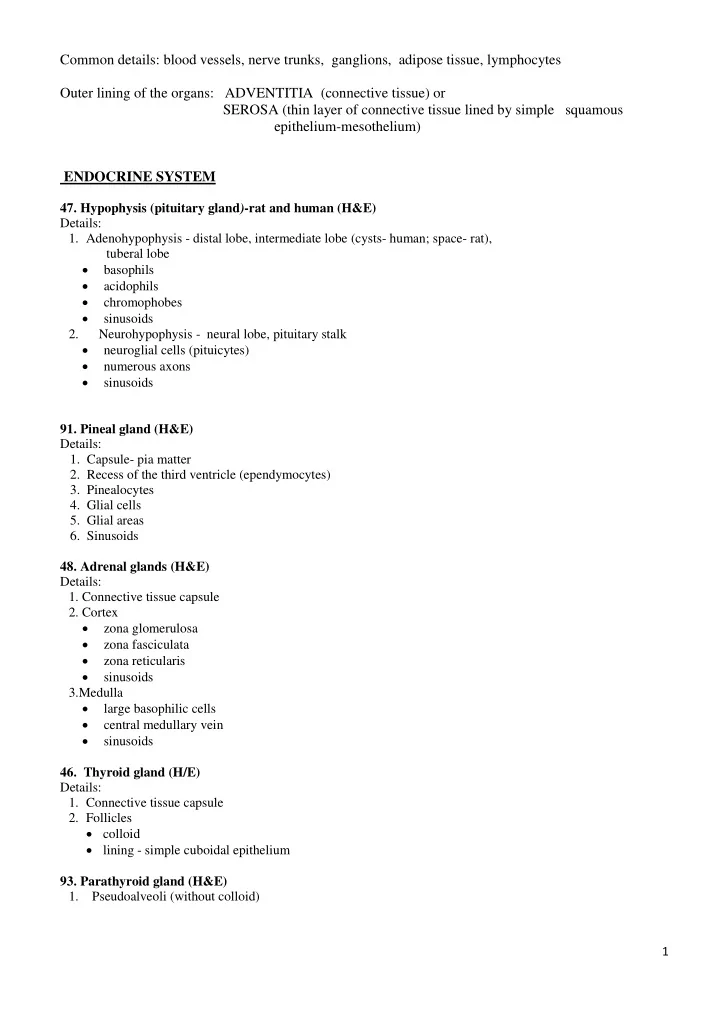
Common details: blood vessels, nerve trunks, ganglions, adipose tissue, lymphocytes Outer lining of the organs: ADVENTITIA (connective tissue) or SEROSA (thin layer of connective tissue lined by simple squamous epithelium-mesothelium)


slide-1
SLIDE 1

1

Common details: blood vessels, nerve trunks, ganglions, adipose tissue, lymphocytes Outer lining of the organs: ADVENTITIA (connective tissue) or SEROSA (thin layer of connective tissue lined by simple squamous epithelium-mesothelium) ENDOCRINE SYSTEM

  • 47. Hypophysis (pituitary gland)-rat and human (H&E)

Details:

  • 1. Adenohypophysis - distal lobe, intermediate lobe (cysts- human; space- rat),

tuberal lobe  basophils  acidophils  chromophobes  sinusoids

  • 2. Neurohypophysis - neural lobe, pituitary stalk

 neuroglial cells (pituicytes)  numerous axons  sinusoids

  • 91. Pineal gland (H&E)

Details:

  • 1. Capsule- pia matter
  • 2. Recess of the third ventricle (ependymocytes)
  • 3. Pinealocytes
  • 4. Glial cells
  • 5. Glial areas
  • 6. Sinusoids
  • 48. Adrenal glands (H&E)

Details:

  • 1. Connective tissue capsule
  • 2. Cortex

 zona glomerulosa  zona fasciculata  zona reticularis  sinusoids 3.Medulla  large basophilic cells  central medullary vein  sinusoids

  • 46. Thyroid gland (H/E)

Details:

  • 1. Connective tissue capsule
  • 2. Follicles

 colloid  lining - simple cuboidal epithelium

  • 93. Parathyroid gland (H&E)
  • 1. Pseudoalveoli (without colloid)
slide-2
SLIDE 2

2

RESPIRATORY SYSTEM

  • 71. Lung (H&E)

Details:

  • 1. Bronchi

 mucosa: pseudostratified ciliated columnar epithelium with goblet cells lamina propria of the mucosa smooth muscle - Reissesen’s membrane  submucosa- hyaline cartilage

  • 2. Bronchiols

 mucosa: pseudostratified ciliated columnar epithelium with goblet cells lamina propria of the mucosa smooth muscle- Reissesen’s membrane

  • 3. Terminal bronchioles- longitudinal section

 terminal bronchioles (lining - simple cuboidal epithelium)  respiratory bronchioles  alveolar ducts  alveolar sacs

  • 71E. Lung (eosin + paraaldehyde fuchsin )

Details: all details from 71 + elastic fibers in the wall of:  bronchi  bronchioles  alveoli  arteries

DIGESTIVE SYSTEM I

  • 29M. Tongue (Masson-Lille staining)

Details:

  • 1. Filiform papillae (stratified squamous keratinized epithelium)
  • 2. Connective tissue (blue color)
  • 3. Skeletal muscle- cross and longitudinal section
  • 4. Endomysium and perimysium
  • 5. Ebner’s gland (serous)
  • 6. Mucus gland
  • 54b. Circumvallate papillae of the tongue (H/E)

Details: 1. Circumvallate papillae:  stratified squamous nonkeratinized epithelium  secondary papillae  taste buds 2. Serous Ebner’s gland:  secretory portions  excretory ducts

  • 3. Mucous glands:

 secretory portions  excretory ducts

slide-3
SLIDE 3

3

  • 55. Parotid gland (H/E)

Details: 1. Lobules 2. Serous acini 3. Intralobular ducts (intercalated and striated ducts) 4. Interlobular ducts 5. Main duct 56/57. Sublingual and submandibular glands (H/E) Details: 1. Parotid gland 2. Submandibular gland:  serous acini  mucous tubules  serous demilunes  ducts 3. Sublingual gland:  mucous tubules  serous demilunes  ducts 4. Lymph node

  • 58. Esophagus (H/E)

Details: 1. Mucosa  stratified squamus keratinized epithelium  lamina propia  muscularis mucosa 2. Submucosa 3. Muscularis – 2 smooth muscle layers (circular and longitudinal)  Auerbach’s plexus 4. Serosa

  • 59. Body of the stomach (H/E)

Details: 1. Simple columnar epithelium of the mucosa  gastric pits  gastric areas 2. Lamina propria of the mucosa – gastric glands  mucous cells  parietal cells  chief cells 3. Muscularis mucosa 4. Submucosa 5. Muscularis – 3 smooth muscle layers (oblique, circular, longitudinal)  Auerbach’s plexus 6. Serosa

  • 63. Duodenum (H/E)

Details:

  • 1. Mucosa: villi & crypts

 simple columnar epithelium (enterocytes )  goblet cells  lymphocytes

  • 2. Submucosa: mucus secreting Brunner’s gland
  • 3. Muscular membrane - 2 smooth muscle layers (circular, longitudinal)

 Auerbach’s plexus- ganglion cells between two muscle layers

  • 4. Adventitia/serosa
slide-4
SLIDE 4

4

DIGESTIVE SYSTEM II

  • 12. Jejunum (H/E)

Details:

  • 1. Mucosa: villi & crypts

 simple columnar epithelium (enterocytes )  goblet cells  lymphocytes 1. Submucosa 2. Muscularis – 2 smooth muscle layers (circular, longitudinal) 3. Serosa 4. Nerve plexuses:  Meissner’s – submucosa  Auerbach’s (myenteric) - between two muscle layers

  • 60. Colon (H/E)

Details: 1. Mucosa - simple columnar epithelium, crypts, goblet cells, muscularis mucosa 2. Submucosa 3. Muscularis – 2 smooth muscle layers  circular (continuous)  longitudinal (discontinuous) – as 3 bands (taeniae coli) 4. Serosa 5. Nerve plexuses

  • 64. Appendix (H/E)

Details: 1. Mucosa (simple columnar epithelium, crypts, goblet cells) 2. Lymphatic nodules, lymphoid epithelium 3. Muscularis – 2 smooth muscle layers (circular, longitudinal) 4. Serosa 5. Nerve plexuses

  • 65. Pig liver (H/E)

Details: 1. Connective tissue capsule 2. Lobules 3. Portal spaces  interlobular vein  interlobular artery  interlobular bile duct 4. Hepatocytes 5. Sinusoids 6. Central vein 7. Sublobular vein

  • 68a. Gall bladder (H/E)

Details: 1. Mucosa (folded)  simple columnar epithelium  lamina propria 2. Muscularis – smooth muscle layers 3. Adventitia/serosa

slide-5
SLIDE 5

5

  • 69. Pancreas (H/E)

Details: 1. Exocrine components – lobules  serous acini  intralobular ducts (intercalated ducts)  interlobular ducts 2. Endocrine components – islets of Langerhans

URINARY SYSTEM

  • 8. Kidney (H/E)

Details: 1. CORTEX  cortical labyrinth - renal corpuscles, proximal convoluted tubules, distal convoluted tubules  medullary rays - collecting tubules

  • Renal corpuscle

 Bowman’s capsule  glomerulus  vascular pole (afferent arteriole & efferent arteriole)  macula densa of the distal convoluted tubules  urinary pole (proximal convoluted tubule) 2. MEDULLA  thin segment of the loop of Henle (simple squamous epithelium)  collecting tubule (simple cuboidal epithelium) 3. Calyx (transitional epithelium) 4. Vessels  interlobular vessels in the cortex  arcuate vessels on the border between cortex and medulla  vasa recta in the medulla

  • 73. Kidney injected with Indian Ink (vascular bed)

Details: 1. Glomeruli 2. Afferent and efferent arterioles 3. Peritubular capillaries 4. Interlobular vessels 5. Arcuate vessels 6. Vasa recta

  • 74. Urinary bladder (H/E)

Details: 1. Mucosa  transitional epithelium with umbrella cells  lamina propria of the mucosa (connective tissue) 2. Muscularis (smooth muscle cells) 3. Serosa/adventitia

slide-6
SLIDE 6

6

MALE REPRODUCTIVE SYSTEM

  • 75. Testis (H/E)

Details: 1. Tunica albuginea 2. Seminiferous tubules  tunica (lamina) propria  spermatogonia  primary spermatocytes  secondary spermatocytes / spermatids  spermatozoa 3. Leydig cells 4. Mediastinum 5. Straight tubules 6. Rete testis

  • 76. Epididymis (H/E)

Details: 1. Efferent ductules (pseudostratified epithelium that contains clumps of cuboidal cells with microvilli and columnar ciliated cells) 2. Epididymal duct (pseudostratified columnar epithelium with stereocilia)

  • 77. Ductus deferens (H/E)

Details: 1. Mucosa (folded) lined with pseudostratified columnar epithelium 2. Muscularis- 2 layers of smooth muscle cells 3. Adventitia

  • 4L. Prostate - main prostatic glands (H/E)

Details: 1. Stroma build of dense connective tissue and some smooth muscle cells 2. Secretory portion of the main glands - folded (simple columnar or pseudostratified epithelium) 3. Ducts of the main glands- smooth (simple cuboidal epithelium) 4. Corpora amylacea

  • 96. Penis (H/E)

Details: 1. Skin  dorsal artery 2. Tunica albuginea 3. Corpora cavernosa (cavernous spaces and trabeculae)  deep artery  fibrous septum 4. Urethra (stratified columnar/cuboidal epithelium) 5. Corpus spongiosum

slide-7
SLIDE 7

7

FEMALE REPRODUCTIVE SYSTEM I

  • 78. Ovary (H/E)

Details: 1. Simple cuboidal epithelium – „germinal epithelium” 2. Tunica albuginea 3. Ovarian follicles  primordial follicle  primary follicle  secondary (antral) follicle  Graafian (mature) follicle

  • ocyte

zona pellucida corona radiata cumulus oophorus antrum granulosa cells theca interna & externa 4. Atretic follicles 5. Interstitial gland

  • 78a. Corpus luteum (H/E)

Details:

  • 1. Corpus luteum

 lutein cells (granulosa lutein cells)  paralutein cells (theca lutein cells)

  • 2. Ovarian follicles
  • 79. Oviduct (fallopian tube)(H/E)

Details: 1. Mucosa (very folded)  simple columnar epithelium  sections through the folds  venous plexus 6. Muscularis – 2 smooth muscle layers (circular, longitudinal) 2. Serosa

  • 80. Uterus (H/E)

Details: 1. Mucosa (endometrium)  simple columnar epithelium  uterine glands (simple cuboidal epithelium) 2. Muscularis – 2 smooth muscle layers (circular, longitudinal) 3. Serosa

slide-8
SLIDE 8

8

FEMALE REPRODUCTIVE SYSTEM II

  • 84. Placenta (H/E)

Details: 1. Chorionic plate  amniotic epithelium (simple cuboidal epithelium)  extraembryonic mesodermal cells  cytotrophoblast  syncytiotrophoblast 2. Stem villi 3. Villi  syncytiotrophoblast  syncytial knots  vasculosyncytial membranes 4. Intervillus space (maternal blood) 5. Anchoring villi 6. Placental septum 7. Basal plate (decidua)  decidual cells  syncytiotrophoblast 8. Fibrinoid

  • 15. Umbilical cord (H/E)

Details: 1. Amniotic epithelium (simple cuboidal epithelium) 2. Stroma – Wharton’s jelly (mucous connective tissue) 3. Atypical muscular vessels – 2 arteries and 1 vein 89/89b. Mammary gland - active/nonactive (H/E) Details: 1. Secretory alveoli 2. Excretory ducts  intralobular (simple cuboidal epithelium)  interlobular (simple cuboidal or columnar epithelium )  lactiferous sinuses (bilayer columnar epithelium) 3. Stroma (connective tissue)