Concentrator Photovoltaics Dr. Katie Shanks K.Shanks2@exeter.ac.uk - - PowerPoint PPT Presentation
concentrator photovoltaics
SMART_READER_LITE
LIVE PREVIEW

Concentrator Photovoltaics Dr. Katie Shanks K.Shanks2@exeter.ac.uk - - PowerPoint PPT Presentation

Concentrator Photovoltaics Dr. Katie Shanks K.Shanks2@exeter.ac.uk University of Exeter Cornwall Campus Dr. Katie Shanks K.Shanks2@exeter.ac.uk 3 Overview 1. What are Solar Concentrators (CPV)? 1. Main Types of CPV 2. CPV parts and


slide-1
SLIDE 1

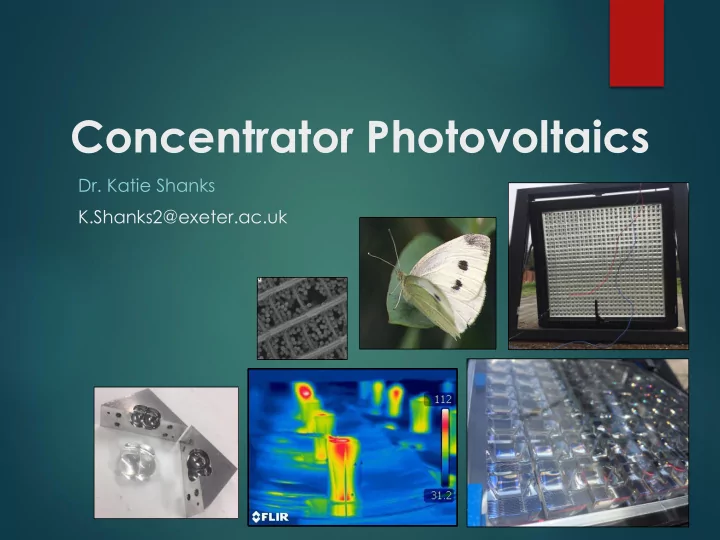
Concentrator Photovoltaics

  • Dr. Katie Shanks

K.Shanks2@exeter.ac.uk

slide-2
SLIDE 2

University of Exeter Cornwall Campus

  • Dr. Katie Shanks

K.Shanks2@exeter.ac.uk

slide-3
SLIDE 3

Overview

3

  • 1. What are Solar Concentrators (CPV)?
  • 1. Main Types of CPV

2. CPV parts and groups

  • 2. Why CPV?
  • 1. Solar Cell Efficiencies
  • 3. Optics for CPV

1. Reflection, Refraction and Scattering

  • 4. My Research
  • 1. Weight reduction
  • 2. Novel materials and Surface

Structures

  • 3. Biomimicry
  • 1. (Interdisciplinary Research)
  • 4. Art and Energy
  • 5. Costs of CPV
  • 6. Progress of CPV
  • 7. UNSW Research and Collaborations
slide-4
SLIDE 4

What are solar concentrators?

4

  • Solar Concentrators use optics such as mirrors

and lenses to increase the sunlight incident on solar photovoltaic or solar thermal devices.

  • Increase the power output by increasing the

power input.

  • Reduce the photovoltaic material required.
slide-5
SLIDE 5

Fresnel Lens?

5

  • Module is typically mounted on a tracker
  • Typically system has built in power conditioning
  • CPV systems are often rated based on their AC power
  • Secondary optics are there to increase acceptance angle

(Primary Optic)

slide-6
SLIDE 6

Cassegrain?

6

  • High concentration ratios
  • Uses a lot of optics/stages/interfaces
slide-7
SLIDE 7

Low Concentration Optics

slide-8
SLIDE 8

Solar Concentrator Grouping

8

slide-9
SLIDE 9

Cell

slide-10
SLIDE 10

Why CPV?

  • solar cell efficiencies

10

slide-11
SLIDE 11

11

slide-12
SLIDE 12

Optics

12

slide-13
SLIDE 13

My research

13

  • Reducing weight
  • Novel Materials and Surface

structures

  • Interdisciplinary Research
  • Art and Energy
slide-14
SLIDE 14

Embedded Plastic Optics

14

  • Reducing weight
  • Novel Materials and Surface

structures

  • Interdisciplinary Research
  • Art and Energy
slide-15
SLIDE 15

Embedded Systems

15

What/Why? Losses Theory/Calcs. Designs/Tracking Cooling Cells Summary

slide-16
SLIDE 16

2D Embedded Systems

16

slide-17
SLIDE 17

Plastic Optics

17

  • Higher Power to weight Ratio
slide-18
SLIDE 18

Biomimicry of Butterflies

 The Pierids heat their flight muscles faster and fly first.  Due to V-shaped basking position?

θ

Solar Cell Mirror Reflectors Light path

b )

Wings Light path Thorax

θ

slide-19
SLIDE 19

Biomimicry of Butterflies

slide-20
SLIDE 20

Biomimicry of Butterflies

Length of wing (mm) Breadth of wing (mm)

slide-21
SLIDE 21

Art and Energy

 Infiltrating domestic market via art and aesthetic appeal.  Trying to change the way the public think about solar panels

and energy

slide-22
SLIDE 22

But costs? Silicon PV cost keeps falling

22

slide-23
SLIDE 23

CPV vs. PV?

23

What/Why? Losses Theory/Calcs. Designs/Tracking Cooling Cells Summary

slide-24
SLIDE 24

Energy and space efficient?

 Cells

 p-Si ~ 375$/m2  c-Si (concentration

  • ptimised) ~ 1000$/m2

 III-V ~ 35000-50000 $/m2

 Shifting the system costs

towards cheaper materials could reduce costs

 Higher efficiency, more

power output for limited space applications.

 More eco friendly, less

mining.

 Flexible in design and

aesthetics.

24

slide-25
SLIDE 25

Building Aesthetics

25

slide-26
SLIDE 26

CPV progress and summary

26

slide-27
SLIDE 27

CPV progress and summary

27

  • Thin (similar to PV Panel), lightweight and

practical

  • Building integrated and other limited

spaces

  • Segmented optics
  • New (or investigate old) materials and

manufacturing

  • 3D printing
  • MicroCPV
  • Consideration of Application and

Location

slide-28
SLIDE 28

UNSW Research Collaboration

 Beam Steering optics for CPV and PV

 3D Printing Optics

 Printing layers of refractive index  Post Shrinking prints to improve resolution

 Perovskite efficiencies at increased concentration?

 Not yet been done, high impact publication likely.

slide-29
SLIDE 29

UNSW Research Collaboration

 Open to collaborations  Perovskite +CPV?

 Perovskites suffer from UV degradation

 Downshifting luminescent concentrators

 Perovskites suffer from exposure to the

air/moisture in air

 Sealed under other CPV optics.

 Not yet been done, high impact

publication likely.

slide-30
SLIDE 30

Thank you for your time

30

 Questions?

Katie Shanks K.shanks2@Exeter.ac.uk