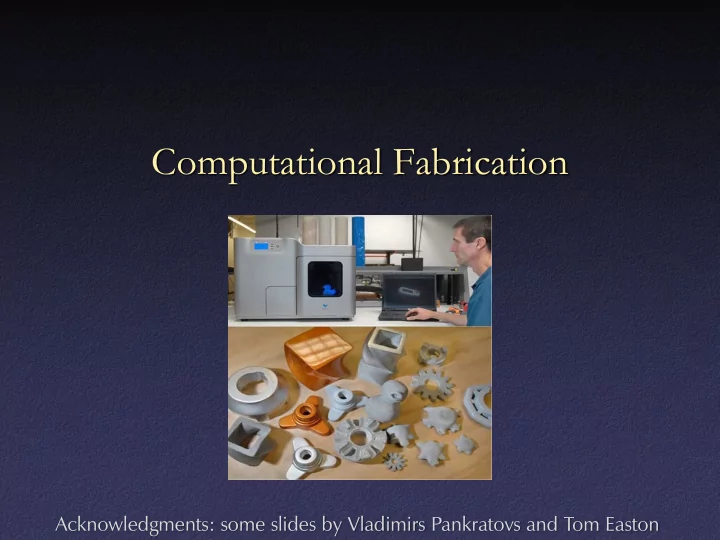
Computational Fabrication Acknowledgments: some slides by Vladimirs - - PowerPoint PPT Presentation

computational fabrication
SMART_READER_LITE
LIVE PREVIEW

Computational Fabrication Acknowledgments: some slides by Vladimirs - - PowerPoint PPT Presentation

Computational Fabrication Acknowledgments: some slides by Vladimirs Pankratovs and Tom Easton Digital Fabrication Technologies Subtractive: computer-controlled milling Materials: metal, wood, plastic, stone Key parameter: # of axes


slide-1
SLIDE 1

Computational Fabrication

Acknowledgments: some slides by Vladimirs Pankratovs and Tom Easton

slide-2
SLIDE 2

Digital Fabrication Technologies

  • Subtractive: computer-controlled milling

– Materials: metal, wood,

plastic, stone

– Key parameter: # of axes

  • 3-axis machines can only

produce height fields

  • 4- through 6-axis machines

available: more flexible

slide-3
SLIDE 3

Digital Fabrication Technologies

  • Additive: “3D printing” of one slice at a time
slide-4
SLIDE 4

3D Printing Pipeline

  • Slice 3D model, build object layer by layer

– Typically a few layers / mm, but >50 for some machines

  • Slow: can take hours

– But it is getting better—rapidly!

slide-5
SLIDE 5

3D Printing Technologies

  • Laminated object manufacturing
  • Fused deposition modeling (FDM)
  • Selective laser sintering (SLS)
  • Stereolithography
slide-6
SLIDE 6

Laminated Object Manufacturing

  • Cut thin layers of

material (plastic, cardboard, etc.) with laser, mill, or knife

  • Assembled by hand
slide-7
SLIDE 7

FDM

  • Extrude a bead of

semi-liquid material (heated plastic, plaster, wax, chocolate, etc.) to form solid layers

slide-8
SLIDE 8

FDM

slide-9
SLIDE 9

SLS

  • Form layer of

small particles: plastic, metal, ceramic or glass powders

  • Fuse (sinter) with

high-power laser

slide-10
SLIDE 10

SLS

slide-11
SLIDE 11

Stereolithography

  • Tank of liquid resin
  • Polymerize (harden)

a layer at a time with UV laser

slide-12
SLIDE 12

Stereolithography

slide-13
SLIDE 13

Variant: Objet Connex

  • Variety of UV-curable materials deposited

by “inkjet” heads

slide-14
SLIDE 14

Variant: Z-Corporation

  • Solid powder with

binder deposited by “inkjet” heads

slide-15
SLIDE 15
slide-16
SLIDE 16
slide-17
SLIDE 17

Limitations

  • Slow
  • Expensive

– Until recently, there were only industrial machines

priced from $20k… High end at $500k+

  • Surface layering visible

– Often higher resolution within a layer than layer

thickness (except for FDM)

slide-18
SLIDE 18

But…

  • Print shops are cropping up

– E.g., Shapeways

  • Specialized products

– Christmas ornaments with your face – Masks – Artwork – Fetuses

  • “The London Ultrasound Centre in the UK offers the

ability to take a 3D scan of your offspring - before birth - and produce a 3D print of the child. Actually, the 3D Print is simply used to create a mold for subsequent bronze casting. There's no official pricing on the Centre's website for this service, but according to the Daily Mail, it costs 1,200 pounds sterling (or around USD$1,800) and takes several weeks to deliver!”

slide-19
SLIDE 19

For the DIY Crowd

  • MakerBot, Bits From Bytes,

Fab@Home

– A few thousand $$

  • RepRap

– Under $1,000 for parts

(and it can print parts for new machines!)

slide-20
SLIDE 20

Where Is It Going?

  • The low-end prices are (in

constant dollars) where the PC was in mid-70s

– So is the relative maturity!

  • Prices will drop,

capabilities will improve

– 3D printers in every home

in 20 years?

slide-21
SLIDE 21

The Design Economy

  • When people can turn a computer file into a

useful solid object, those computer files will become products

  • People with CAD skills, or 3D scanners,

will make them

  • People with printers will buy them
  • Another opportunity for the developing world?
slide-22
SLIDE 22

New Business Models

  • Sell (and customize) 3D models, not widgets
  • Sell raw materials
  • Sell equipment to recycle materials
  • Sell a printer linked to file source (Think Kindle!)
slide-23
SLIDE 23

Emerging Applications: Bioprinting

slide-24
SLIDE 24

Emerging Applications: Food

slide-25
SLIDE 25

Emerging Applications: Architecture

slide-26
SLIDE 26

Towards Computational Fabrication

  • Going beyond simple slicing to enable design

for desired appearance, deformation, structural properties, etc.

  • As with computational photography:

the ability to perform complex computation allows for a greater range of capabilities

slide-27
SLIDE 27

Computational Fabrication Pipeline

3D Model Simulation Optimization Goal Printer Capabilities Fabrication