
SLIDE 1
Compelling Case Studies & Research: PROMPT in Action
GSHA 2019 -- February 15, 2019
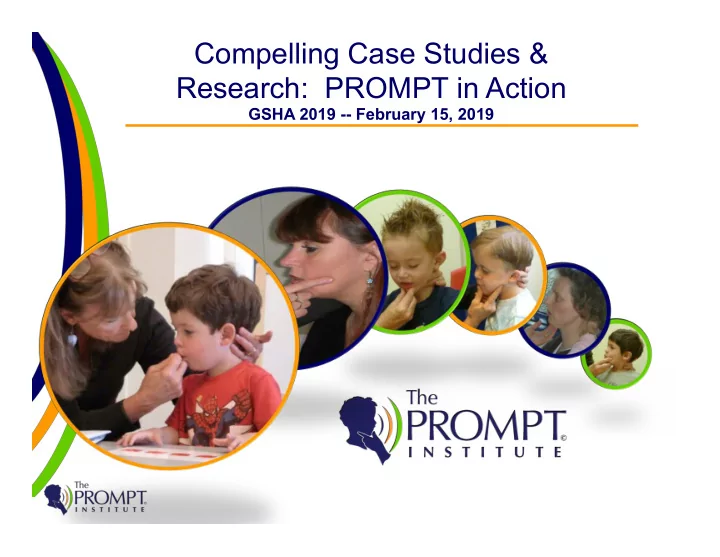
Compelling Case Studies & Research: PROMPT in Action GSHA 2019 - - PowerPoint PPT Presentation
Compelling Case Studies & Research: PROMPT in Action GSHA 2019 -- February 15, 2019 Disclosure Statement I have the following relevant relationship in the services described and reviewed in this presentation: PROMPT Institute Contract
GSHA 2019 -- February 15, 2019
I have the following relevant relationship in the services described and reviewed in this presentation: PROMPT Institute
conducting PROMPT courses and PROMPT Instructor responsibilities.
to the System Analysis Observation (SAO) and Motor Speech Hierarchy (MSH)
Motor Speech Hierarchy (MSH) and Conceptual Framework (CF)
Treatment
5
SANTA FE, NEW MEXICO www.prompt.org
improving verbal communication and interactions for children and adults.
trained by the PROMPT Institute
§ PROMPT Trained
§ PROMPT Certified Clinician § PROMPT Certified Instructor
9
Conceptual Framework Treatment Activities
10
– A tactile-kinesthetic- proprioceptive (touch- movement) based treatment method
12
Physiological (muscular) Neurological (motor)
Refined, stable motor speech control What is the Tactile-Kinesthetic-Proprioceptive input doing to the brain?
What is the Tactile-Kinesthetic-Proprioceptive input doing to the brain?
Clinician acts as external programmer by giving TKP input… to develop/ restructure connections… which then changes the output!
PROMPT the entire word
phonemes
Cite: Namasivayam, A. K., Granata, F., Huynh, A., & Van Lieshout, P.H.H.M. (2018). Randomized Control Trial of PROMPT Intervention for Children With Severe Speech Sound Disorders. Presentation at the American Speech-Language-Hearing Association Convention, Boston, USA (November 15–17).
17
19
20
TONE
Increased/ decreased tone Neurological concerns Postural support
21
PHONATORY CONTROL
Airflow Breath support Phonation/valving
22
MANDIBULAR CONTROL
Jaw stability Jaw grading Up/down movements
23
24
LABIAL-FACIAL CONTROL
Medial 1/3 Lip contact Lip-jaw dissociation Independent lower lip Retracting Rounding
25
26
LINGUAL CONTROL
Anterior Mid Mid-back Posterior
27
28
29
SEQUENCED MOVEMENTS
Vocal timing Smooth, coordinated transitions Optimal functioning of all speech subsystems
30
PROSODY
Integration of breath support, phrasing, stress, rate, loudness
31
32
33
34
35
inter-connected
system, find the point of breakdown(s)
whole system!
subsystems for treatment
36
38
39
40
41
Areas to observe General Assessment Questions Skeletal Structure How does the client’s skeletal structure and muscular development impact movement? Sensation What is the status of the neuromuscular system? How well do the sensory
Neuromuscular Integrity What factors impact global motor and speech motor control?
Areas to observe General Assessment Questions Perception; sensation, discrimination, recognition How does the client process information and interact with the environment to learn? Concept Formation How does the environment need to be structured for learning? What modifications are necessary for the client to learn?
Areas to observe General Assessment Questions Interpersonal Interactions How does the client express their needs and wants? Trust What communicative functions does the client exhibit? How does the client use significant others to aid in the acquisition of knowledge
45
Conceptual Framework
PROMPT Conceptual Framework
Environment
External
Client
Internal
Hayden 02
Cultural Physical Social
intrapersonal interpersonal Physical Sensory
Skeletal Structure Neuromuscular Integrity Sensation
Cognitive Linguistic
Perception sensation discrimination recognition Concept Formation
Social Emotional
Interpersonal Interaction Trust
Sensory- Motor
Communication
Behavioral Outcomes
47
Environment
External
Client
Internal
Hayden 02
Cultural Physical Social
intrapersonal interpersonal Physical Sensory
Skeletal Structure Neuromuscular Integrity Sensation
Cognitive Linguistic
Perception sensation discrimination recognition Concept Formation
Social Emotional
Interpersonal Interaction Trust
Sensory
Communication
Behavioral Outcomes
4 8
Published Papers
Speech Sound Disorders
ü
Developmental Delays Motor Speech Disorders
ü ü
Hearing Impairment Autism Spectrum Disorders
ü
Fluency Disorders Foreign Accent Modification
49
50
Conceptual Framework Treatment Activities
for organizing and executing a treatment plan
Use data from Domains Evaluation Use SAO & MSH to select Motor Speech Priorities Develop Goals & Objectives, Motor-Phoneme Targets, Lexicon, Activities
phoneme links
functional lexicon
functional, interactive routines/activities
52
55
Conceptual Framework Treatment Activities
Online Courses/ Mentoring Technique Practicum
56 Introduction to Technique Certificati
Bridging – Technique to Intervention Online Courses/ Mentoring Technique Practicum
X
Introduction to Technique Certification Project Bridging – Technique to Intervention
57