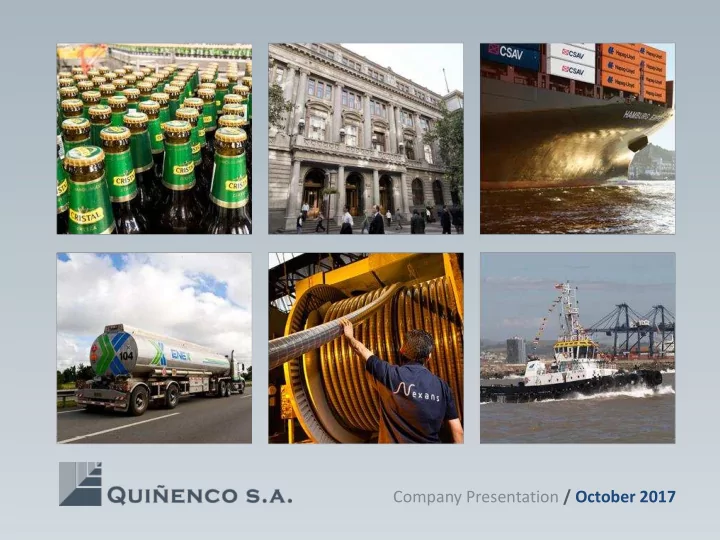
Company Presentation / October 2017 Financial Conclusions Quienco - - PowerPoint PPT Presentation
Company Presentation / October 2017 Financial Conclusions Quienco Overview Recent Events Overview 2 Ownership Structure Minority Shareholders (Chilean Stock Exchanges) 81% 19% Mining Industrial / Financial Services Market
Quiñenco Overview
Recent Events Financial Overview Conclusions
2
Ownership Structure
(1) Market Capitalization as of September 25, 2017.
Mining Industrial / Financial Services 81% 19% Minority Shareholders (Chilean Stock Exchanges)
Market Capitalization US$ 4.8(1) billion
3
- Quiñenco is one of Chile’s
largest business conglomerates with US$71 billion in assets under management
- Companies managed by
Quiñenco generated sales revenue of US$23 billion in 2016
- The Quiñenco group of
companies employs around 65,000 people in Chile and abroad
4
Quiñenco Diversified business conglomerate
5
(1) Market Capitalization as of September 25, 2017. (2) Corresponds to Invexans’ and to Techpack ‘s stake in Nexans as of June 30, 2017. Quiñenco’s stake in Invexans and Techpack was 98.7% and 100% respectively, as of June 30, 2017. Invexans’ market cap as of September 25, 2017, was US$330 million. (3) CSAV had a 22.58% stake in Hapag-Lloyd as of June 30, 2017. (4) Book value as of June 30, 2017.
51.3%
5
% Control as of June 2017
- Leading bank in
Chile in net income and profitability
- Jointly controlled
with Citigroup
- No.1 Chilean beer
producer
- One of the main
beverage producers in Chile
- 2nd largest beer
producer in Argentina
- Jointly controlled
with Heineken
- Global leading
French cable manufacturer, with presence in 40 countries and business activities throughout the world
- Main business is
container shipping, through Hapag-Lloyd, one
- f the main
container shipping companies worldwide
- Leading port,
cargo & shipping services company: port concessions, tug boats, and logistics
- One of the main
port operators in South America
- 4th largest tug
boat company worldwide
- No.2 retail
distributor of fuels in Chile with 470 service stations and 131 convenience stores
- Shell licensee in
Chile
- Presence in
industrial segment Mkt.Cap(1): US$ 15.2 bln Mkt.Cap(1): US$ 4.9 bln Mkt.Cap(1): US$ 2.5 bln Mkt.Cap(1): CSAV: US$ 1.7 bln HL: US$7.6 bln Mkt.Cap(1): US$ 1.1 bln US$ 860 mln(4)
60.0% 29.0%(2) 56.0%(3) 52.2% 100%
Quiñenco: Main Operating Companies
- Francisco Pérez Mackenna
Chief Executive Officer
- Rodrigo Hinzpeter Kirberg
Chief Counsel
- Carolina García de la Huerta Aguirre
Corporate Affairs and Communications Manager
- Luis Fernando Antúnez Bories
Chief Financial Officer
- Pilar Rodríguez Alday
Investor Relations Manager
- Alvaro Sapag Rajevic
Sustainability Manager
- Pedro Marín Loyola
Performance Control Manager and Internal Auditor
- Andrea Tokman Ramos
Chief Economist
- Davor Domitrovic Grubisic
Senior Attorney
- Oscar Henríquez Vignes
General Accountant Andrónico Luksic C. Chairman Jean-Paul Luksic F. Vice Chairman Gonzalo Menéndez D. Director Hernán Büchi B. Director Matko Koljatic M. Director Fernando Cañas B. Director
Board of Directors Senior Management
6
Nicolás Luksic P. Director Andrónico Luksic L. Director
First Class Board and Management
Sociedad Forestal Quiñenco S.A is created. Empresas Lucchetti S.A. and Forestal Colcura S.A. are added to its scope of activities. Hoteles Carrera S.A. is added to Quiñenco. Acquisition of shares of Banco O’Higgins and
- f Banco de Santiago.
Controlling shares of Madeco and of Compañía Cervecerías Unidas are acquired. The OHCH group is established, to later control Banco de Santiago in 1995. Quiñenco established as the financial and industrial parent company of the Group. Quiñenco’s subsidiary VTR sells 100% of mobile phone company, Startel, to CTC, and sells VTR Hipercable. Quiñenco sells stake in OHCH, later acquiring 51.2% of Banco de A. Edwards and 8% of Banco de Chile. Quiñenco buys a 14.3% stake in Entel S.A. Quiñenco becomes the controller of Banco de Chile. Banco Chile and Banco Edwards merge. Quiñenco divests Lucchetti Chile, then buys Calaf through joint venture with CCU. Quiñenco buys 11.4% of Almacenes París, later sold off with profits. Banco de Chile and Citibank Chile merge. Historical transaction between Madeco and French cable producer Nexans. Sale of Entel shares. Quiñenco divests Telsur. Citigroup exercises its options for 17.04% of LQIF, controlling entity of Banco de Chile, reaching 50% share. Quiñenco acquires a 20.6% stake in shipping company CSAV. Madeco signs agreement with Nexans and increases its stake up to 19.86%. Quiñenco acquires Shell’s assets in Chile. Quiñenco carries out capital increase of US$500 million. Quiñenco increases stake in CSAV to 37.44%. SAAM spin-off from CSAV in February. SM SAAM created as parent company of SAAM. Quiñenco’s stake in SM SAAM is also 37.44% Quiñenco reaches 65.9% stake in Madeco. Madeco divided in Invexans and newco Madeco. Enex acquires Terpel for US$240 million. Quiñenco increases stake in CSAV to 46% and in SM SAAM to 42.4%. Quiñenco capital increase of US$700 mln. LQIF carries out a secondary offering selling 6.7 bln shares, reducing stake in Bco Chile to 51%. CSAV and Hapag-Lloyd merge container ship
- businesses. CSAV’s initial 30% stake in HL
increases to 34% after capital increase at HL. SAAM starts joint operations with SMIT Boskalis in tugboats. Invexans and Nexans end agreement. Techpack (ex-Madeco) acquires HYC Packaging and sells Madeco brand to Nexans in US$1 mln.
1957 1960’s 1970’s 1980’s 1990’s 2010
1957 - 2009 2010 - 2014 2015 - 2016
7
Quiñenco launches Tender Offer for 19.55%
- f Invexans, increasing its stake to 98.3%.
Quiñenco increases its stake in CSAV to 55.2% after subscribing capital increase. Techpack acquires 24% of Alusa, reaching 100% ownership. CCU sells Natur and Calaf to Carozzi, and establishes joint operation in powdered juices. SM SAAM adds TISUR port in Peru to its portfolio. Hapag-Lloyd carries out IPO raising US$300 million. CCU increases stake to 100% in Manantial and Nutrabien, and acquires 51% of Sajonia Brewing Company SRL, craft beer producer in Paraguay. Quiñenco increases stake in SM SAAM to 52.2% Techpack sells flexible packaging business to Australian Amcor in net amount of MUS$216 fot Techpack. Hapag-Lloyd and UASC sign BCA. Combined entity to be one of the five largest container shipping companies, with combined annual sales of US$12 billion. SM SAAM signs agreement to purchase 51%
- f two concessions in Puerto Caldera, Costa
Rica. Quiñenco carries out Tender Offer for Techpack, withdrawal and purchase rights are exercised, and reached 100% ownership. Techpack acquires 0.53% stake in Nexans.
2012 2013 2011 2014 2015
Over 50 Years of History
2000’s 2016
1970’s 1980’s 1990’s 2000 2010 2012
- Beverage & Food
- Hotels
- Beverage & Food
- Hotels
- Manufacturing
- Telecom
- Financial Services
- Beverage & Food
- Hotels
- Manufacturing
- Telecom
- Financial Services
- Beverage & Food
- Manufacturing
- Telecom
- Financial Services
- Beverage & Food
- Manufacturing
- Financial Services
- Beverage & Food
- Manufacturing
- Financial Services
- Energy
- Transport
- Port Services
8
Focused Diversification
During its history Quiñenco has tended to invest in sectors where it has a recognized track-record and experience in the industry
Brand & consumer franchise development potential Sufficient critical mass Prior operating or industry experience Access to strategic partners / commercial alliances / synergies Growth platform or add-on acquisition potential Controlling stakes
9
Investment Criteria
Quiñenco partners with world class players to develop its markets and products to take advantage of combined know-how, experience and financial capacity
Financial Manufacturing Beverage & Food
10
Energy Transport Port Services
World Class Strategic & Commercial Alliances
Quiñenco has developed a value creation system through the professional management of its investments . . .
Divest/Retain
- Max. Profitability
Restructuring Acquisition 1 2 3 4
Continuous growth of shareholder value
Hoteles
- Acquisitions of
companies
- Restructuring and
administrative &
- perational
improvements
- Develop and maximize
profitability of business portfolio
- Divestments / Retain
1 2 3 4
11
Value Creation System
. . . which has led to various transactions throughout its history, generating US$1.8 billion in profits over the last 19 years from divestments of US$4.3 billion
12
Note: Figures in millions of US$. Figures translated from constant Chilean pesos at the exchange rate as of June 30, 2017, of Ch$664.29= 1US$
(1) Includes the gain generated by Citigroup’s first option for 8.52% share of LQIF, before taxes. The second option for an additional 8.52% generated an increment in
equity of US$285.8 million, after taxes.
Hotels
936 59
- 10
- 11
38 727 18 1,756
Telecom Retail Real estate/HotelsBeverage & Food Utility Financial Services Manufacturing Total
(1)
Corporate Level Transactions
1,450 1,989 2,028 2,721 3,071 2,142 3,275 5,789 5,137 6,858 6,541 5,351 4,660 5,364 6,359 2003 2004 2005 2006 2007 2008 2009 2010 2011 2012 2013 2014 2015 2016 jun-17
(2)
Over the past 13 years, the net value of Quiñenco’s assets has grown at an average compound annual rate of 11%
Note: Figures in millions of US$ translated from Chilean pesos at the observed exchange rate (published by the Central Bank) on the working day following the close of each period. (1): From 2003-2016 (2): Includes ENEX at book value Source: Bloomberg, Quiñenco and subsidiaries
Market value of Quiñenco’s
- perating
companies Market value of financial investments Book value of other assets Corporate level cash Corporate level debt NAV
+ + +
- =
The Net Asset Value has been calculated as follows:
Quiñenco - NAV
(MUS$)
13 (1)
Strong Growth in NAV
(1) (2) (2) (2) (2) (2)
The company’s investment strategy allows it to maintain a leading position in all of its business areas and product segments
(1): Ranking and Market Share as of December 2016. (2): Excludes subsidiaries abroad. (3): Excludes HOD and powdered juice. (3): Includes mineral, purified and flavored water. (4): Includes beer and cider in Argentina, carbonated soft drinks and mineral water in Uruguay, beer, soft drink, nectars and mineral water in Paraguay. (5): Domestic and export wines from Chile, Export market reported by Asociación de Viñas de Chile. Excludes bulk wine. (6): Corresponds to share in total volume. Enex’s share in number of service stations was 29% at year end. (7): As reported by Hapag-Lloyd, assumes announced mergers (Hapag-Lloyd and UASC; NYK & MOL & K-Line; Maersk and Hamburg Süd), receive regulatory approvals.
Source: Quiñenco and subsidiaries
Business Industry Product Ranking(1) Market Share(1)
Financial Services Loans Deposits 2(2) 1 18% 23% Beverages Chile (non-alcoholic and alcoholic beverages)(3) International segment (beer, cider, soft drinks and mineral water)(4) Wine(5)
- 42%
14% 18% Manufacturing Cables (Worldwide) 2
- Energy
Fuels Service stations 2 2 21%(6) 25%(6) Transport Container shipping (Worldwide) 5(7)
- Port & Shipping Services
Port operator (South America) Tug boats (Worldwide) 4 4
- 14
Leading Market Positions
Becoming one of the most diversified holding companies in Chile
(1) Quiñenco’s investments at book value. (2) Market Value of Quiñenco’s operating companies + Market Value of Financial Investments + Book value of other assets, net of other liabilities + Cash
at the Corporate level - Debt at the Corporate level.
Investments by Sector(1) Net Asset Value(2) (NAV)
15
Financial Services 29% Beverage & Food 8% Manufacturing 13% Energy 15% Transport 18% Port Services 8% Other 1% Cash 8%
(US$ 5.5 billion as of June 30, 2017)
Financial Services 41% Beverage & Food 19% Manufacturing 7% Energy 11% Transport 9% Port Services 6% Other 1% Cash 6%
(US$ 6.4 billion as of June 30, 2017) (Percentages calculated over gross assets)
Diversified Investments
NAV/Share Price Trend
as of June 30, 2017
16
2,448 2,509 2,363 2,339 2,064 1,981 1,999 2,017 1,953 2,043 1,974 2,077 1,990 2,025 2,031 2,004 2,160 2.416 2.540 1,540 1,610 1,399 1,275 1,325 1,190 1,145 1,295 1,300 1,280 1,335 1,400 1,250 1,230 1,285 1,459 1,575 1.733 1.840 500 1.000 1.500 2.000 2.500 3.000 NAV per share (Ch$) Share price (Ch$)
NAV : US$6.4 bln
NAV, Share Price & Dividends
3.9% 3.4% 5.8% 1.5% 1.7% 2013 2014 2015 2016 2017
Dividends Paid
(MCh$)
50% 60% 35% 40% 30%
69,821 74,904 119,731 38,648 53,071 2013 2014 2015 2016 2017
Dividend Yield
Percentage of prior year net income paid
- ut as dividends.
(1) Market information and book values as of June 30, 2017.
Mkt Cap: US$4.6 bln
(1) (1)
Financial Overview
Quiñenco Overview Recent Events Conclusions
17
Quiñenco has achieved diversified revenues with a positive growth trend . . .
Aggregate Revenues by Sector(2)
(YTD June 2017)
18
(1) Consolidated revenues under IFRS = Total Revenues (Industrial Sector) + Total Net Operating Income (Banking Sector) (2) Considers the sum of the sales of the main operating companies Quiñenco participates in. Of these, Quiñenco does not consolidate with CCU (Beverage & Food), Nexans
(Manufacturing) nor Hapag-Lloyd (Transport). Note: Figures translated at the exchange rate as of June 30, 2017: Ch$664.29 = 1US$
Consolidated Revenues(1)
(MUS$) 4,876 5,881 4,910 5,397 2,659 2,849 2013 2014 2015 2016 jun-16 jun-17
Financial Services 10% Beverage & Food 9% Manufacturing 29% Energy 11% Transport 39% Port Services 2%
Growing and Diversified Revenues
. . . and sound bottom line results
Net Income(2)
19
(1) Net Income: Net income attributable to owners of the controller. (2) Corresponds to the contribution of each segment to Quiñenco’s net income. (3) The Segment Other includes the contribution from CCU (US$50 million) and Quiñenco and others (-US$11 million) in 2016, and from CCU (US$23 million), and Quiñenco and
- thers (-US$15 million) in June 30, 2017.
Note: Figures translated at the exchange rate as of June 30, 2017: Ch$664.29.
Net Income(1)
(MUS$)
188 515 145 266 103 50
2013 2014 2015 2016 jun-16 jun-17 (YTD December 2016, MUS$) 18 168 30
- 15
266
39
Manufacturing Financial Services Energy Transport Port Services Other (3) Total
26
CCU
Sound Results
(YTD June 2017, MUS$) 24 93 17
- 114
50 8
Manufacturing Financial Services Energy Transport Port Services Other (3) Total
22
CCU
Long term investments are financed with equity and long term debt in Chilean pesos . . .
Assets
Liabilities and Equity
20
US$ 5.6 billion as of June 2017 US$ 5.6 billion as of June 2017
LT Assets 92% Cash 8% Other 0% SH Equity 82% LT Debt 17% ST Debt 1% Note: Figures translated from nominal Chilean pesos at the exchange rate as of June 30, 2017, of Ch$664.29 = 1US$
Quiñenco Holding: Conservative Financial Structure
. . . maintaining low levels of debt through asset disposals and strong dividend flow . . .
Net Debt
MUS$
21
MUS$ 2013 2014 2015 2016 Jun-2017 Debt 810 873 822 1,196 1,175 Cash
- 753
- 472
- 191
- 461
- 440
Net Debt 57 401 631 735 736
Note: Figures translated from nominal Chilean pesos at the exchange rate as of June 30, 2017, of Ch$664.29 = 1US$. Figures correspond to debt and cash at the corporate level, plus 50% of the debt and cash of both LQIF Holding and IRSA. 57 401 631 735 736 2013 2014 2015 2016 jun-17
Low Financial Corporate Debt
. . . to the parent company based on good operating company performance
Dividends
Composition of Dividends
(MUS$) (YTD June 2017)
22
2013 2014 2015 2016 jun-17 SM SAAM Banchile Vida CSAV Invexans IRSA/CCU LQIF (additional) LQIF/Banco de Chile IRSA/CCU 19% Banchile Vida 11% LQIF/Banco de Chile 54% SM SAAM 16% Note: Figures translated from nominal Chilean pesos at the exchange rate as of June 30, 2017, of Ch$664.29 = 1US$. LQIF additional dividend in 2014: paid by LQIF after the sale of 6.7 billion Banco de Chile shares in January 2014. 75 124 454 120 99
Stable Dividend Cashflow
Dominant position in its markets Proven track record in value creation Sound financial position Controlling interest in its investments Diversified Chile Risk Prestigious Controlling Shareholders Quiñenco’s companies are leaders in their respective markets. Holding has proven track record in value creation as evidenced by sale
- f investments for approximately US$4.3 bln and gains on sale of US$1.8
bln over the last 19 years. Current level of debt and a sound cash position allow business
- pportunities to be undertaken.
Quiñenco currently holds a controlling interest in the majority of its investments. Quiñenco’s investments are diversified in six key sectors of the Chilean economy. Quiñenco has locally and internationally well-known and prestigious shareholders (the Luksic Family).
23
Quiñenco – Strong Fundamentals
Recent Events
Quiñenco Overview Financial Overview Conclusions
24
Techpack – Quiñenco completes Tender Offer
25
- May 24 2017: merger between Hapag-Lloyd and UASC
materialized, following regulatory approvals and consent from financial entities, among other required conditions. BCA was signed in July 2016.
- Hapag-Lloyd became the fifth largest container shipping
company worldwide, with one of the most modern and efficient fleets.
- Significant value creation through expected annual
synergies of approximately US$435 million by 2019 and reduced investment needs over coming years.
- US$400 million capital increase within six months after
closing, approved by AGM on May 29, 2017.
Hapag-Lloyd and United Arab Shipping Company (UASC) merger
Combined entity:
- Total transport capacity: 1.6 million TEU
- Total annual volumes transported: 10 million TEU
- Total fleet: 230 container ships
- average size 7,110 TEU
- average age 7.1 years
Techpack – Quiñenco completes Tender Offer
26
CSAV
- Dilution in Hapag-Lloyd from merger generated an
accounting loss of US$167 million, reported in CSAV’s Financial Statements as of June 2017.
Hapag-Lloyd and United Arab Shipping Company (UASC) merger
- New ownership structure prior to capital increase:
Shareholders of UASC received new shares equivalent to 28% stake, of which Qatar Holding LLC received 14.4%, Public Investment Fund (Saudi Arabia) received 10.1%, and other minority shareholders of UASC the remaining 3.5%.
- CSAV’s stake declined from 31.4% to 22.6%.
- CSAV has announced that it will participate in Hapag-
Lloyd’s capital increase, so as to reach a share of 25%.
- In turn, CSAV is to carry out a capital increase of
approximately US$300 million.
CSAV 22.6% City of Hamburg 14.9% Kühne Maritime 17.6% QH (Qatar) 14.4% PIF (Saudi Arabia) 10.1% Other minority 20.4%
27
Puerto Caldera, Costa Rica
- September 27, 2016: SAAM signed agreement to
acquire control (51%) of two concessions at Puerto Caldera (subject to approval from Costa Rica’s regulatory authorities), the second largest port of Costa Rica, for a total amount of US$48.5 mln.
- February 8, 2017: transaction materialized after
approval from local regulatory authorities was granted.
- Puerto Caldera is a multipurpose terminal,
strategically located at 79.5 km from San José.
SM SAAM adds port in Costa Rica, sells stake in Tramarsa (Peru), and increases stake in ITI
Tramarsa, Peru
- April 21, 2017: SM SAAM reports the sale of its 35% stake in Tramarsa to the Romero group in Peru. Tramarsa has
- perations in ports, tug boats and logistics primarily in Peru.
- Transaction involved a total amount of US$124 million.
- SM SAAM reported that the transaction generated a non recurring after tax gain of US$30.5 million during the 2Q
2017. Iquique, Chile
- June 9, 2017: SM SAAM acquired an additional 15% stake in Iquique Terminal Internacional
for approximately US$11 million, thus reaching 100% ownership.
CCU signs agreement with Anheuser-Busch InBev on Budweiser Argentina
28
AB InBev - Budweiser
- September 6, 2017: CCU announced agreement signed with AB InBev
regarding anticipated termination of distribution license for Budweiser in
- Argentina. The transaction is subject to approval from antitrust authority
in Argentina.
- CCU Argentina to receive US$400 million, corresponding to:
- US$306 million single payment.
- US$28 million annually for three year commercial transition
period.
- US$10 million for manufacturing contract.
- AB InBev also to transfer to CCU Argentina the brands Isenbeck, Diosa,
Norte, Iguana and Báltica, among others, which in all represent a volume similar to that of Budweiser in Argentina. CCU established alliance for Pisco and sells remaining snack business
- During June 2017 CCU announced the acquisition of a 40% stake in Americas Distilling Investments LLC, which owns
the brand Barsol and productive assets in Peru. The remaining 60% is held by LDLM Investments LLC, which ahs over a decade of experience commercializing pisco in the international markets.
- During September 2017 CCU announced an agreement with Ideal, subsidiary of the Bimbo Group, to sell the sweet
snack company Nutra Bien, a fully owned subsidiary of Foods (affiliate of CCU).
Conclusions
Quiñenco Overview Recent Events Financial Overview
29
Outlook
Portfolio Optimization Healthy Financial Structure Strong Cash Position
- Good
performance of main operating companies should contribute to sustained dividend up-flow.
- Sound financial
indicators
- Well structured
Balance Sheet
- AA/AA local rating
- Strong cash levels
- Conservative
financing policy
Factors that contribute to Quiñenco’s ability to pursue and undertake new investment opportunities
30
Appendix: Main Operating Companies
32
Banco de Chile
Ownership Structure Net Income(1) Contribution by Business Area
(YTD December 2016)
- Established in 1893, Banco de Chile has a highly
recognized name in Chile.
- One of the most profitable banks in terms of
return on assets and equity.
- Assets of US$47 billion.
- Over 14,600 employees
- Nationwide network of 423 branches, 2,374 Caja
Chile and 1,453 ATMs.
- Traded on the NYSE and Santiago Stock
Exchanges.
- Strategic alliance with Citigroup complements the
Bank’s financial services of excellence for its customers and gives access to one of the most important financial platforms in the world.
- The Bank maintains a diversified and efficient
financing structure, granting it a competitive advantage in terms of funding.
- One of the most solid private banks in Latin
America with an international credit rating of A from S&P and Aa3 from Moody’s.
51.2% (Voting Rights) 33.6% (Economic Rights) 50.0% 50.0%
33
Subsidiaries 5% Wholesale Banking 41% Retail Banking 48% Treasury 6%
(June 2017)
(1) Before taxes
Banco de Chile
Operating Revenues
(MUS$)
Net Income
(MUS$)
ROAE
- In 2016 the Bank’s net income was slightly below the
previous year. Despite low inflation and lower than expected economic growth, operating revenues increased by 5.4%, boosted by both customer related and non-customer income. Loan loss provisions increased mostly due to loan growth and countercyclical provisions. Operating expenses rose due to higher personnel and administrative expenses. Tax expense were up by 44%.
- Net income in 2016 was MUS$831, 1.2% below 2015, the
highest in the Chilean financial system.
- YTD June 2017, Banco de Chile reported positive results,
based on lower loan loss provisions and lower operating expenses, offsetting slightly lower operating revenues.
34
Note: Figures translated from nominal Chilean pesos at the exchange rate as of June 30, 2017, of Ch$664.29 = 1US$ 2,192 2,478 2,478 2,612 1,334 1,311 2013 2014 2015 2016 jun-16 jun-17 773 890 841 831 427 451 2013 2014 2015 2016 jun-16 jun-17
23,5% 24,4% 21,4% 19,6% 20,4%
2013 2014 2015 2016 jun-17
Source: Banco de Chile
CCU
Ownership Structure Weighted Volume Market Share
- Founded in 1850, CCU is a multi-category branded
beverage company operating in Chile, Argentina, Bolivia, Colombia, Paraguay and Uruguay with an extensive wine export business to more than 80 countries.
- Assets of US$2.8 billion.
- Over 8,100 employees.
- 33 beverage facilities.
- Extensive distribution network reaching over
127,000 sales points for the Chile operating segment and more than 159,000 in Argentina.
- Jointly controlled with Heineken, one of the main
breweries worldwide.
- Traded on the NYSE and Santiago Stock Exchanges.
- In January 2015, CCU launched the “ExCCelencia CCU”
program, with the aim to achieve efficiencies in various areas.
- In 2015 CCU’s Quilicura beer plant became the only
plant in Latin America to receive certification from Heineken (Laboratory Star System), and the first Heineken grants to a beer licensee worldwide.
- Natur and Calaf brands sold to Carozzi, and joint-
venture established for instant powdered drinks.
- In 2016 CCU increased its stake in HOD water business
to 100%, started commercialization of Watt’s brand juices in Uruguay, and acquired craft beer brands in Paraguay.
50.0% 50.0%
- Inv. y Rentas
60.0% 2016 Chile Operating segment 42.3% (1) International segment 14.0% (2) Wine Operating segment 18.0% (3) Total 28.1% (4)
35
(June 2017)
(1) Excludes HOD and powdered juice. (2) Includes beer and cider in Argentina, carbonated soft drinks and mineral water in Uruguay, beer, soft drink, nectars and mineral water in Paraguay. (3) Domestic and export wines from Chile. Export market reported by Asociación de Viñas de Chile. Excludes bulk wine (4) Weighted average of the markets where CCU participates, based on category market share and weighted by CCU’s estimations of market sizes (February 2017).
(December 2016)
CCU
Sales
(MUS$)
EBITDA* by Business Segment
- Sales grew 4% in 2016 to MUS$2,347, reflecting growth
in the Chile and Wine segments, compensating lower sales in the International Business segment.
- EBITDA reached MUS$428 in 2016, down a slight 0.8%
from 2015, mostly due to the impact of the devaluation
- f the Argentine peso on USD denominated costs.
- Net income in 2016 reached MUS$178, down by 1.9%,
mainly due to the decline in operating income, in a highly competitive environment with low economic growth in its markets.
- YTD June 2017 results increased by 8.2%, reflecting
positive operating results of the International Business and Chile segments, compensating lower results at the Wine segment.
EBITDA
(MUS$)
Net Income
(MUS$)
36
Chile 78% International Segment 11% Wine 11% Note: Figures translated from nominal Chilean pesos at the exchange rate as of June 30, 2017, of Ch$664.29 = 1US$
(YTD June 2017)
1,802 1,954 2,256 2,347 1,087 1,195 2013 2014 2015 2016 jun-16 jun-17 380 374 431 428 192 218 2013 2014 2015 2016 jun-16 jun-17 185 180 182 178 77 83 2013 2014 2015 2016 jun-16 jun-17
* Excludes Other.
Invexans
37
- Invexans’ main asset is its 28.50 % stake in
Nexans, a leading cable manufacturer with worldwide presence, based in France.
- An agreement signed in September 2008 allowed
Invexans (Madeco at the time) to become the main shareholder of Nexans, after the sale of Invexans’ regional cable business to said French company, in exchange for cash and a 9% share in Nexans.
- Invexans now has three directors on the Board, a
member of the Compensations and Designations Committee, a member of the Strategic Committee, and a member of the Accounting and Audit Committee.
- In January 2015 Quiñenco launched a tender offer
at Ch$10 per share, reaching in February of the same year a stake of 98.3% in Invexans.
Ownership Structure
(June 2017)
INVEXANS
98.7%
Assets by Business Area
(June 2017)
37
Nexans 93% Other 7%
Nexans
June 2017 Sales by Key-end Markets
- Nexans is a worldwide leader in the cable
industry with presence in 40 countries and commercial activities worldwide, after over a century of progress.
- Headquartered in Paris, France, Nexans produces
cables and cabling systems, constantly innovating its products, solutions and services.
- 26,300 employees
- Nexans is listed on Euronext Paris.
Transmission, Distribution & Operators 37% Industry 22% Distributors & Installers 28% Others 13% 38
EUR (millions) 2013 2014 2015 2016 Jun-16 Jun-17 Sales 6,711 6,403 6,239 5,814 2,951 3,206 Operating margin 171 148 195 242 135 140 Net income (333) (168) (194) 61 30 91
- 93
- 74
- 64
13 7 29
2013 2014 2015 2016 jun-16 jun-17
- 106
- 46
- 56
15 8 28
2013 2014 2015 2016 jun-16 jun-17
Invexans
39
Operating Income Non-operating Income Net Income (Loss)
Note: Invexans reports in US$
- In 2016 Invexans’ net income mainly reflects its
proportional share in Nexans’ net gain for the year, turning around the prior year’s losses, reflecting the favorable impact of the strategic initiatives implemented. At Invexans, results also improved with the favorable management of legal contingencies and the sale of real estate.
- YTD June 2017 mainly includes Invexans’ share in
Nexans’ results for the first half of 2017, which increased substantially based on sound operating performance and a favorable core exposure effect.
(MUS$) (MUS$) (MUS$) 16
- 29
- 8
- 1
- 1
1
2013 2014 2015 2016 jun-16 jun-17
- Until May 2016, Techpack was a regional leader in
flexible packaging, with presence in Chile, Argentina, Peru and Colombia, over 2,300 employees, and an installed capacity of 85,000 tons/year.
- During 2013 and 2014, Techpack discontinued its
brass mills and profiles operations, concentrating its activities in flexible packaging.
- In March 2015, Techpack acquired Alusa’s shares
held by third parties, reaching 100% of its property .
- On May 31, 2016, Techpack sold its flexible
packaging business to Australian leader in packaging, Amcor, for a net amount of US$216 million.
- During November 2016, Techpack acquired
229,860 shares of Nexans, equivalent to a 0.53% stake.
Ownership Structure
(June 2017)
TECHPACK
100.0%
Techpack
41
41
Sales Operating Income Net Income
Note: Techpack reports in US$
- Techpack’s net income in 2016 was a gain of
MUS$6, mainly reflecting the gain on the sale of the flexible packaging business, which amounted to an after tax gain of US$21 million.
- During the first half of 2017 Techpack posted a net
loss of MUS$5, primarily reflecting the negative price adjustment of MUS$2 agreed with Amcor during March 2017, along with other taxes and expenses related to the transaction.
(MUS$) (MUS$) (MUS$)
351 372
2013 2014 2015 2016 jun-16 jun-17
2
- 28
2 6 10
- 5
2013 2014 2015 2016 jun-16 jun-17
78 20
- 5
- 7
- 4
- 1
2013 2014 2015 2016 jun-16 jun-17
Techpack
Enex
Service Stations
(December 2016)
Market Share of Liquid Fuel Sales
- Enex S.A. has a network of 470 service stations,
with 131 convenience stores.
- Main business activities:
- Distribution of fuels through its service
stations.
- Distribution of fuels to industrial clients and
transport sector.
- Distribution of Shell lubricants.
- Holds a 14.9% share of Sociedad Nacional de
Oleoductos (Sonacol) and a 33.3% share of Sociedad de Inversiones de Aviación (SIAV).
- 3,000 employees.
Source: Quiñenco
(December 2016)
Ownership Structure
100%
Source: Enex Source: Enex
- No. Service Stations
% Copec 633 39% Enex 470 29% Petrobras 286 17% Others 238 15% Total 1,627 100%
42 Copec 58% Enex 21% Petrobras 13% Others 8%
(June 2017)
Enex
Net Income
(MUS$)
Sales
(MUS$)
Operating Income
(MUS$)
43
- In 2016 sales reached MUS$2,546, down 0.4%, mainly
due to lower fuel prices, which offset 12.2% growth in sales volumes. Gross income, however, was up 17% boosted by higher sales volumes through service stations and the industrial channel.
- Operating income increased 10% to MUS$41 in 2016, due
to the rise in gross income, offset by higher operating expenses related to the service stations and convenience stores.
- Net income in 2016 amounted to MUS$30, up by 2.3%
from 2015, primarily due to positive operating performance.
- YTD June 2017 Enex reported a 19% decrease in net
income, mainly due to lower operating results in the industrial channel.
2,646 3,277 2,556 2,546 1,218 1,359
2013 2014 2015 2016 jun-16 jun-17
29 52 30 30 21 17
2013 2014 2015 2016 jun-16 jun-17 Note: Figures translated from nominal Chilean pesos at the exchange rate as of June 30, 2017, of Ch$664.29 = 1US$
38 50 37 41 31 22
2013 2014 2015 2016 jun-16 jun-17
CSAV
Ownership Structure
(June 2017)
- CSAV, founded in 1872, is one of the oldest shipping
companies in the world.
- Its activities include overseas transport of
containerized cargo through its investment in Hapag- Lloyd, car carrier, and logistics/freight forwarder.
- Total assets as of December 2016 of US$2.2 billon.
- In December 2014 CSAV merged its container ship
business with the German shipping company Hapag- Lloyd (HL), becoming shareholder of the merged entity with a 30% stake. After the merger, HL became the fourth largest container ship liner worldwide.
- At year-end 2014 CSAV raised US$398 million in a
capital increase.
- CSAV subscribed €259 million in Hapag-Lloyd’s capital
increase of €370 million, thus reaching a 34% stake.
- In November 2015 Hapag-Lloyd carried out its IPO,
raising US$300 million. CSAV subscribed US$30 million, reducing its stake to 31.35%.
- CSAV sold its liquid bulk operation in October 2016.
- BCA signed between Hapag-Lloyd and UASC in July
2016, subject to regulatory approvals.
- In May 2017, the merger between HL and UASC was
- materialized. HL became the fifth largest container
ship liner worldwide.
Source: Quiñenco
44.0% 56.0%
Source: CSAV
44
Others
(June 2017)
Assets by Business Area
Hapag-Lloyd 81% Other 19%
CSAV
EBITDA
(MUS$)
Net Income/Loss
(MUS$)
Sales
- In 2016 CSAV’s sales reached MUS$127, 24% below 2015, mostly
due to the closure of the reefer business and lower freight rates in the car carrier business.
- In 2016 CSAV reported a net loss of MUS$23, mostly reflecting its
share in Hapag-Lloyd’s net loss of MUS$107, adjusted by fair value accounting. HL’s results reflect the strong fall in average rates, partially compensated by the positive effect of synergies and cost savings.
- YTD CSAV posted a net loss of MUS$201, impacted by the
accounting loss of MUS$167 generated by its dilution in Hapag- Lloyd following the merger with UASC. Hapag-Lloyd in turn posted improved operating results, based on higher volumes, synergies and cost savings, although bottom line results were affected by non-recurring items related to the merger. CSAV’s car carrier business also reported improved operating performance.
(MUS$)
45
Note: CSAV reports in US$; EBITDA as reported by CSAV 127 3,206 235 167 58 59 2013 2014 2015 2016 jun-16 jun-17
- 174
757
- 8
7 5 2 2013 2014 2015 2016 jun-16 jun-17
- 169
389
- 15
- 23
- 60
- 201
2013 2014 2015 2016 jun-16 jun-17
Hapag-Lloyd
Sales Mix
(December 2014)
- Hapag-Lloyd is a leading global liner shipping
company, with a fleet of 166 modern ships, 7.6 million TEU transported a year and a total capacity
- f around 1 million TEU. (Prior to merger with
UASC)
- Founded in 1847 and headquartered in Hamburg,
Germany, Hapag-Lloyd offers a global network of 120 liner services.
- 9,400 employees.
Source: CSAV
Container Shipping Services 91% Other Shipping Services 9% 46
US$ (millions) 2013 2014 2015 2016 Jun-16 Jun-17 Sales 8,724 9,046 9,814 8,546 4,212 4,900 Operating result 11 (550) 344 115 (58) 76 Net income (131) (804) 124 (107) (160) (51)
SM SAAM
Ownership Structure EBITDA Mix1
(YTD June 2017)
- SM SAAM is dedicated to port services and
management of port concessions, including three main business areas: port terminals, tug boats, and logistics.
- SM SAAM has presence in 13 countries and over
70 ports in America.
- SM SAAM currently operates 11 port terminals
and a fleet of 161 tug boats, being one of the main port operators in South America and the 4th largest tug boat operator in the world.
- SM SAAM subscribed an association with the Dutch
company Boskalis to jointly operate and develop the tug boat business in Mexico, Brazil, Canada and
- Panama. The association started operations in July
2014, capturing over MUS$15 in synergies during its first year of operations.
- In 2017, Puerto Caldera in Costa Rica was added to
SM SAAM’s portfolio, SM SAAM sold its stake in Tramarsa, with activities in port terminals, tug boats and logistics in Peru, and increased its stake in Iquique Terminal Internacional to 100%, after acquiring an additional 15%.
Source: Quiñenco
47.8% 52.2%
47
Others
1 EBITDA includes proportional values of affiliates
100.0%
Tug boats 44% Port terminals 51% Logistics 5%
(June 2017)
SM SAAM
48
Net Income
(MUS$)
Sales
(MUS$)
Operating Income
(MUS$)
Note: SM SAAM reports in US$
- In 2016, SM SAAM’s consolidated sales reached
MUS$394, down by 8%, mainly due to lower sales of logistics, due to lower activity in Chile, and the closure of certain operations in Chile and of Brazil, and also of port terminals and tug boats.
- SM SAAM obtained net income of MUS$55 in 2016, 21%
lower than 2015, mainly due to a non recurring gain of US$32 million reported in 2015, related to the restructuring of Tramarsa (Peru).
- YTD June 2017, SM SAAM’s net income rose 50%, mainly
due to a non-recurring gain on the sale of its minority stake in Tramarsa (Peru) during the second quarter.
479 492 426 394 195 222 2013 2014 2015 2016 jun-16 jun-17 66 53 60 40 21 92 2013 2014 2015 2016 jun-16 jun-17 74 61 69 55 29 44 2013 2014 2015 2016 jun-16 jun-17