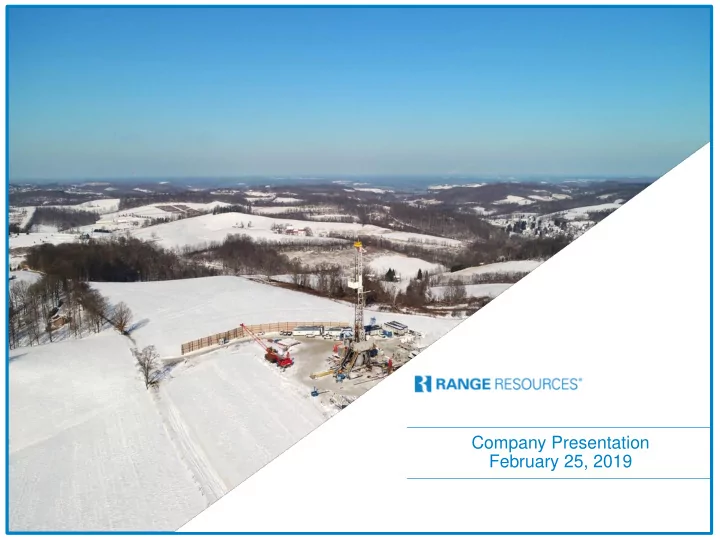
Company Presentation January 2018 Company Presentation February 25, - - PowerPoint PPT Presentation

company presentation january 2018
SMART_READER_LITE
LIVE PREVIEW

Company Presentation January 2018 Company Presentation February 25, - - PowerPoint PPT Presentation

Company Presentation January 2018 Company Presentation January 2018 Company Presentation February 25, 2019 Forward Looking Statements All statements, except for statements of historical fact, made in this presentation regarding activities,


slide-1
SLIDE 1

Company Presentation January 2018 Company Presentation January 2018 Company Presentation February 25, 2019

slide-2
SLIDE 2

Forward Looking Statements

2

All statements, except for statements of historical fact, made in this presentation regarding activities, events or developments the Company expects, believes or anticipates will or may occur in the future are forward-looking statements within the meaning of Section 27A of the Securities Act of 1933, as amended, and Section 21E of the Securities Exchange Act of 1934, as amended. These statements are based on assumptions and estimates that management believes are reasonable based on currently available information; however, management's assumptions and Range's future performance are subject to a wide range of business risks and uncertainties and there is no assurance that these goals and projections can or will be met. Any number of factors could cause actual results to differ materially from those in the forward-looking statements. Further information on risks and uncertainties is available in Range's filings with the Securities and Exchange Commission (SEC), including its most recent Annual Report on Form 10-

  • K. Unless required by law, Range undertakes no obligation to publicly update or revise any forward-looking statements to reflect circumstances or events after the date they

are made. The SEC permits oil and gas companies, in filings made with the SEC, to disclose proved reserves, which are estimates that geological and engineering data demonstrate with reasonable certainty to be recoverable in future years from known reservoirs under existing economic and operating conditions as well as the option to disclose probable and possible reserves. Range has elected not to disclose its probable and possible reserves in its filings with the SEC. Range uses certain broader terms such as "resource potential,” “unrisked resource potential,” "unproved resource potential" or "upside" or other descriptions of volumes of resources potentially recoverable through additional drilling or recovery techniques that may include probable and possible reserves as defined by the SEC's guidelines. Range has not attempted to distinguish probable and possible reserves from these broader classifications. The SEC’s rules prohibit us from including in filings with the SEC these broader classifications of reserves. These estimates are by their nature more speculative than estimates of proved, probable and possible reserves and accordingly are subject to substantially greater risk of actually being realized. Unproved resource potential refers to Range's internal estimates of hydrocarbon quantities that may be potentially discovered through exploratory drilling or recovered with additional drilling or recovery techniques and have not been reviewed by independent engineers. Unproved resource potential does not constitute reserves within the meaning of the Society of Petroleum Engineer's Petroleum Resource Management System and does not include proved reserves. Area wide unproven resource potential has not been fully risked by Range's management. “EUR”, or estimated ultimate recovery, refers to our management’s estimates of hydrocarbon quantities that may be recovered from a well completed as a producer in the area. These quantities may not necessarily constitute or represent reserves within the meaning of the Society of Petroleum Engineer’s Petroleum Resource Management System or the SEC’s oil and natural gas disclosure rules. Actual quantities that may be recovered from Range's interests could differ substantially. Factors affecting ultimate recovery include the scope of Range's drilling program, which will be directly affected by the availability of capital, drilling and production costs, commodity prices, availability of drilling services and equipment, drilling results, lease expirations, transportation constraints, regulatory approvals, field spacing rules, recoveries of gas in place, length of horizontal laterals, actual drilling results, including geological and mechanical factors affecting recovery rates and other factors. Estimates of resource potential may change significantly as development of our resource plays provides additional data. In addition, our production forecasts and expectations for future periods are dependent upon many assumptions, including estimates of production decline rates from existing wells and the undertaking and outcome of future drilling activity, which may be affected by significant commodity price declines or drilling cost increases. Investors are urged to consider closely the disclosure in our most recent Annual Report on Form 10-K, available from our website at www.rangeresources.com or by written request to 100 Throckmorton Street, Suite 1200, Fort Worth, Texas 76102. You can also obtain this Form 10-K on the SEC’s website at www.sec.gov or by calling the SEC at 1-800-SEC- 0330.

slide-3
SLIDE 3

Range Overview

3

Market Snapshot

(a) As of 2/22/2019 (b) As of 12/31/2018 (c) Assumes strip pricing. For reference, the 10-year average was $2.83/mmbtu NYMEX natural gas and $51.54/bbl WTI (d) Includes acreage purchase option

2019 Capital Program of $756 million ▪ >$100 million in free cash flow with ~6% corporate growth ▪ Approximately 90% allocated to Marcellus 2018 Year-End Proved Reserves of 18.1 Tcfe ▪ Future Development cost of ~$0.40 per mcfe ▪ Marcellus comprises 94% of proved reserves

Acreage Position

NYSE Symbol: RRC Market Cap (a): $2.6B Net Debt (b): $3.8B Enterprise Value: $6.5B Proved Reserves PV-10 at YE18 Strip (c): $9.9B Proved Developed PV-10 at YE18 Strip (c): $6.6B

Recent Highlights

▪ Appalachia ▪ SW Marcellus = ~500,000 net acres ▪ NE Marcellus = ~95,000 net acres ▪ Dry Utica = ~400,000 net acres ▪ Upper Devonian = ~500,000 net acres ▪ North Louisiana ▪ ~140,000 net acres(d)

slide-4
SLIDE 4

4

Sustainable Free Cash Flow Driven by High-Return Assets

▪ Disciplined spending supported by low base decline and maintenance capital ▪ Consistent emphasis on debt-adjusted per share metrics in management incentives ▪ Target free cash flow yield competitive with industry and broader market

Improving Corporate Returns

▪ Corporate returns expected to improve through expanding margins and improving capital efficiencies ▪ Cost structure improvements led by lower gathering and transportation expense per mcfe from utilizing existing infrastructure, and lower interest expense

Balance Sheet Strength

▪ Absolute debt reduction through organic free cash flow ▪ Target Investment Grade leverage profile of net debt/EBITDAX below 2.0x ▪ Continued focus on asset sales to accelerate de-levering process

Be Good Stewards of the Environment and Operate Safely Positions Range to Return Capital to Shareholders

Strategic Focus

slide-5
SLIDE 5

Large Core Marcellus Inventory

5

Large contiguous acreage position allows for long-lateral development ~3,700 undrilled Core Marcellus wells (a)

~285 wells with 40+ Bcfe EUR ~385 wells with 30-40 Bcfe EUR ~1,370 wells with 20-30 Bcfe EUR ~1,370 wells with 15-20 Bcfe EUR(b) Based on 10,000 foot average lateral lengths

Marcellus resource potential (b)

~ 40 Tcf of natural gas ~ 3 billion barrels of NGLs ~ 149 million barrels of condensate

Significant inventory of highly prolific Deep Utica wells not included above ~Half million acres of low-risk Upper Devonian provides additional wet/dry

  • ptionality in the future, but is not included

above

(a) Estimates as of YE2018; based on production history from ~1,000 wells. Includes ~300 locations not shown on map. Majority of inventory of 1.5 – 2.0 Bcfe/1000’ wells are downspaced locations (not in the 5-year development plan) that incorporate expected recoveries of ~75% of 1,000’ spaced wells. (b) Does not include 18.1 Tcfe of YE2018 proved reserves.

Range acreage

  • utlined in green
slide-6
SLIDE 6

Proved Developed Proved Undeveloped Resource Potential

High Quality Resource Base

6

Included in Reserves

▪ Proved Developed reserves of 9.8 Tcfe with PV-10 of $6.6 billion at YE18 strip ▪ Proved Undeveloped reserves of 8.3 Tcfe with PV-10 of $3.3 billion at YE18 strip ▪ Approximately 400 Marcellus locations

Resource Potential Not in Reserves:

▪ Resource Potential of ~100 Tcfe ▪ Any development in years six and beyond ▪ Approximately 3,300 undrilled core Marcellus wells, or over 35 years of core Marcellus inventory at current drilling pace ▪ Stacked pay potential from ~400,000 net acres

  • f Dry Utica and ~500,000 net acres of Upper

Devonian

Reserves History

▪ PUD Development Costs consistently better than Appalachia peers ▪ Positive performance revisions to reserves each year for the last decade

9.8 Tcfe 8.3 Tcfe ~100 Tcfe

Proved reserves valued at ~$9.9 billion PV-10 at YE18 strip. Equals ~$24/share, net of YE18 debt balance.

$0.00 $0.10 $0.20 $0.30 $0.40 $0.50 $0.60 $0.70 $0.80 2015 2016 2017 2018

PUD Development Costs ($ per mcfe)

Peer Average RRC

Note: Peers include AR, CNX, COG, EQT, GPOR and SWN. SWN excluded from peer group in 2015 and 2016. PUD Development Costs defined as future development costs / PUD reserves.

Peer-Leading Development Costs

slide-7
SLIDE 7

Appalachia Assets – Stacked Pay

7

▪ ~1.5 million net effective acres (a) in PA leads to decades of drilling inventory ▪ Gas In Place analysis shows the greatest potential is in Southwest Pennsylvania ▪ Approximately 1,000 producing Marcellus wells demonstrate high quality, consistent results across Range’s position ▪ Near-term activity led by Core Marcellus development in Southwest PA ▪ Range’s Utica wells continue to produce strongly and our most recent well continues to be one of the best in the play ▪ Adequate takeaway capacity in Southwest PA Upper Devonian Marcellus Utica/Point Pleasant

Stacked Pay and Existing Pads Allow for Multiple Development Opportunities

(a) Assumes stacked pay opportunities in Marcellus, Utica and Upper Devonian

Gas In Place For All Zones

slide-8
SLIDE 8

Southwest Appalachia Acreage Position

▪ Longer laterals and existing pads in 2019 provide low-risk efficiency gains ▪ Liquids and dry optionality with existing pads across acreage position ▪ Concentrated acreage position simplifies water logistics and drives further cost savings, as Range continues to recycle ~100% of produced water

8 Dry Wet Super-Rich EUR 25.2 Bcf 29.6 Bcfe 26.0 Bcfe EUR/1,000

  • ft. lateral

2.52 Bcf 2.96 Bcfe 2.60 Bcfe Well Cost $6.6 MM $7.7 MM $8.5 MM Cost/1,000

  • ft. lateral

$661 K $756 K $845 K Lateral Length 10,000 ft. 10,000 ft. 10,000 ft. IRR* - $3.00 61% 69% 68% IRR* at Strip as of 1/31/2019 46% 51% 52%

* Returns as of 1/31/19. For flat pricing case, gas price assumed to be $3.00/mcf and oil price assumed to be $60/bbl to life.

Southwest Marcellus Economics

PA OH WV

Note: Grey area is greater Pittsburgh area. Range acreage outlined in green. = Existing Pad

slide-9
SLIDE 9

<20% ~10% <20% ~11% 0% 5% 10% 15% 20% 25% 500 1,000 1,500 2,000 2,500 3,000 4Q18 4Q19 4Q20 4Q21 4Q22

PDP Decline Rate Daily Production (Mmcfe/d)

$- $100 $200 $300 $400 $500 $600 $700 2018 2019E 2020E Capital Spending ($ in millions)

Low Base Decline Supports Low Maintenance Capital

9

Significant improvement in Maintenance Capital post-2018

▪ 2019 maintenance capital improves significantly following steady 2018 capital development cadence ▪ Production profile of longer laterals generates a lower base decline ▪ 2019 D&C Maintenance Capital expected to be ~$525 million(a) to hold 4Q18(b) production flat ▪ 2020 D&C Maintenance Capital expected to be ~$550 million to hold 4Q19 production flat

Base Decline Rate Shallows Over Time

▪ Corporate base decline <20% in 2019 ▪ Base decline remains <20% entering 2020 despite higher base production level

Over 3,700 undrilled Marcellus wells

▪ 60-70 wells per year holds production flat ▪ Decades of core Marcellus inventory

Shallow Base Decline Drives Sustainably-Low Maintenance Capital

(a) D&C capital includes facilities costs. (b) Actual 4Q18 production was 2,149 Mmcfe/d. Adjusted 4Q18 production was 2,260 Mmcfe/d, which includes 10 Bcfe of curtailments in 4Q18 from third-party processing downtime. (c) Assumes steady operational and production cadence in 2019.

D&C Maintenance Capital(a) Corporate Decline Rate

Hold 4Q18(b) Flat (~2.26 Bcfe/d) Hold 4Q19(c) Flat after ~6% y/y growth

slide-10
SLIDE 10

0% 10% 20% 30% 40% 50% 60% 70% 80% 90% 100% 2019 2020+

% of Operating Cash Flow

Maintenance Capital 2019 Growth Capital 2019 Free Cash Flow Cash Flow above Maintenance Capital

Low Maintenance Capital Supports Sustainable Free Cash Flow

10

2019 Plan Balances Free Cash Flow with Modest Growth

Hold 4Q18 Production Flat ~6% y/y growth

(a) (c)

(a) Assumes midpoint of 2019 cost guidance and strip as of 2/22/19; (b) Assumes $2.70/mmbtu natural gas and $55/bbl WTI; (c) Maintenance Capital includes $60 million in non-D&C spending

FCF Yield

Considerations for Cash Flow above Maintenance Capital

Free Cash Flow

▪ Generating a free cash flow yield that is competitive versus peers as well as broader market ▪ Absolute debt reduction de-risks the business and better positions Range for commodity cycles

Growth Capital

▪ EBITDA growth can improve leverage ratio towards long-term goal of investment grade leverage profile ▪ Modest production growth sustains or improves current operational efficiency metrics ▪ Modest production growth reduces cash

  • perating costs per mcfe, improving margins

and breakevens ▪ FCF available to shareholders over a 5-year period is similar with moderate allocation towards growth vs. maintenance capital only

(b)

slide-11
SLIDE 11

2019-2023 Cumulative Free Cash Flow $1.2-$1.3 billion $1.2-$1.3 billion $0 $2.0-$2.1 billion Ending Net Debt (Year-End 2023) $2.7-$2.8 billion $2.7-$2.8 billion ~$4.0 billion $1.9-$2.0 billion Year-End 2023 Net Debt/EBITDAX 3.0x - 3.1x 2.0x - 2.1x 1.9x - 2.0x 1.1x - 1.2x 2023 Cash Unit Costs per Mcfe $2.10 - $2.15 $1.87 - $1.92 $1.70 - $1.75 $1.85 - $1.90 Base Decline (Exit 2023) <15% <20% ~20% <20%

Maintenance Capital Balanced Approach Full Reinvestment Balanced Approach

Capital Allocation Scenarios – Five-Year Outlook Summary

11

As planned for 2019, a balanced approach towards capital allocation allows Range to decrease debt while improving unit costs and leverage. FCF generation provides corporate optionality for uses of cash (share buybacks, dividends, etc.) after near-term leverage targets are realized.

Note: Five-year outlook projections assume midpoint of cost guidance and strip as of 2/22/19 in 2019, and $2.70/mmbtu natural gas and $55/bbl WTI in 2020-2024. Upside Case projections assume midpoint of cost guidance and strip as of 2/22/19 in 2019, and $2.85/mmbtu natural gas and $60/bbl WTI in 2020-2024. Additional assumptions on slide16.

Upside Prices

@ $2.85 gas/$60 WTI

Base Prices

@ $2.70 gas/$55 WTI

slide-12
SLIDE 12

Improving Cost Structure Drives Cash Flow & Margin Growth

12

Cost structure improves as Range utilizes existing gathering, contracts expire and interest expense improves as free cash flow reduces debt.

$1.00 $1.25 $1.50 $1.75 $2.00 $2.25

4Q18 4Q19 4Q23 (Modest Growth)

Cash Operating Costs ($ per mcfe)

TGP&C LOE Production Taxes Cash G&A Interest

Cost Structure Improves ~7% from 4Q18 to 4Q19 Cost Structure Improves ~$0.30/mcfe from 4Q18 to 4Q23

slide-13
SLIDE 13

24% 35% 36% - 40%

2015-2016 2017-2018 2019E-2023E

($0.49) ($0.20) ($0.10) - ($0.20)

2015-2016 2017-2018 2019E-2023E

Natural Gas

▪ Differentials stabilizing closer to NYMEX as pipeline transportation projects were completed in 2018, providing access to Midwest, Gulf Coast and Southeast markets ▪ With long-haul transport projects completed in 2H18, TGC&P expense per mcfe expected to peak in 4Q 2018 before trending downward

Natural Gas Liquids

▪ Range has sent 20,000 barrels per day of ethane to Marcus Hook export facilities since early 2016 using Mariner East I ▪ Range is also sending propane and butane out of Marcus Hook, using a combination of pipe and rail. ▪ Beginning in 2020, Range will have Mariner East pipe capacity to move 40,000 barrels per day combined of propane and butane to export markets ▪ Tightness in fractionation capacity at Mont Belvieu supports NGL product pricing in 2019

Condensate (Oil)

▪ 2018 oil price drove highest condensate realizations since 2014

Differentials Have Stabilized and Improved vs Historical Levels

Natural Gas Differential(a) NGL as a % of WTI(b) Condensate Differential

13

(a) NG estimate includes basis hedges and is based on strip pricing at 2/15/2018 (b) 2019E based on NGL strip pricing at 2/15/19. 2018 represents recent accounting change.

($12.03) ($4.87) ($6.00) - ($8.00)

2015-2016 2017-2018 2019E-2023E

slide-14
SLIDE 14

Current Enterprise Value a Discount to YE18 PV-10

14

(a) Strip pricing as of 12/29/2018 (b) Enterprise Value as of 2/22/2019 (c) Marcellus resource potential of 58 Tcfe excludes ~500k net acres prospective for the Upper Devonian and ~400k net acres prospective for the Utica

YE18 PV-10 at Strip Pricing(a) Enterprise Value(b)

$9.9 billion $6.5 billion

YE18 Proved Reserves Enterprise Value(b)/Proved Reserves

18.1 Tcfe ~$0.36 per mcfe

YE18 PV10 > Enterprise Value. Excludes the value of ~58 Tcfe Marcellus resource potential(c). Trading at ~$0.36 per Proved Mcfe which excludes ~58 Tcfe of Marcellus resource potential(c).

slide-15
SLIDE 15

Appendix

slide-16
SLIDE 16

Five-Year Outlook Assumptions

16

Assumptions:

▪ Production growth is driven by de-risked Marcellus inventory. ▪ Commodity Price Assumptions: ▪ Henry Hub: $2.90 (2019), $2.70 (2020-2023) ▪ Natural Gas Differential: $(0.14) in 2019, $(0.11) in 2020-2023 ▪ WTI: $57.50 (2019), $55 (2020-2023) ▪ NGL: 37% of WTI (2019), 40% (2020-2023 average) ▪ Free cash flow used to reduce debt. ▪ Range is pursuing multiple asset sales, but no asset sales have been included in five-year outlook. Any additional asset sale proceeds would be used to accelerate timeframe for de-levering and returning capital to shareholders. ▪ Deep Utica and Upper Devonian not considered in 5-year development outlook, though they provide thousands of additional drilling locations to Range inventory. ▪ Lateral lengths kept at 10,000 feet for calculating efficiencies. ▪ Additional efficiency gains from drilling and completion improvement and optimization are not included, though historical trends realized by the company would suggest this is possible. ▪ Capital savings from operational efficiencies assumed to be minimal. ▪ Minimal capital spent in North Louisiana.

Definitions:

Recycle ratio - Cash margin per mcfe / PUD development costs per mcfe. Example in Appendix Non-GAAP cash flow - Net cash from operations before changes in working capital Free cash flow - Non-GAAP cash flow minus total capital spending Free cash flow yield - Free cash flow / Market Cap. Maintenance capital - Estimated capital required to hold production flat from the previous year’s exit rate

slide-17
SLIDE 17

4Q18 As Reported 4Q18 Old Method Difference: 4Q17 As Reported 4Q17 New Method Difference: Realized Price- Pre-hedge (per bbl) Natural Gas Liquids: 24.21 $ 19.37 $ 19.70 $ 24.19 $ Total NGL Volumes (bbls) 9,316 9,316 9,755 9,755 Total NGL Revenue 225,566 $ 180,486 $ 45,080 $ 192,232 $ 235,974 $ 43,742 $ TGC&P per Mcfe 1.51 $ 1.28 $ 1.00 $ 1.22 $ Total Corporate Volumes (mcfe) 197,695 197,695 199,681 199,681 Total TGC&P Expense 298,716 $ 253,636 $ 45,080 $ 200,300 $ 244,042 $ 43,742 $

17

No change to cash margin, production or cash flow. The accounting change effectively increased NGL revenue and TGC&P by the same amount.

Identical increase in NGL revenue and TGC&P expense Range adopted the new revenue recognition accounting standards in 1Q18 which changes our financial statement presentation related to revenue from certain gas processing contracts. As shown below, this is solely an accounting change and has no effect on earnings or cash flow.

($ in thousands, except for per bbl and per mcfe metrics)

Revenue Recognition Accounting Standard Adopted in 2018

slide-18
SLIDE 18

Maintenance Capital Example

18 J F M A M J J A S O N D

Starting production assumed 2,260 Mmcfe/d Ending production

  • f 1,820 Mmcfe/d

1st year recoveries(a) for SW PA wells:

  • Super Rich = 2.8 Bcfe gross (2.3 Bcfe net)
  • Wet = 3.7 Bcfe gross (3.0 Bcfe net)
  • Dry = 4.3 Bcf gross (3.5 Bcf net)

Simple Average: ~2.9 Bcfe net per well

Well Costs(a) for SW PA:

  • Super Rich: $8.5 million
  • Wet : $7.7 million
  • Dry: $6.6 million

Average: $7.6 million cost per well

<20% Base Decline Production = ~85 Bcfe

(a) Assumes 10,000 ft. laterals (b) Assumes constant DUC inventory

Typical Operating Adjustments(b)

  • Considerations impacting annual development
  • Ethane flexibility
  • TIL allocation (wet vs. dry)
  • Timing of TILs
  • Maintenance
  • Weather

~$525 million Maintenance D&C Capital

Blue-Sky Example(b)

  • Average well contributes ~1.45 Bcfe net in calendar

year if brought on mid-year under perfect conditions

  • Production can be held flat with ~60 wells

60 wells x 1.45 Bcfe recovery = ~85 Bcfe

  • 60 wells x $7.6 average well cost = $455 million

~$455 million Maintenance D&C Capital

slide-19
SLIDE 19

SW PA Super-Rich Area Marcellus 2019 Well Economics

19

NYMEX Gas Price Rate of Return Strip - 52% $3.00 - 68%

Estimated Cumulative Recovery for 2019 Production Forecast

Condensate (Mbbls) Residue (Mmcf) NGL w/ Ethane (Mbbls) 1 Year 87 1,150 193 2 Years 122 1,949 328 3 Years 146 2,637 443 5 Years 179 3,791 637 10 Years 230 5,942 996 20 Years 291 8,683 1,460 EUR 360 11,890 1,999

▪ Southwestern PA – (Wet Gas case) ▪ ~110,000 Net Acres ▪ EUR / 1,000 ft. – 2.6 Bcfe ▪ EUR – 26.0 Bcfe

(360 Mbbls condensate, 1,999 Mbbls NGLs & 11.9 Bcf gas)

▪ Drill and Complete Capital $8.5 MM

($845 K per 1,000 ft.)

▪ Average Lateral Length – 10,000 ft. ▪ F&D - $0.39/mcf ▪ Includes current and expected differentials less gathering and transportation costs ▪ For flat pricing case, gas price assumed to be $3.00/mcf and oil price assumed to be $60/bbl ▪ Strip dated 1/31/19 with 10-year average $53.98/bbl and $2.85/mcf

slide-20
SLIDE 20

SW PA Wet Area Marcellus 2019 Well Economics

20

NYMEX Gas Price Rate of Return Strip - 51% $3.00 - 69%

Estimated Cumulative Recovery for 2019 Production Forecast

Condensate (Mbbls) Residue (Mmcf) NGL w/ Ethane (Mbbls) 1 Year 29 1,737 292 2 Years 43 2,890 486 3 Years 52 3,823 644 5 Years 63 5,300 892 10 Years 73 7,849 1,321 20 Years 78 10,982 1,849 EUR 80 14,491 2,440

▪ Includes current and expected differentials less gathering and transportation costs ▪ For flat pricing case, gas price assumed to be $3.00/mcf and oil price assumed to be $60/bbl ▪ Strip dated 1/31/19 with 10-year average $53.98/bbl and $2.85/mcf ▪ Southwestern PA – (Wet Gas case) ▪ ~240,000 Net Acres ▪ EUR / 1,000 ft. – 2.96 Bcfe ▪ EUR – 29.6 Bcfe

(80 Mbbls condensate, 2,440 Mbbls NGLs & 14.5 Bcf gas)

▪ Drill and Complete Capital $7.7 MM

($756 K per 1,000 ft.)

▪ Average Lateral Length – 10,000 ft. ▪ F&D - $0.31/mcf

slide-21
SLIDE 21

SW PA Dry Area Marcellus 2019 Well Economics

21

▪ Southwestern PA – (Dry Gas case) ▪ ~150,000 Net Acres ▪ EUR / 1,000 ft. – 2.52 Bcf ▪ EUR – 25.2 Bcf ▪ Drill and Complete Capital $6.6 MM

($661 K per 1,000 ft.)

▪ Average Lateral Length – 10,000 ft. ▪ F&D - $0.32/mcf

NYMEX Gas Price Rate of Return Strip - 46% $3.00 - 61%

Estimated Cumulative Recovery for 2019 Production Forecast

Residue (Mmcf)

1 Year 4,341 2 Years 6,677 3 Years 8,379 5 Years 10,870 10 Years 14,846 20 Years 19,487 EUR 25,199

Based on Washington County well data

▪ Includes current and expected differentials less gathering and transportation costs ▪ For flat pricing case, gas price assumed to be $3.00/mcf and oil price assumed to be $60/bbl ▪ Strip dated 1/31/19 with 10-year average $53.98/bbl and $2.85/mcf

slide-22
SLIDE 22
  • 500

1,000 1,500 2,000 2,500 3,000 200 400 600 800 1000 1200 1400

AVERAGE ORIGINAL TARGETING AVERAGE OPTIMIZED TARGETING

Targeting / Downspacing Production Results

22

▪ Optimized targeting shows ~50% increase in cumulative production after 1,300 days ▪ No detrimental production impact seen

  • n the original wells

Normalized Mmcfe/Day per 1,000 ft.

slide-23
SLIDE 23

1 10 100 1,000 10,000 100,000 Mar-14 Oct-14 May-15 Dec-15 Jul-16 Mar-17 Oct-17 May-18 Dec-18 Wellhead Gas (MCFD) Wellhead Gas

Return to Existing Pads – Marcellus

23

Ability to target our best areas with significant cost savings

Additional 3 wells

Drilled Wells - 2015 Future Locations Drilled Wells - 2014

slide-24
SLIDE 24

Deep Utica

24

▪ Range has drilled three Deep Utica wells ▪ Range’s third well appears to be

  • ne of the best dry gas Utica

wells in the basin (next slide) ▪ Continued improvement in well performance due to higher sand concentration and improved targeting ▪ 400,000 net acres in SW PA prospective

Note: Townships where Range holds ~2,000+ or more acres are shown outlined above

The Industry Continues to Delineate the Utica around Range’s Acreage

slide-25
SLIDE 25

Utica Wells – Wellhead Pressure vs. Cumulative Production

25

Range’s DMC Properties well one of the best in the Utica

slide-26
SLIDE 26

Innovative NGL Marketing Agreements Enhance Pricing

26

5,000 10,000 15,000 20,000 Mariner East Propane Mariner East Ethane Atex Ethane Mariner West Ethane

Bbls/d Marcus Hook

▪ First-mover on Appalachian NGL exports to Europe via ethane sales to INEOS using Mariner East capacity ▪ Range’s propane has been sold internationally since 2016 through Marcus Hook, with option to sell into premium NE winter markets ▪ Mariner West ethane sent to Nova Chemical (Canada) ▪ ATEX moves Appalachia ethane to the Gulf Coast (Mont Belvieu)

Mont Belvieu

Range NGL Transport

(a)

(a) FOB Houston Plant

slide-27
SLIDE 27

2 4 6 8 10 12 14 16 18 20 2008 2009 2010 2011 2012 2013 2014 2015 2016 2017 2018

Total Proved Reserves (Tcfe)

Consistent Track Record of Reserve Growth

27

▪ Proved reserves of 18.1 Tcfe as of year end 2018 ▪ YE18 proved reserves increased ~18% y/y ▪ Future development costs for proved undeveloped reserves are estimated to be $0.40 per Mcfe at YE2018

2018 PV10 of $9.9 billion at YE18 strip

Positive Performance Revisions for Last Decade Indicate Quality of Reserves

slide-28
SLIDE 28

Financial Detail

slide-29
SLIDE 29

$498 $929 $749 $943 $750

$- $500 $1,000 $1,500 $2,000 $2,500 $3,000 2019 2020 2021 2022 2023 2023 2024 2025

($ in Millions)

Range Notes Senior Secured Revolving Credit Facility

Well-Structured, Resilient Balance Sheet

29

Debt Maturity Schedule(a) Capital Structure(a) ▪ $4 billion credit facility, ($3B borrowing base, $2B committed) ▪ No note maturities until 2021 ▪ Simple capital structure ▪ Near-term cash flow protected with hedges Debt/Proved Developed Reserves

(a) As of 12/31/18 (b) Weighted-average interest rate of 2022 notes

$3 Billion Borrowing Base $2 Billion Bank Commitment

Note: Peer average includes AR, CHK, CNX, COG, EQT, GPOR and SWN.

(millions)

4Q18 Bank Debt 943 $ Senior Notes 2,877 Senior Sub Notes 49 Debt 3,869 Debt to Capitalization 49% Debt/TTM EBITDAX 3.1x

Interest Rate 5.75% 5.3%(b) 5.0% 4.875%

$0.00 $0.10 $0.20 $0.30 $0.40 $0.50 $0.60 $0.70 $0.80 $0.90 2013 2014 2015 2016 2017 2018E Net Debt/Proved Developed Reserves ($/mcf)

RRC Peer Average

slide-30
SLIDE 30

30

Cash margin per mcfe / PUD development costs per mcfe.

(a) Assumes strip pricing as of 2/22/19 and midpoint of 2019 guidance

Numerator: Pre-Hedge Realized Price (a) 3.12 $ per mcfe All-In Cash Costs (Mid-Point of 2019 Guidance) 2.10 $ per mcfe Adjusted Margin per Mcfe 1.02 $ per mcfe Denominator: Future Development Costs of YE 2018 PUDs 3.3 $ billion Proven Undeveloped (PUD) Reserves at YE 2018 8.3 Tcfe Future Development Costs per Mcfe 0.40 $ per mcfe Unhedged Recycle Ratio 2.5x

Development Cost & Recycle Ratio Calculation

slide-31
SLIDE 31

Natural Gas & Oil Hedging Status

31

Time Period Volumes Hedged (Mmbtu/day) Average Hedge Prices ($/Mmbtu) Natural Gas1 (Henry Hub)

1Q19 Swaps 2Q19 Swaps 3Q19 Swaps 4Q19 Swaps FY20 Swaps 1,385,000 1,455,000 1,455,000 1,428,478 80,000 $3.05 $2.80 $2.80 $2.81 $2.77

*As of 12/31/18 1) Range also sold call swaptions of 230,000 Mmbtu/d for calendar 2020 at an average strike price of $2.80 per Mmbtu.

Time Period Volumes Hedged (bbl/day) Average Hedge Prices ($/bbl) Oil (WTI)

FY19 Collars 1H19 Swaps 2H19 Swaps FY20 Swaps 1,000 7,000 7,000 1,562 $63 x 73 $55.08 $55.45 $61.05

slide-32
SLIDE 32

Liquids Hedging Status

32

Time Period Volumes Hedged (bbls/day) Average Hedge Prices ($/gal) Propane (C3)

1Q19 Collars 1Q19 Swaps 2Q19 Collars 2Q19 Swaps 7,000 8,500 1,000 8,500 $0.927 x $1.029 $0.963 $0.90 x $0.96 $0.878

Normal Butane (NC4)

1Q19 Swaps 2,250 $1.22

Natural Gasoline (C5)

1Q19 Swaps 2Q19 Swaps 3Q19 Swaps 4Q19 Swaps 3,750 3,000 1,500 1,500 $1.438 $1.401 $1.472 $1.475

*As of 12/31/18

slide-33
SLIDE 33

Contact Information

33

Range Resources Corporation 100 Throckmorton St., Suite 1200 Fort Worth, Texas 76102

Laith Sando, Vice President – Investor Relations (817) 869-4267 lsando@rangeresources.com Michael Freeman, Director – Investor Relations & Hedging (817) 869-4264 mfreeman@rangeresources.com John Durham, Senior Financial Analyst (817) 869-1538 jdurham@rangeresources.com

www.rangeresources.com