COM OMPANY ANY exercitation ullamco laboris nisi ut aliquip ex ea - - PowerPoint PPT Presentation

com ompany any
SMART_READER_LITE
LIVE PREVIEW

COM OMPANY ANY exercitation ullamco laboris nisi ut aliquip ex ea - - PowerPoint PPT Presentation

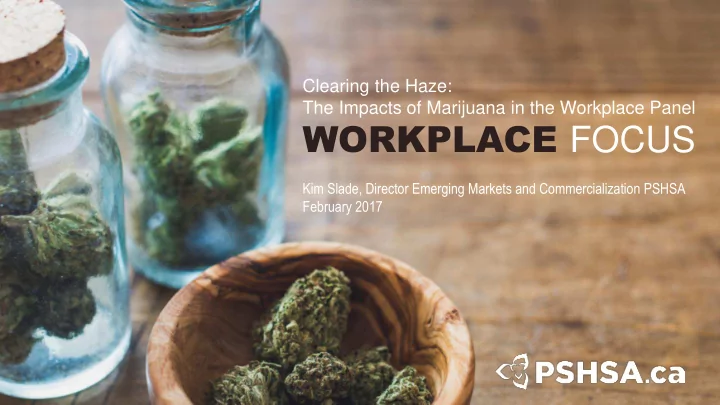
Clearing the Haze: The Impacts of Marijuana in the Workplace Panel WORKPLACE FOCUS Kim Slade, Director Emerging Markets and Commercialization PSHSA February 2017 COM OMPANY ANY exercitation ullamco laboris nisi ut aliquip ex ea commodo


slide-1
SLIDE 1

COM OMPANY ANY

exercitation ullamco laboris nisi ut aliquip ex ea commodo consequat. Duis aute irure dolor in reprehenderit in voluptate velit esse cillum dolore eu occaecat cupidatat non proident, sunt in culpa qui

Clearing the Haze: The Impacts of Marijuana in the Workplace Panel

WORKPLACE FOCUS

Kim Slade, Director Emerging Markets and Commercialization PSHSA February 2017

slide-2
SLIDE 2

ARE Y ARE YOU OU PREPARED?

Nearly 1/3 of employers surveyed are concerned about attendance, work performance or erratic behaviour following legalization.

71% 70% 76% 10%

  • f employers feel they

are not well prepared

have employees in safety-sensitive jobs do drug testing Believe legalization with have a great or moderate impact

HRPA, Clearing the Haze Survey 2018

slide-3
SLIDE 3

IMPAIRMENT AT WORK

As a result of “social normalization” of Cannabis

  • nce the Cannabis Act is passed

WORKPLA ORKPLACE CE

CONCERNS

SAFETY SENSITIVE JOBS

A safety sensitive job is a job in which is one in which incapacity due to drug or alcohol impairment could result in direct and significant risk of injury to the employee, others or the environment.

slide-4
SLIDE 4

WHA WHAT T I DO I DO IN MY OWN TIME…

As individuals, we may hold varying opinions about the use, and the personal or societal impact of alcohol and drugs, and make our own lifestyle choices… However, regardless

  • f personal opinion, the fact is that the alcohol

and drugs can adversely affect an individuals mental and physical abilities. This fact represents

an obvious and real concern for companies that are committed to providing employees with a safe workplace.” (Enform Alcohol and Drug Policy Model)

slide-5
SLIDE 5

POLICY POLICY

T Y P E S

Zero Tolerance

  • No amount of THC is

acceptable

  • Bonafide occupational

requirement

  • Safety Sensitive

Positions

  • Duty to accommodate

Per Se Law

  • Determine upper limit
  • f impairment
  • Current practice is to use

urine tests

  • There are alternatives

to testing

Two-Tier

  • Used when there are

safety sensitive and non safety sensitive jobs in the workplace

slide-6
SLIDE 6

In order to enact a zero tolerance policy employers need to establish that sobriety is a bona fide

  • ccupational

requirement.

ZERO TOLERANCE

slide-7
SLIDE 7

Limits of impairment are defined. Employees who appear to be impaired should be assessed.

PER PER SE LAW

slide-8
SLIDE 8

WHAT THE LITERATURE SAYS ABOUT DRUG TESTING

  • Research suggests that the presence of a

workplace drug testing program

  • bserved a reduced rate of injuries

(~51% - construction industry)

  • Has to align with Ontario Human Rights

Code Requirements

  • However, drug testing does not provide

a quantitative level of impairment similar to a breathalyzer

  • It can be unreliable

A UK based study found that urine samples for THC would likely test positive up to

  • 4 days after last cannabis use for

an occasional or first time user

  • 10 days after last cannabis use for

a frequent user

  • 1-2 months after last cannabis

use for a very heavy user

French 2004, Marques 2014, Pidd, 2014, Wickizer, 2004, Enform

slide-9
SLIDE 9

AL ALTERN TERNATIVES TIVES

TO DRUG TESTING

“The Commission supports the use of methods other than drug testing for dealing with employee impairment. Awareness, education, rehabilitation and effective interventions such as enhanced employee supervision and monitoring are the most effective ways of ensuring that performance issues with alcohol and drug use are detected and resolved.”

  • Canadian Human Rights Commission
  • Performance tests for cognitive or

psychomotor impairment related to integral parts of the job

  • Training supervisors on identifying

behaviors and physical indicators

  • f employees that can affect

workplace safety

  • Planned or random observation

and audits, peer or supervisor monitoring

  • Drug education and health

promotion programs in the workplace

slide-10
SLIDE 10

Employers have an obligation to take steps to adjust rules, policies or practices that have a negative impact on individuals,

  • r groups of individuals, based on prohibited

grounds of discrimination. Accommodation must be individualized. To the point of undue hardship.

WORKPLA ORKPLACE CE

A C C O M M O D AT I O N

CHRC Impaired at Work Accommodation Guide

slide-11
SLIDE 11
  • 1. Focus on detection of

impairment and providing a safe workplace

  • 2. Identify safety sensitive

positions

  • 3. Provide programs that

emphasize awareness, education, and training with respect to drug use

  • 4. Focus on rehabilitation vs.

punishment

  • 5. SEEK LEGAL COUNSEL

when developing policies related to medical and recreational use of cannabis

5 TIPS FOR

POLICY

DEVELOPMENT

slide-12
SLIDE 12
  • Dr. Peter Smith @ the Institute for Work

and Health has received funding from the Canadian Institute for Health Research (CIHR) to “advance knowledge regarding the impacts of the proposed cannabis legislation.” We will be examining:

  • Consumption patterns and views of

legalization across different market segments, safety sensitive roles

  • Workplace norms and risk

behaviours

  • Perceptions about employee rights

Contact: PSmith@iwh.on.ca

NEW RESEARCH

slide-13
SLIDE 13

Thank you for your time, Kim Slade kslade@pshsa.ca www.pshsa.ca