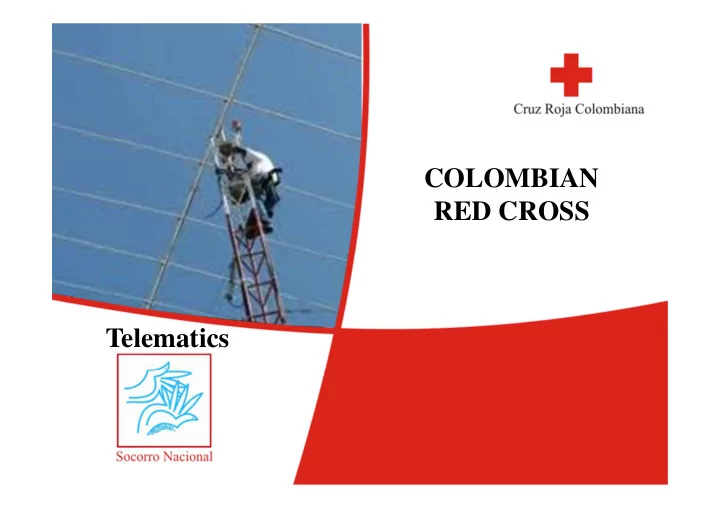
SLIDE 1
COLOMBIAN RED CROSS Telematics
SLIDE 2 LEGAL FRAMEWORK
Act 49 of 1948 Through which is created the National Relief
- f the Colombian Red Cross in case of Public
Calamity.
SLIDE 3
LEGAL FRAMEWORK
Through resolution No. 003555 December 30, 1999 the MINTIC formalized the Colombian Red Cross Society with the use of the radio- electric spectrum to deliver the auxiliary aid service till December of 2004.
SLIDE 4
LEGAL FRAMEWORK
Through resolution 000652 April 12, 2005 the grant of using the radio-electric spectrum was extended to deliver the auxiliary aid service till December 31, 2015.
SLIDE 5 HISTORY OF DISASTER COMMUNICATION IN COLOMBIA
- April 9, 1948 – “El Bogotazo”.
- 1980 The taking of the Dominican Republic
Embassy.
- 1983 – Fire at Puente Aranda.
- 1983 – Popayan’s earthquake.
- 1985 – The taking of the Justice Court.
- 1985 – Armero’s avalanche.
- 1994 – Paez River avalanche.
SLIDE 6 HISTORY OF DISASTER COMMUNICATION IN COLOMBIA
- 1999 – Coffee region earthquake.
- 1998 - 2001 – Détente area
- 2004 – 2010 – Ashes emission and eruption of Galeras
volcano.
- 2010 – 2011 – “La Niña’s” phenomenom winter
season operations. Currently attending changes of state of Nevado del Ruiz volcano, Tolima department.
SLIDE 7 USE OF ICT IN THE HUMANITARIAN LABOUR
Vulnerable and exposed population to natural risks and Climate Change impacts. Affected population by emergencie, disasters and the armed conflict. Population in process
relocation, displacement and adaptation after the disaster (natural or complex).
SLIDE 8
ICT’s USE
Updated and reliable information is a vital resource in disaster management and the humanitarian assistance work. For this reason we rely on the 7 connection layers established at the institutional level.
SLIDE 9
NETWORK STRUCTURE
SLIDE 10 NETWORK STRUCTURE INTERNET NETWORKS
Computer systems networks and connection that allows to hold video and audio conferences with our branches during emergencies. For this reason we activate the crisis room.
SLIDE 11 NETWORK STRUCTURE VHF RADIO NETWORK
Throughout the country we have:
37 networks.
VHF frequencies from local point to point in 14 networks.
installed repeaters: 53 in VHF
SLIDE 12 NETWORK STRUCTURE UHF RADIO NETWORKS
Throughout the country we have:
5 networks.
UHF installed repeater.
SLIDE 13 NETWORK STRUCTURE HF RADIO NETWORK
Throughout the country we have:
3 networks. Total of stations in HF:
- 42 based-stations.
- 10 mobile-stations.
SLIDE 14 NETWORK STRUCTURE SATELITE TELEPHONY
We have:
for field communicatio.
units to send data and audio.
SLIDE 15 NETWORK STRUCTURE MOBILE TELEPHONY
field operations.
system
phone allerts (chain call) is a solution in situations were is required a rapid response.
SLIDE 16
VOLUNTEERS TRAINING
For the effective use ICT it is not enough to have all the appropriate equipments, the staff training that will operate the communication systems must be included.
SLIDE 17 TRAINED PERSONNEL
GENERAL : 430 volunteers
32 branches trained in telecommunications basics. National Intervention Team - NIT There are 30 NITs in Telecommunication TECHNICS: There are 10 technics at the national level that support the technical area.
SLIDE 18 FIELD SUPPORT
MOBILE TELECOMMUNICATIONS UNIT
It connects communications in field with
institutions.
SLIDE 19 FIELD SUPPORT
DATABASE
We register data for the humanitarian assistance delivery and for the Damage and Needs Assessment data.
It can be trasmitted in real time if there is monile phone coverage in the area.
SLIDE 20 FIELD SUPPORT
DATABASE
Information to be registered at the terminal.
SLIDE 21 FIELD SUPPORT
DATA BASE
Data verifying
missing people, the RFL team is activated.
SLIDE 22 STRENGTHENING COMMUNITIES WITH EARLY WARNING SYSTEMS
We are working in the installed early warning systems:
- Machin volcano, Tolima department.
- Affected municipalities by the Nevado del Ruiz
volcano, Tolima department.
- Paez River basin, Huila’s Nevado volcano, Huila
department.
- Cauca department, avalanche.
- Tumaco municipality, Tsunamis.
SLIDE 23 STRENGTHENING COMMUNITIES WITH EARLY WARNING SYSTEMS
municipality, Cauca department because of slides.
- Hurricaines, Guajira department.
- Villa
Restrepo Tolima, Combeima canyon because of avalanches. The installed systems may be sirens, communication networks, mud flows
- monitoring. These equipments and devices
help in the actions
prevention and evacuations, when needed.
SLIDE 24