
SLIDE 1
1
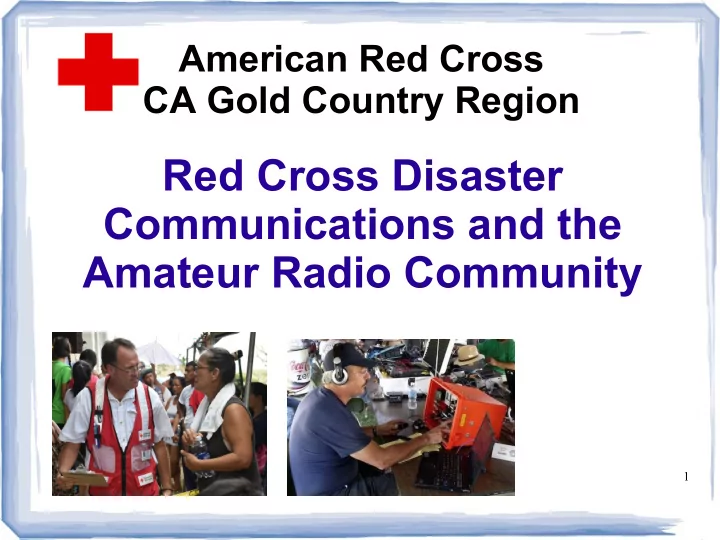
Red Cross Disaster Communications and the Amateur Radio Community - - PowerPoint PPT Presentation
American Red Cross CA Gold Country Region Red Cross Disaster Communications and the Amateur Radio Community 1 American Red Cross Gold Country Region What you can learn from this presentation: Who is the Red Cross. What the Red Cross
1
2
What you can learn from this presentation: Who is the Red Cross. What the Red Cross does for disaster relief. Nature of Red Cross potential disaster message traffic. How you, as our Amateur Radio partners, can help us.
3
American Red Cross registered volunteer since 2014 Amateur Radio interests: Disaster Communications & Public Service ARES 1994-2012 DEC Santa Cruz County late '90s CERT Santa Cruz County 2002-2008 NDMS Disaster Medical Assistance Team CA-11, Sac
Beau coup FEMA and other disaster training courses
4
No, I'm not a doctor. But, I play one on tv!
5
American Red Cross Gold Country Region
6
The mission of the Red Cross is to
7
American Red Cross Gold Country Region
Family burned out of their home Residents burned out of an apartment building
Wild-land fire threatening occupied structures Earthquake (e.g., '89 Loma Prieta and '14 Napa quakes) Flood (Katrina, Matthew, Oroville Dam, etc.) Hurricane (Matthew, Irma, Maria, etc. (more to come)
8
American Red Cross Gold Country Region
9
Effective mid 2020: San Joaquin & Stanislaus Counties going away; gaining Del Norte, Humboldt, Mendocino, & Lake Counties
10
American Red Cross Gold Country Region
County, state & Red Cross resources spread to the max!
Red dots are potential Red Cross shelters
11
American Red Cross Gold Country Region
Small incident, by the Incident Commander on the
Action Team
12
American Red Cross Gold Country Region
**Photo from the public domain
13
American Red Cross Gold Country Region
14
American Red Cross Gold Country Region
15
American Red Cross Gold Country Region
Large incident: Request from EOC officials to the Red Cross for an evacuation center or shelter close to the affected area for an approximated number of affected individuals
16
American Red Cross Gold Country Region
17
American Red Cross Gold Country Region
18
American Red Cross Gold Country Region
19
American Red Cross Gold Country Region
20
American Red Cross Gold Country Region
21
American Red Cross Gold Country Region
22
DPM via support from headquarters (Exposition Blvd., Sacramento) contacts Shelter Manager and
Ideally, Red Cross Operations Group contacts our amateur radio partners to request radio resources Contacts other partners (e.g., Salvation Army or Southern Bapist Disaster Relief, Islamic Relief USA, SPCA, etc.) Contacts Red Cross On-Call Nurse to assess client un-met medical needs
American Red Cross Gold Country Region
23
American Red Cross Gold Country Region
Ref: National Incident Management System Incident Command System ICS Forms Booklet FEMA 502-2
24
Red Cross is the only ngo designated as the primary agency in the NIMS NRF as Emergency Support Function 6: Mass Care, Emergency Assistance, Housing, and Human Services
Designated as a support agency for five other ESF's: #5 Information and Planning #7 Logistics #8 Public Health and Medical Services #11 Agriculture and Natural Resources #15 External Affairs
American Red Cross Gold Country Region Refer to: ICS 800 National Response Framework – An Introduction
25
American Red Cross Gold Country Region
Refer to handout: Incident Action Plan
26
American Red Cross Gold Country Region
Job Director (Incident Commander) AD Operations (Ops Chief) AD Planning (Plans Chief) AD Logistics (Logs Chief) AD Finance (Finance Chief) AD External Relations Government Liaison Public Affairs
27
American Red Cross Gold Country Region
AD Operations (Ops Chief) AD Planning (Plans Chief) AD Logistics (Logs Chief) AD Finance (Finance Chief) Bulk Distribution Client Services Feeding Sheltering Lead Disaster Assessment Information Dissemination Statistical Information Supply / Procurement Staff Services Disaster Services Technology
COML
(Communications Lead)
DHS Nurse Lead Shelter DHS Nurse SV AD External Relations Government Liaison Public Affairs
28
DST sets up and manages telecom (cell phone) and datacom network at the DOC, issues cell phones to functions (e.g., Shelter Manager(s), Disaster Health Services, etc.) Incident Communications Center Manager “Red Cross” (tactical call) at HQ/DOC (aka “net control”)
American Red Cross Gold Country Region
AD Logistics (Logs Chief) Disaster Services Technology COML/ Comm Center Manager
29
Heavy reliance on cell phone As response grows, DST brings in resources: phone, intranet and internet infrastructure cell phones server(s) laptops, printers, and earth station. But for cell phones, DST equipment supports the local District Ops Center only, not the shelters Verizon and AT&T
American Red Cross Gold Country Region
30
American Red Cross Gold Country Region
Refer to handout: Disaster Messaging When the Phones Go Out
31
DPM or designee contacts amateur radio in area affected (as noted previously) At the behest of the Ass't Director for Operations (ADO / Ops Chief), radio
Radio operators respond self-contained with appropriate equipment and personal items.
American Red Cross Gold Country Region
32
Disaster “event” can interrupt all Mountain Ranch (Calaveras County) lost above ground public utilities during Butte Fire Camp Fire, Verizon lost 1 of 17 cell sites in Paradise. Backhaul was over fiber cable which was rapidly lost.
American Red Cross Gold Country Region
33
Disaster “event” can interrupt all '89 Loma Prieta Quake interrupted all utilities in Santa Cruz County (POTS d/t subscribers overloading system) Fiber cut 2009 Santa Clara County interrupted all telecom & datacom traffic in Santa Cruz County Puerto Rico now the prime, extreme example.
American Red Cross Gold Country Region
34
No “graceful degradation” (unfortunately the norm):
Normal everyday: Dial-up POTS Cell phone High Speed Internet Crash, Boom, Ka-Pow! Loss of Dial Up d/t copper and / or fiber connections to Central Office d/t poles down, fire burning out lines, etc. Loss of Cell phone d/t loss of tower (saturated cell sites, power utility failure, back-up power loss, cell towers physically down, etc.) Sneaker and Chevy nets are left intact
American Red Cross Gold Country Region
35
“Normal” telecom infrastructure: POTS Cell phone Internet Most carried by fiber back-haul
American Red Cross Gold Country Region
36
Response Latency in a Major Disaster
American Red Cross Gold Country Region
Time 0 – Disaster happens Time 0 + X hours – County agencies respond Time 0 + Y Hours – Support agencies (including NGOs) alerted with request to respond Time 0 + 2 hours – Red Cross responds to civil agency request. Time 0 + upwards to 72 hours – Shelters on their
Telecommunications impacted.
37
Communications Infrastructure Impact in a Disaster
American Red Cross Gold Country Region
Loss of Dial Up d/t copper and / or fiber connections to Central Office lost. Loss of Cell phone sites and/or back-haul to Mobile Telephone Switching Office (MTSO). Radio repeaters carrying both voice and data traffic (hardened & intact?) HF radio carrying both voice and data traffic intact. Verizon and AT&T (inherent response latency) Sneaker and Chevy Nets
38
American Red Cross Gold Country Region
39
Consider this scenario: you are asked to report to the Alta Community Center Shelter. No comm equipment cached on the premises. Task: establish comms with Red Cross Gold Country Region Disaster Operations Center (DOC). With what equipment are you prepared to respond? With what communications modes are you prepared to operate? Over what channels? (Refer to ICS205 handout)
American Red Cross Gold Country Region
40
American Red Cross Gold Country Region Refer to Handout: Comm Disaster Response Plan & Region Headquarters Disaster Comm Procedures (cover sheet: Disaster Messaging When the Phones Go Out)
41
Topic 7: Digital Options in Message Handling
Digital Communication: Pros and Cons: (continued)
Being a mostly analog communication service is not a bad thing. ... However, many of the agencies we serve are already beginning to ask about our digital capabilities…
assignments between sites?”
down?”
computer maps?” When the agency you serve asks questions like these, you’ll want to be able to reply with more than a blank stare!
42
Applies regardless the served agency:
What kind of information needs to be communicated? In what form is that information best communicated? What is its precedence? Do delivery & understanding need to be acknowledged? What is/are optimal route(s) for transmission? Does anyone else need to know? Does the info need to be protected or kept private? Sender/receiver authentication needed? What is impact to mission if info does not get delivered or is misinterpreted?
American Red Cross Gold Country Region
43
American Red Cross Gold Country Region
44
Refer to Handout: ICS213 (cover sheet: Disaster Messaging When the Phones Go Out) American Red Cross Gold Country Region
45
Initial 4 hours: 209 messages – declarations of emergency, sit reps, assistance reqs, tactical traffic Traffic passed over Amateur Radio circuits Via voice channels: 17 Via data channels: 524 Mixed 150 Even PACTOR 3 was slow for volume of traffic
Refs: QST Sept 2016; https://www.fema.gov/cascadia-rising-2016 Joint Multi-State AAR
American Red Cross Gold Country Region
46
Initial requirement was for Radio operators to move Red Cross Safe and Well Excel spreadsheets Problem: how do you send an Excel spreadsheet
Think out of the box ...
American Red Cross Gold Country Region
47
American Red Cross Gold Country Region
Short, tactical messages for status reports, immediate materiél needed, emergencies/911 Voice: “To Mary Pearce, Solid Rock Shelter Manager, from Bob Jones, Logisitics Lead: “ERV enroute with 50 cots.' ”
48
American Red Cross Gold Country Region
Data: lengthy logistics requests, daily shelter manager and Disaster Health Services reports, personnel assignments, family reunification, etc.
49
American Red Cross Gold Country Region
Note: Anticipate precedence of Routine (most typical), Immediate/Urgent (occasional) or Emergency (rarely). Ask originator for precedence. (Do not presume, do not over or under state).
50
American Red Cross Gold Country Region
https://safeandwell.communityos.org/
51
American Red Cross Gold Country Region
52
American Red Cross Gold Country Region
Ham radio is our shipping department
Ham Radio
53
American Red Cross Gold Country Region
Winlink Advantages Direct to addressee email File attachments easy, similar to conventional email Built-in tracking Many VHF and HF gateways Built-in HF modems (Winmor, ARDOP, VARA etc.)
A utility that can pass data intact, without errors.
Disadvantages Operator temptation to use built-in proprietary forms Requires practice to master
54
American Red Cross Gold Country Region
55
What About Confidentiality and Health Information Privacy Accountability Act (HIPAA)?
“ If the President declares an emergency or disaster and the Secretary (of Health and Human Services) declares a public health emergency, the Secretary may waive sanctions and penalties against a covered hospital that does not comply with certain provisions of the HIPAA Privacy Rule ... “ … the HIPAA Privacy Rule permits disclosures for treatment purposes and certain disclosures to disaster relief organizations. For instance, the Privacy Rule allows covered entities to share patient information with the American Red Cross so it can notify family members of the patient’s location.” (45 CFR 164.510(b)(4). As a policy, Red Cross keeps confidential the names of its clients.
http://www.hhs.gov/hipaa/for-professionals/faq/1068/is-hipaa-suspended-during-a-national-or-public- health-emergency/index.html
American Red Cross Gold Country Region
56
More Disaster Health Services Messages & HIPAA...
Healthcare “civilians” (including ham radio operators) are not HHS/HIPAA “covered entities.” Red Cross nurses are well acquainted with HIPAA and are highly guarded with respect to client information. Though the Red Cross is specifically exempted from HIPAA, if DHS has a message regarding a client, confidentially will be maintained.
American Red Cross Gold Country Region
57
More Disaster Health Services Messages & HIPAA...
American Red Cross Gold Country Region
58
Refer to Handout: Disaster Messaging When the Phones Go Out)
American Red Cross Gold Country Region
59
ARC ICS 213 General Message ARC ICS 204 Work Assignments Disaster Requisition 6409 Staff Request Client Incident Report Staff Injury Report Unaccompanied Minor and Separated Child Report Emergency Welfare Inquiry Safe and Well Registration
American Red Cross Gold Country Region
60
IMPORTANT: Noted previously, the Red Cross Concept of Operations follows the ICS disaster management model, including ICS forms, though modified specifically for Red Cross purposes. ICS imperative for a consistent form and function for “One Red Cross” Especially important as responders come from all across the country ICS prevents a “Tower of Babel”
American Red Cross Gold Country Region
61
ARRL EC-16, Topic 4a: ARES Management and Incident Command System: ARES Leadership
Communications, Topic 4a: ARES Management and Incident Command System: ARES Leadership p.7 of 14
62
flmsg “custom” HTML forms Completed forms saved as an flmsg .k2s object file in a 'compact' size that facilitates efficient transfer over a data link. Compare: ARC_Unaccompanied_Minor_Form_v_1.0.html – 63kB DEMO_Unacc_Minor_20170601-151607L-3.k2s – 2Kb
Nota bene (as you already know): message transfer over a data path ensures maximum speed, efficiency, and integrity by way of minimum auto repeats, no transcription errors (when created by the message
American Red Cross Gold Country Region
63
American Red Cross Gold Country Region
64
American Red Cross Gold Country Region
65
Red Cross ICS 213 General Message
American Red Cross Gold Country Region
66
Red Cross ICS 213 General Message
American Red Cross Gold Country Region
218 words in message body How efficiently can you pass this message via CW or phone?
67
Red Cross 6409 Disaster Requisition Form
American Red Cross Gold Country Region
68
ARC Client Incident Report
American Red Cross Gold Country Region
“Challenging” to pass over a phone circuit.
69
Red Cross Safe & Well Registration Form
American Red Cross Gold Country Region
70
American Red Cross Gold Country Region
71
American Red Cross Gold Country Region
(page 1 of a two page report)
72
American Red Cross Gold Country Region Family Reunification / Safe and
73
American Red Cross Gold Country Region
74
On reporting to a shelter
Sign-in on volunteer check-in sheet Ask for and report to Shelter Manager If 1st operator to shelter, ask where to set-up radio station If shift relief, ask to be directed to radio station. Frequently first 24 hours of shelter operations tend to be a cluster f**k Might need to suggest a place for setting up the radio position Be advised: Shelters are noisy!
American Red Cross Gold Country Region
75
On reporting to Sac Disaster Operations Center (DOC)
Sign-in on volunteer check-in sheet Ask for and report to COML Radio station at back of DOC On reporting to district operations center Sign-in on volunteer check-in sheet Ask for and report to COML If 1st operator to DOC, ask where to set-up radio station If shift relief, ask to be directed to radio station First 24 hours of operations tend to be a cluster f**k
American Red Cross Gold Country Region
76
American Red Cross Gold Country Region
77
American Red Cross Gold Country Region
78
How many Radio Operators per shift*? Well, it depends on the situation. Typical at start and as determined by COML:
2 max for the Sacramento DOC (radio room is very space limited). 2 for district ops center 1-2 at a shelter 1 in a vehicle (E.G., Damage Assessment Teams, outreach teams) 1 Community Outreach Center Nota bene: Inadvisable to respond with more operators than requested.
* Red Cross shelter staff works 12-hr shifts. Size of the DRO response, DOC might work same. Else 8-10 hour days.
American Red Cross Gold Country Region
79
American Red Cross Gold Country Region
80
Understand the greater Red Cross mission Understand the mission of the communicator / radio operator when serving the Red Cross Speak Red Cross language Can work in an ICS structure (helps to have completed ICS 100, 200, 700, 800)
American Red Cross Gold Country Region
81
American Red Cross Gold Country Region
Semper Gumby
82
Self-contained
Depending on commitment, communications equipment, personal supplies, sleeping gear, etc. according to the assignment location.
American Red Cross Gold Country Region
83
American Red Cross Gold Country Region
84
Expertise Most Red Cross volunteers (other than DST personnel) have no understanding of radio and depend on Radio operators to get the job done ARRL ARES task book (demonstrates certified task & skill-set proficiencies) Need no supervision. Shelter & DOC staff have too much on their plates to supervise supporting partners.
American Red Cross Gold Country Region
85
Equipment – Special Considerations Service sites: No radio equipment available. Radio operators need to be completely self contained. Headphones & noise-canceling mic advisable. Vehicles – consider: Mag-mount antenna Cig power connector Using an HT? >>2M amplifier ERVs have fiberglass roofs
American Red Cross Gold Country Region
86
American Red Cross Gold Country Region
87
In-house training on-going for Red Cross volunteers & staff: What ham radio can do for us during a disaster How to use a radio operator at HQ and in a shelter What do we need to provide for the radio operator Forms use Most Important: when to request ham radio support (“I'll call 'em when I need 'em” is a tad late ...)
American Red Cross Gold Country Region
88
American Red Cross Gold Country Region
89
American Red Cross Gold Country Region
90
American Red Cross Gold Country Region
91
Red Cross offers numerous free training courses to its volunteers. Highly useful disaster basics classes to help understand Red Cross operations: Disaster Cycle Services: An Overview (web-based) Disaster Relief Operation Orientation for Event- Based Volunteers (YouTube) Concept of Operations Basics (YouTube) Operational Training for Shelter Workers (YouTube) If you take nothing else: CPR / AED / Basic First Aid
American Red Cross Gold Country Region
92
93
94
95
96
Recommended Resources and references:
QST Public Service column Aug 2015 Interfacing with Local Emergency Officials QST Mar 2016 Education – Foundation of Preparation (re ICS 100, 200, 700, 800) ARRL/ARC MoU (Search ARRL web site) American Red Cross training www.redcross.org/take-a-class/disaster-training https://www.fema.gov/cascadia-rising-2016 USGS ArkStorm http://geography.wr.usgs.gov/science/mhdp/arkstorm. html This is ArkStorm https://vimeo.com/19012969