
SLIDE 1
1
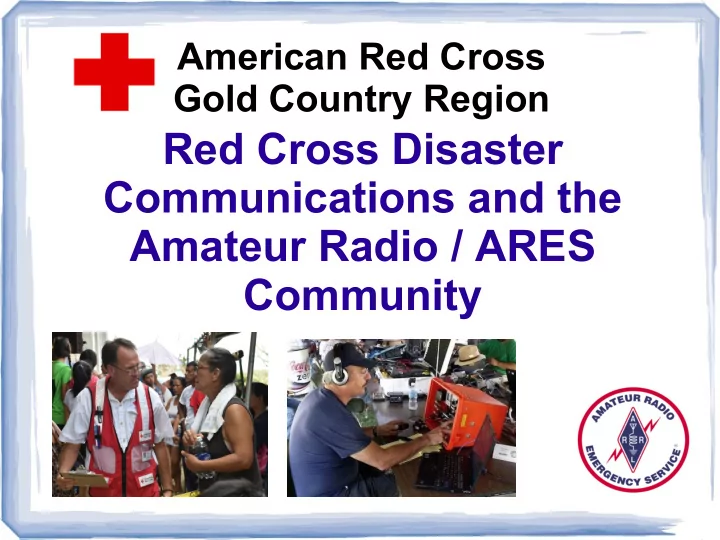
Red Cross Disaster Communications and the Amateur Radio / ARES - - PowerPoint PPT Presentation
American Red Cross Gold Country Region Red Cross Disaster Communications and the Amateur Radio / ARES Community 1 American Red Cross Gold Country Region Jim Piper, RN & N6MED Disaster Health Services Disaster Services Technology:
1
2
Comms
Sacramento
courses
3
4
“Small” localized incidents:
family burned out of their home Residents burned out of an apartment
building
Wide-area disasters:
Wild-land fire threatening occupied
structures (e.g., 2015 Calif Fires fires)
Earthquake (e.g., '89 Loma Prieta and '14
Napa quakes) American Red Cross Gold Country Region
5 Wild-land fire Flooding Train Derailment (think toxics shipped by
Major power outage
American Red Cross Gold Country Region
6
American Red Cross Gold Country Region
7
American Red Cross Gold Country Region
Small incident (house or apartment house fire) by
8
American Red Cross Gold Country Region
**Photo from the public domain
9
American Red Cross Gold Country Region
Large incident (earthquake, wild-land fire, etc), if EOC activated, request from EOC officials to the EOC Red Cross representative for an evacuation center or shelter close to the affected area an approx number of affected individuals
10
American Red Cross Gold Country Region
11
American Red Cross Gold Country Region
12
American Red Cross Gold Country Region
13
American Red Cross Gold Country Region
14
Introduction)
American Red Cross Gold Country Region
15
American Red Cross Gold Country Region
16
American Red Cross Gold Country Region
Job Director (Incident Commander) AD Operations (Ops Chief) AD Planning (Plans Chief) AD Logistics (Logs Chief) AD Finance (Finance Chief) DHS Nurse Lead AD External Relations Government Liaison Public Affairs
17
American Red Cross Gold Country Region
AD Operations (Ops Chief) AD Planning (Plans Chief) AD Logistics (Logs Chief) AD Finance (Finance Chief) DSH Nurse Lead Bulk Distribution Client Services Feeding Sheltering Lead Disaster Assessment Information Dissemination Statistical Information Supply / Procurement Staff Services Shelter DHS Nurse Manager Disaster Services Technology
COML
(Communications Lead)
18
and datacom network at the DOC, issues cell phones to functions (e.g., Shelter Manager(s), Disaster Health Services, etc.)
Fills role of Incident Comm Center
Manager
Manages the tech and ops aspects of
radio communications
Supervises Radio Operators Develops Incident Radio Comm Plan Particiaptes in ops & planning meetings Understands the realities of deployment
American Red Cross Gold Country Region
AD Logistics (Logs Chief) Disaster Services Technology COML
19
Services Technology brings in equipment to support phone, intranet and internet infrastructure: cell phones, server(s), laptops, printers, and earth station.
local DOC only, not the shelters
might be called which responds within 24-48 hours
American Red Cross Gold Country Region
20
DPM or COML (Liaison to ARES) contacts
ARES responds radio operators to areas of
Radio Operators respond self-contained with
American Red Cross Gold Country Region
21
“Normal” telecom infrastructure:
POTS Cell phone Internet
Most carried by fiber backhaul
American Red Cross Gold Country Region
22
Disaster “event” can interrupt all Mountain Ranch (Calaveras County) lost above ground public utilities during Butte Fire
American Red Cross Gold Country Region
23
Disaster “event” can interrupt all '89 Loma Prieta Quake interrupted all utilities in Santa Cruz County (POTS d/t subscribers overloading system) Fiber cut 2009 Santa Clara County interrupted all telecom & datacom traffic in/out Santa Cruz County
American Red Cross Gold Country Region
24
consideration/component (unfortunately the norm):
Normal everyday: Dial up POTS Cell phone High Speed Internet Crash, Boom, Ka-Pow: Loss of Dial Up d/t copper and / or fiber
connections to CO d/t poles down, fire burning
Loss of Cell phone d/t loss of tower (saturated cell
sites, power utility failure, back-up power loss, cell towers physically down, etc.
Sneaker net is left intact American Red Cross Gold Country Region
25
Ideally, with “graceful degradation” built in as a major consideration/ component:
–
Dial up POTS
–
Cell phone
–
High Speed Internet
d/t poles down, fire burning out lines, etc.
power utility failure, back-up power loss, cell towers physically down, etc.
American Red Cross Gold Country Region
26
degradation” component: Ham Radio, by carrying both voice and data traffic, can help keep the wheels of the Red Cross disaster response moving: Consider:
Assessment Teams, and Emergency Response Vehicles (ERVs) and Disaster Operations
American Red Cross Gold Country Region
27
American Red Cross Gold Country Region
28
American Red Cross Gold Country Region
29
(addressee)”
Red Cross purposes), the addressee should receive the delivered message exactly as it was given to the radio operator.
near end to the far end intact and delivered in its
American Red Cross Gold Country Region
30
What About Confidentiality and Health Information Privacy Accountbility Act (HIPAA)?
clients.
Secretary declares a public health emergency, the Secretary may waive sanctions and penalties against a covered hospital that does not comply with certain provisions of the HIPAA Privacy Rule ...
purposes and certain disclosures to disaster relief organizations. For instance, the Privacy Rule allows covered entities to share patient information with the American Red Cross so it can notify family members of the patient’s location. (45 CFR 164.510(b)(4).”
http://www.hhs.gov/hipaa/for-professionals/faq/1068/is-hipaa-suspended-during-a-national-or-public- health-emergency/index.html
American Red Cross Gold Country Region
31
American Red Cross Gold Country Region
32
American Red Cross Gold Country Region
33
American Red Cross Gold Country Region
34
IMPORTANT:
Noted previously, the Red Cross follows the ICS disaster management model, including ICS forms, though modified specifically to Red Cross purposes.
“One Red Cross”
the country
available as a file and in printed form with shelter kits)
American Red Cross Gold Country Region
35
available as a file)
facilitate efficient transfer over a data link, regardless AX.25 packet, WinLink/RMS Express, or other transfer mode of radio operator's choosing.
by way of minimum auto repeats, no transcription errors (when created by the message originator), with delivery precisely in the form sent.
American Red Cross Gold Country Region
36
American Red Cross Gold Country Region
37
IMPORTANT:
American Red Cross Gold Country Region
38
Sign-in on volunteer check-in sheet
Ask for and report to Shelter Manager
If 1st operator to shelter, ask where to set-up radio station
If shift relief, ask to be directed to radio station.
a cluster f**k
position
American Red Cross Gold Country Region
39
Sign-in on volunteer check-in sheet
Ask for and report to COML or DST Manager
Radio station at back of DOC
Sign-in on volunteer check-in sheet
Ask for and report to COML or DST Manager
If 1st operator to DOC, ask where to set-up radio station
If shift relief, ask to be directed to radio station
cluster f**k
American Red Cross Gold Country Region
40
DOC
ADO would likely release you
Advise COML or DST Manager of being released and availability for reassignment
Shelter Manager would release you
Advise COML or DST Manager of being released and availability for reassignment
American Red Cross Gold Country Region
41
How many radio operators per shift*? Well, it depends on the
2 max for the Sac Disaster Ops Center (radio
room is very space limited).
2 for local DOC 1-2 at a shelter 1 in a vehicle (E.G., Damage Assessment
Teams)
1 Community Outreach Center
Nota bene: Inadvisable to repond with more operators than requested. * Red Cross shelter staff works 12-hr shifts. Size of the DR response, DOC might work same. Else 8-10 hour days.
American Red Cross Gold Country Region
42
Understand the greater Red Cross mission Understand the mission of the
Speak Red Cross language Can work in a managed ICS structure Can improvise, adapt, and overcome
American Red Cross Gold Country Region
43
Depending on commitment, personal supplies, sleeping gear, etc. according to the assignment location.
American Red Cross Gold Country Region
44
Most Red Cross volunteers (other than DST
personnel) have no understanding of radio comms and depend on radio operators to get the job done
much on their plates to supervise supporting partners.
DOC Sacramento has a radio room complete with
VHF, UHF, Low-band (47MHz) radios, computer on DOC LAN. No HF as of today.
Shelters and Vehicles: No radio equipment available.
Radio operators need to be completely self contained.
American Red Cross Gold Country Region
45
Shelters: No radio equipment available. Radio operators need to be completely self
contained.
Headphones & noise-cancelling mic
advisable.
Vehicles – consider Mag-mount antenna Cig power connector 2M amplifier ERVs have fiberglass roofs American Red Cross Gold Country Region
46
American Red Cross Gold Country Region
47
American Red Cross Gold Country Region
48
April 2015 “Golden Pineapple” where 9 shelters across region were opened. ARES was not formally written into exercise but was invited to participate. The Disaster Program Director intends to specifically write Amateur Radio into the next exercise (date 2016 tbd). The script will not be disclosed before the exercise. ARES support would be requested via normal channels:
American Red Cross Gold Country Region
49
American Red Cross Gold Country Region
50
American Red Cross Gold Country Region
51
Red Cross offers numerous free self-paced, on-line disaster training courses. ARES members might find some of the disaster basics classes highly useful as a basis to understand Red Cross
Highly Recommended if you take nothing else:
American Red Cross Gold Country Region
52
53
54
55
Local Emergency Officials
https://embarc-learning.sabacloud.com
– Disaster Services Cycle: an Overview – Shelter Fundamentals – ARC Concept of Operations
(classroom)