
SLIDE 1
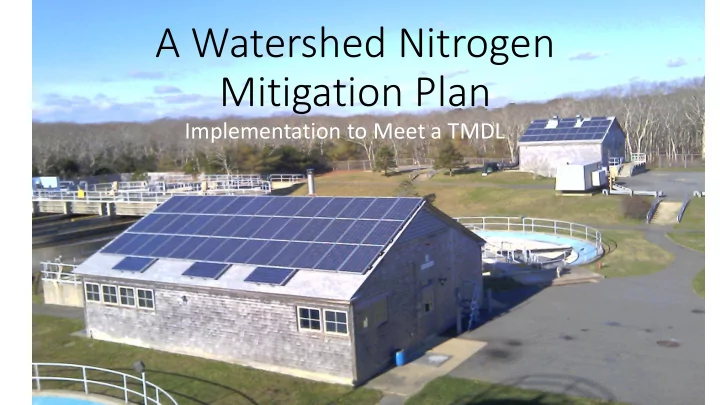
A Watershed Nitrogen Mitigation Plan Implementation to Meet a TMDL - - PowerPoint PPT Presentation
A Watershed Nitrogen Mitigation Plan Implementation to Meet a TMDL Edgartown Great Pond and Watershed Edgartown Great Pond MVC Recommendations 1. Sewer in watershed in Pond impacted by development- suitable
Edgartown Great Pond MVC Recommendations Pond impacted by development- algae and loss of eelgrass, decline of shellfish. Town agrees to help fund MEP study to be issued in 2004. 1999 Martha's Vineyard Commission study leads to Special condition (g) added to Discharge Permit of 2004.
suitable areas
dredging
shellfish and historic herring runs
shoreline setbacks.
more sparsely settled areas
Nitrogen Loading Factors to Edgartown Great Pond
Sp Specia ial l Condit itio ion (g (g) file filed with ith DEP 1/2 /26/2004
mg/L Total Nitrogen
septics from the watershed.
SEPTICS, SEWER, AND POND: NITROGEN (N) LOADING IN SCALES OF 10. SEPTIC TITLE V AND CESSPOOLS INFLUENT COMES IN AT N OF 35 MG/L. SYSTEM EMITS N AT 35 MG. PER LITER (or 35 parts per million) (A nitrogen reducing Alternative System may reduce this to 15 MG/L if functioning properly.) WASTEWATER TREATMENT—INFLUENT COMES IN AT N OF 35 MG/L. The effluent is discharged after treatment to ground sand beds AT <3 MG/L. THE TARGET N FOR THE EDGARTOWN GREAT POND IS 0.35 MG/L.
Watershed Projec ject
lots/6,600 gpd. These were the A/I systems.
lots/66,000 gpd.
BR/135 lots/ 59,400 gpd.
lots/11,000 gpd
lots/4,400 gpd. Total: 1340 BR/335 lots/147,400 gpd. THESE ARE ALL LOW PRESSURE GRINDER PUMPS........
Llewellyn
Facility
The Low Pressure Sewer Option in Retrospect
plain avoided
Im Imple lementatio ion
These systems have not proven themselves effective in seasonally occupied
mg/L “Parcels in thinly settled areas should be contemplated for Alternative Systems, as much to have "skin in the game" with other residents as for their more limited mitigation potential.”
Plan feature Pressure Sewer: Low cost and flexibility. Basic maintenance by wastewater staff should be contemplated and reflected in overall rates-the Continuity of Service Argument. Rates for sewer users to encompass Capital Replacement-or fair warning to
substantial replacement cost in the future. Effects Initial low cost. Otherwise, maintenance, service and eventual Capital Replacement Cost-to be borne by who? The Continuity of Service Argument: Sewer customers, gravity and pressure, are all paying at similar rates and pump customers should be able to expect the same Continuity of Service as gravity
Wastewater Dept. will replace it with a working one immediately, no charge.
Sources:
Program, 1996-1998" Martha's Vineyard Commission, William M. Wilcox et al. 1999
Groundwater Discharge Permit SE #2-24" Edgartown Wastewater Commission. 1999
Threshold for the Edgartown Great Pond System, Edgartown, MA." Mass. Estuaries Project, SMAST, MADEP. Final Report, December 2008.
itself" Henry S. Albro, NEWEA, January 29, 2014