SLIDE 1
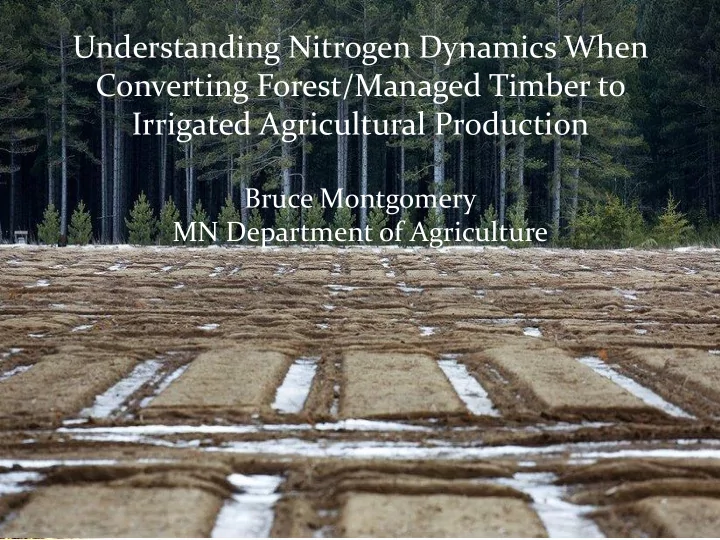
Understanding Nitrogen Dynamics When Converting Forest/Managed Timber to Irrigated Agricultural Production
Bruce Montgomery MN Department of Agriculture
SLIDE 2
Oakes Irrigation Test Area
Past Work Experience………assessing the environmental impacts of the Garrison Diversion Irrigation Project in North Dakota
SLIDE 3
Key Environmental Issues---Garrison Diversion
Could we manage nitrogen losses adequately to protect Hudson Bay with this massive irrigation expansion? Biota transfer from the Missouri River into Hudson Bay was another significant concern.
SLIDE 4
Understanding Nitrogen Behavior Is Critical
SLIDE 5
Drastic Land Use Changes Such as Plowing Virgin Prairie or Woodlands Will Have Temporal Impacts on the Release of Organic Nitrogen These Changes Are Rarely Documented
SLIDE 6
Large Undisturbed Soil Columns Were Used at the N.D. Research Sites to Monitor Nitrogen Movement
NDSU Research
SLIDE 7 “Nitrogen Flush” from the Conversion of Dryland to Irrigated Conditions Took Two to Five Years to Equilibrate
Jan-89 Jan-90 Jan-91 Jan-92 Jan-93 Jan-94 Jan-95 Jan-96 Jan-97 Jan-98 Jan-99 Jan-00 Jan-01
Nitrate-N (mg L
20 40 60 80 Observed data Equation [1] fit 10 mg L-1 MCL 95 % Confidence Interval Phase 1 Phase 2 Phase 3
Jan-89 Jan-90 Jan-91 Jan-92 Jan-93 Jan-94 Jan-95 Jan-96 Jan-97 Jan-98 Jan-99 Jan-00 Jan-01 Nitrate-N (mg L-1) 20 40 60 80 100 120 140 160 180
Observed concentrations Equation [1] fit 10 mg L-1 MCL Calculated from soil test N
Phase 1 Phase 2 Phase 3
Undisturbed Soil Columns Intermediate Monitoring Wells NDSU Research NDSU Research
SLIDE 8 Understanding the accelerated mineralization rates from the Garrison Diversion Project provided the
- pportunity to:
- Significantly reduce nitrogen fertilizer rates for the
first 2-3 years after the conversion;
- Separate water quality impacts from the organic N
pool vs from the addition of nitrogen fertilizer
NDSU Research
SLIDE 9
Implications Of Land Conversion within the Pineland Sands Area?
SLIDE 10 A Few Quick Stats Regarding the Potlatch/RDO Land Conversion Issue
- Potlatch has sold 60,000 acres of timber/pine
plantation holdings in MN but only 6,000- 8,000 suitable for irrigation;
- The RDO Corporation originally planned to
convert about 7,800 acres for agricultural use;
- Potlatch: Taxes are 2-3 X as high in Minnesota
than the southern states and northern trees take 50-70 years to mature while southern trees take 25-30.
Ag Week Pates 6-2015
SLIDE 11
Anticipating many environmental questions from the public, the foundation for a very unique partnership and water quality demonstration site began in 2013
Byron Township Demonstration Site
Cass County, MN
SLIDE 12
Byron Township Demonstration Site
Cass County, MN
SLIDE 13
Byron Site is Equipped to Monitor Nutrient and Percolation Losses Beyond the Root Zone
SLIDE 14 Typical Long-Term Installation Field Design Used by the MN Department of Agriculture
>24” deep
Installation Notes:
- All piping placed below the depth of tillage operations
- Lysimeters pull water from a depth of 4-6 feet deep
- Below the crop root zone
SLIDE 15
Demonstration Goals at the Byron Site
Starting with “NEAR PRISTINE” CONDITIONS……… Quantify the magnitude of temporal N flushes from the conversion of “managed timber” to irrigated production; Quantify nitrate leaching losses over multiple rotations which would include seed potatoes once every 3rd or 4th year; Minimize inputs and potentially reducing N losses by integrating “low input” crops within the rotation; Use cover cropping systems to the fullest extent possible to control off-season losses AND to minimize the use of soil fumigants such as Vapam.
SLIDE 16
Some Evidence of a Temporal Nitrate Flush During the First Production Year But Dissipated Relatively Quickly
(Crop: Soybeans No Commercial Nitrogen Applied)
0.00 5.00 10.00 15.00 20.00 25.00 30.00 Average Nitrate-N Below the Root Zone
SLIDE 17
Nitrogen Losses Will Occur Even When BMPs and Water Management Are Implemented
SLIDE 18 1993-97 Simulation Year
20 40 60 80 100 120 140 160 180 200
1 2 3 4 5 6 7
Nitrogen Rates (Lb/A) Yields (Bu/A)
10 20 30 40 50 60 70
Nitrate-N Loss
Conceptual Relationship under Corn Production: Inputs, Yields and Environmental Outputs
“Background” Losses Under Row Crop Systems Add’l Losses at Rec. Rate Excess Inputs
SLIDE 19
Typical Irrigated Crop Rotation with Late Season Potatoes---Pineland Sands Region
Russet Potatoes Corn Edible Beans
SLIDE 20
Proposed Alternative Rotation at Byron
Potential N Inputs Reduced: 70-80% Potential Irrigation Use Reduced: 30-40%
Seed Potatoes Dark Red Kidney Beans Soybeans Peas
SLIDE 21
Cover Crops Following Short Season Crops Will Serve an Important Role in Reducing Fall Soil Nitrate Levels
SLIDE 22
Rye and oats have been used as a successfully as a cover crop following a short-season crop such as small grains, peas or early season potatoes in Central Minnesota. Brown mustard, show here, produces ITCs (isothiocyanate compounds) which have a biocidal effect similar to Vapam.
SLIDE 23
Additional Rotations Proposed in Phase 2 of the Special Study (State Agencies)
Traditional Irrigated Rotation Crops---No Potatoes Late Season Potatoes with Conventional Rotation Existing Byron Site-Low Impact Crops with Seed Potatoes Late Season Potatoes Rotated with Low Impact Crops
SLIDE 24 Today’s “Take Home” Message
- The unique partnership and associated demonstration
site is well positioned to answer some probing nitrogen related questions about timberland conversion and the long-term substantiality of a “highly input reduced” rotation;
- Outcomes will help refine agricultural practices across
Minnesota’s irrigated acres;
- Additional sites are highly recommended to accurately
reflect agricultural practices and rotations currently practiced across the Pineland Sands;