Clock-Driven Scheduling (in-depth) Precompute static schedule - - PDF document

clock driven scheduling in depth
SMART_READER_LITE
LIVE PREVIEW

Clock-Driven Scheduling (in-depth) Precompute static schedule - - PDF document

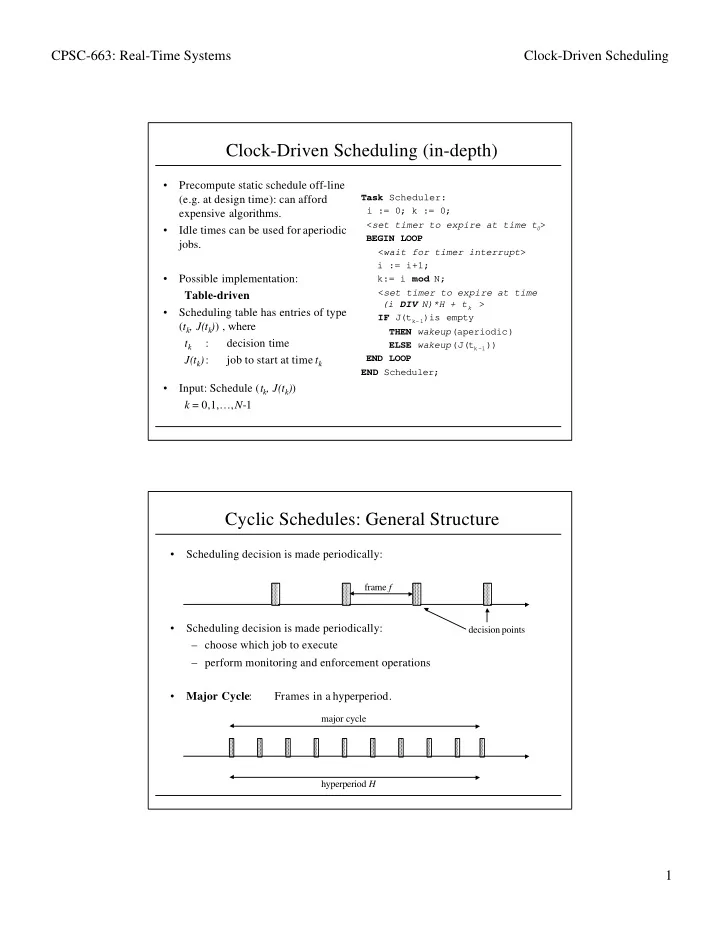
CPSC-663: Real-Time Systems Clock-Driven Scheduling Clock-Driven Scheduling (in-depth) Precompute static schedule off-line Task Scheduler: (e.g. at design time): can afford i := 0; k := 0; expensive algorithms. <set timer to expire at


slide-1
SLIDE 1

CPSC-663: Real-Time Systems Clock-Driven Scheduling 1

Clock-Driven Scheduling (in-depth)

Task Scheduler: i := 0; k := 0; <set timer to expire at time t

0>

BEGIN LOOP <wait for timer interrupt> i := i+1; k:= i mod N; <set timer to expire at time (i DIV N)*H + tk > IF J(tk-1)is empty THEN wakeup(aperiodic) ELSE wakeup(J(tk-1)) END LOOP END Scheduler;

  • Precompute static schedule off-line

(e.g. at design time): can afford expensive algorithms.

  • Idle times can be used for aperiodic

jobs.

  • Possible implementation:

Table-driven

  • Scheduling table has entries of type

(tk, J(tk)) , where tk : decision time J(tk): job to start at time tk

  • Input: Schedule (tk, J(tk))

k = 0,1,…,N-1

Cyclic Schedules: General Structure

  • Scheduling decision is made periodically:
  • Scheduling decision is made periodically:

– choose which job to execute – perform monitoring and enforcement operations

  • Major Cycle:

Frames in a hyperperiod.

frame f decision points hyperperiod H major cycle

slide-2
SLIDE 2

CPSC-663: Real-Time Systems Clock-Driven Scheduling 2

Frame Size Constraints

  • Frames must be sufficiently long so that every job can start and complete

within a single frame:

  • The hyperperiod must have an integer number of frames:
  • For monitoring purposes, frames must be sufficiently small that between

release time and deadline of every job there is at least one frame: ) max( ) 1 (

i

e f ≥

) " " ( ) 2 ( H divides f H f

i i i i

D f p f f p t t D t t f ≤ − ≥ − ≤ − − ) , gcd( 2 ) 3 ( ) , gcd( ' ) ' ( 2

t t+f t+2f t+3f t’ t’+Di t’+pi

Frame Sizes: Example

  • Task set:

660 ) 22 , 3 , 22 ( ) 26 , 2 , 20 ( ) 14 , 1 , 15 (

1 1 1

= = = = H T T T 6 , 5 , 4 , 3 : for values possible 6 , 5 , 4 , 3 , 2 ) , gcd( 2 : ) 3 ( ,.. 10 , 6 , 5 , 4 , 3 , 2 ) 2 ( 3 : ) 1 ( f f Di f pi f i f H f f e f i

i

⇒ = ⇒ ≤ − ∀ = ⇒ ≥ ⇒ ≥ ∀ pi ei Di

slide-3
SLIDE 3

CPSC-663: Real-Time Systems Clock-Driven Scheduling 3

Slicing and Scheduling Blocks

  • Slicing

?! 4 ) 3 ( 5 ) 1 ( ) 20 , 5 , 20 ( ) 5 , 2 , 5 ( ) 4 , 1 , 4 (

3 2 1

   ≤ ⇒ ≥ ⇒ = = = f f T T T 4 4 ) 3 ( 3 ) 1 ( ) 20 , 1 , 20 ( ) 20 , 3 , 20 ( ) 20 , 1 , 20 ( ) 5 , 2 , 5 ( ) 4 , 1 , 4 (

33 32 31 2 1

=    ≤ ⇒ ≥ ⇒ = = = = = f f f T T T T T

slice T3

1 31 1 1 1 1 2 2 2 2 33 32

4 8 12 16 20

…..

scheduling block

H

pi ei Di

Cyclic Executive

Input: Stored schedule: L(k) for k = 0,1,…,F-1; Aperiodic job queue. TASK CYCLIC_EXECUTIVE: k = 0; /* current frame */ BEGIN LOOP accept clock interrupt at time k*f; IF <the last job is not completed> take action; CurrentBlock := L(k); k := k+1 mod F; IF <any slice in CurrentBlock is not released> take action; WHILE <CurrentBlock is not empty> execute the first slice in it; remove the first slice from CurrentBlock; END WHILE; WHILE <the aperiodic job queue is not empty> execute the first job in the queue; remove the just completed job; END WHILE; END LOOP; END CYCLIC_EXECUTIVE;

slide-4
SLIDE 4

CPSC-663: Real-Time Systems Clock-Driven Scheduling 4

What About Aperiodic Jobs?

  • Typically:

– Scheduled in the background. – Their execution may be delayed.

  • But:

– Aperiodic jobs are typically results of external events.

  • Therefore:

– The sooner the completion time, the more responsive the system – Minimizing response time of aperiodic jobs becomes a design issue.

  • Approach:

– Execute aperiodic jobs ahead of periodic jobs whenever possible. – This is called Slack Stealing.

Slack Stealing (Lehoczky et al., RTSS’87)

xk Amount of time allocated to slices executed during frame Fk. sk Slack during frame Fk: sk := f - xk.

  • The cyclic executive can execute aperiodic jobs for sk amount of time

without causing jobs to miss deadlines.

  • Example:

4 8 12 16 20 1.5 0.5 2.0 4 9.5 10.5

slide-5
SLIDE 5

CPSC-663: Real-Time Systems Clock-Driven Scheduling 5

Sporadic Jobs

  • Reminder:

Sporadic jobs have hard deadlines; the release time and the execution time are not known a priori. Worst-case execution time known when job is released.

  • Need acceptance test:

J(d,e)

Fc-1 Fc Fc+1 Fl Fl+1 sc sc+1 sl

d

=

=

l c i i

s l c S ) , ( : Total amount of slack in Frames Fc, …, Fl.

  • Acceptance Test:

IF S(c,l) < e THEN reject job; ELSE accept job; schedule execution; END; how?!

Scheduling of Accepted Jobs

  • Static scheduling:

– Schedule as large a slice of the accepted job as possible in the current frame. – Schedule remaining portions as late as possible.

  • Mechanism:

– Append slices of accepted job to list of periodic-task slices in frames where they are scheduled.

  • Problem: Early commit.
  • Alternatives:

– Rescheduling upon arrival. – Priority-driven scheduling of sporadic jobs.

slide-6
SLIDE 6

CPSC-663: Real-Time Systems Clock-Driven Scheduling 6

EDF-Scheduling of Accepted Jobs

...

T1 T2 T3 TN

priority queue aperiodic processor reject acceptance test

periodic tasks

Acceptance Test for EDF-Scheduled Sporadic Jobs

  • Sporadic Job J with deadline d arrives:
  • Test 1:

Test whether current amount of slack before d is enough to accommodate J. If not, reject!

  • Test 2:

Test whether sporadic jobs still in system with deadlines after d will miss deadline if J is accepted. If yes, reject!

  • Accept!
  • (*) Define S(Ji) :

Amount of slack up to time di after Ji has been scheduled.

  • (**) Update all S(Ji) with di > d , that is,

e J S J S d d i

i i i

− = > ∀ ) ( ) ( : such that

slide-7
SLIDE 7

CPSC-663: Real-Time Systems Clock-Driven Scheduling 7

Pros and Cons of Clock-Driven Scheduling

  • Pros:

– Conceptual simplicity – Timing constraints can be checked and enforced at frame boundaries. – Preemption cost can be kept small by having appropriate frame sizes. – Easy to validate: Execution times of slices known a priori.

  • Cons:

– Difficult to maintain. – Does not allow to integrate hard and soft deadlines.