Clear, Concise, Compelling: How to Present your Science to Best - - PowerPoint PPT Presentation

clear concise compelling how to present your science to
SMART_READER_LITE
LIVE PREVIEW

Clear, Concise, Compelling: How to Present your Science to Best - - PowerPoint PPT Presentation

Clear, Concise, Compelling: How to Present your Science to Best Effect Sinad Griffin (@sineatrix) Berkeley Lab/UC Berkeley Task: Open Day Talk Some high school students are visiting your university (16-18 years old). You have one minute to


slide-1
SLIDE 1

Clear, Concise, Compelling: How to Present your Science to Best Effect

Sinéad Griffin (@sineatrix) Berkeley Lab/UC Berkeley
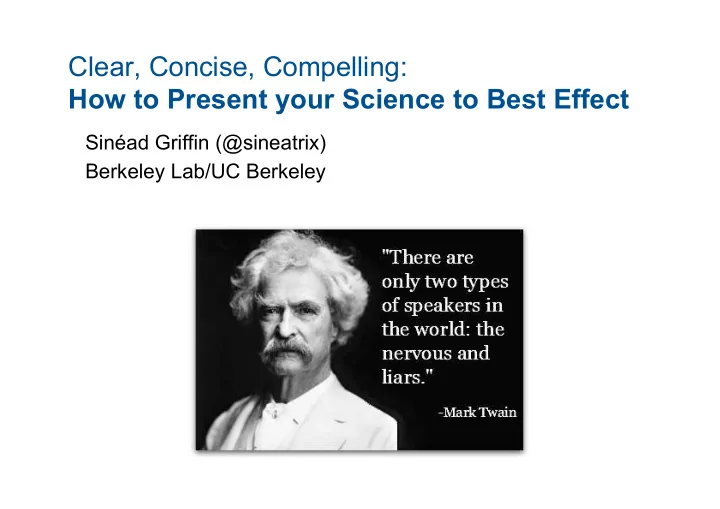
slide-2
SLIDE 2

Task: Open Day Talk

Some high school students are visiting your university (16-18 years old). You have one minute to describe one of the following: 1. Your research project/thesis 2. What your research group do 3. A recent exciting discovery in your field

slide-3
SLIDE 3

What makes a bad talk?

slide-4
SLIDE 4

What makes a good talk?

slide-5
SLIDE 5

Voice and delivery Body language Good introductions The body of the talk – tips Answering Questions Dealing with nerves Presenting your science in 3 minutes How to deliver you talk Anatomy of a Talk The Elevator Pitch

slide-6
SLIDE 6

Voice and delivery Body language Good introductions The body of the talk – tips Answering Questions Dealing with nerves Presenting your science in 3 minutes How to deliver you talk Anatomy of a Talk The Elevator Pitch

slide-7
SLIDE 7

How should you sound?

  • Good posture
  • Pitch! Try not to squeal! (words aren’t as audible)
  • Vary the tone – not all flat
  • Don’t shout, but be audible – speak to the person in the

corner of the room

  • Don’t cover your mouth
  • Practice words that you find difficult (and include them

in your slides in some cases)

slide-8
SLIDE 8

Very Special Relativity: The Pause

  • Pauses appear much longer to you than

they are to your audience

  • Why bother?
  • Increase impact and emphasis
  • Give the audience a break
  • Give yourself a break!
  • Can recover if you are lost

5-10 second breaks at appropriate times Can put a reminder into your slides

slide-9
SLIDE 9

Facial Expressions and Eye Contact

  • There’s no wrong way
  • Be genuine
  • Eye contact with every part of the room – don’t fixate on one corner or person
slide-10
SLIDE 10

Your Body Language

  • Dress appropriately
  • Be aware of your posture
slide-11
SLIDE 11

Keeping it Lively: Gestures

  • Makes a talk very lively
  • Practice in front of a mirror
  • Use gestures congruent with words
  • Examples:
  • One on hand, on the other hand
  • As we lower the temperature, the

percentage increased

  • I would like to give a broad outline and

then give some details

slide-12
SLIDE 12

Making use of the stage

  • Try not to stand in one spot the whole

time (for longer talks)

  • No nervous pacing
  • Move to interact more with your

audience

slide-13
SLIDE 13

Friend or Foe? The Laser Pointer

  • Can be a good alternative to cumbersome sticks/pointers
  • Use it sparingly!
  • Be careful of shaking hands
  • Hold the pointer in place for long enough
slide-14
SLIDE 14

Things to Avoid

  • Covering your mouth
  • Crossing your arms
  • Fidgeting, or playing with

things: have a strategy!

  • Reading your slides
  • Watch out for cables
  • Empty your pockets
  • Familiarize yourself with

equipment

slide-15
SLIDE 15

Voice and delivery Body language Good introductions The body of the talk – tips Answering Questions Dealing with nerves Presenting your science in 3 minutes How to deliver you talk Anatomy of a Talk The Elevator Pitch

slide-16
SLIDE 16

Have a confident beginning

  • Dress appropriately
  • Check that your laptop works before your

talk

  • Organise/check a pointer
  • Courtesy of Kings: be on time!
  • Before you start look around the room and

make some eye contact. Familiarize yourself with the room.

  • Check your posture, smile!
  • Thank the chair/ Introduce yourself
  • KNOW THE BEGINNING BY HEART!
slide-17
SLIDE 17

Graphs are Easy…

  • 1. Explain in general what you have

plotted (description of the title)

  • 2. Describe your x-axis with units, and

your y-axis with units

  • 3. Point out the different lines/features of

your graph and the legend

  • 4. Explain the key features of your graph

in more detail

  • 5. Reference

Red: Chae et al. Blue: Fiebig et al. Theory

Chae et al. PRL 108 10242 (2012)

slide-18
SLIDE 18

…and the end: Questions!!!

This is your research, you know what you have done And finally have a definite, pre-planned ending, and thank everyone. What is I don’t know the answer?

  • Ask them to rephrase/clarify the question
  • Acknowledge their point and say that you can discuss it after the talk
  • It’s ok to say you don’t know!
  • If it’s not relevant, address why it’s not and move on
  • You can repeat the question out loud to give yourself time to construct an answer
slide-19
SLIDE 19

Practice Makes Perfect

  • On your own, with your research group, colleagues
  • Pay attention to the beginning, the ending, and the transitions between slides

Aspect Comments Head

Structure, clarity, easy to follow, language, articulation

Hand

Posture, gesticulation, eye contact, use of visual aids

Heart

Sincerity, personal style, in touch with listeners, enthusiasm

Other observations

slide-20
SLIDE 20

Dealing with Nerves: Tips and Tricks

  • Practice!
  • Nerves are a good thing: use them to

your advantage

  • Concentrate on speaking clearly and

loudly

  • Adopt a confident posture (even if you

don’t feel that way!)

  • Eye contact and a smile at the

beginning

slide-21
SLIDE 21

Voice and delivery Body language Good introductions The body of the talk – tips Answering Questions Dealing with nerves Presenting your science in 3 minutes How to deliver you talk Anatomy of a Talk The Elevator Pitch

slide-22
SLIDE 22

The Short Pitch: talks for non-specialists

  • Open days
  • Attracting students
  • Funding
  • Journalists
  • Generally explaining what you do

The Elevator Pitch

slide-23
SLIDE 23

The he mos most impor important ant thing hing is is… …

slide-24
SLIDE 24

The Beginning!

  • ONE point, question or statement
  • Should summarize what you’ll talk about
  • Make it engaging for your audience

The he mos most impor important ant thing hing is is… …

slide-25
SLIDE 25

How it’s different from a usual scientific talk

  • No slides
  • Very short!
  • Your audience will probably not understand your

scientific jargon

  • You have to convince the audience that they want

to listen to you

  • You need to know the structure of your talk in your

head (again, can’t rely on slides)

slide-26
SLIDE 26

How to Open Your Talk

  • 1. An interesting piece of evidence or fact

Particle accelerators are used to dry the paint on soft drinks cans.

  • 2. An anecdote about you or something the audience will be familiar with
  • 3. Statement or Question that you will address – build suspense
  • 4. Something funny
  • 5. A scenario (Imagine that …)

Above all, make sure it’s interesting!

The audience will decide whether or not to pay attention to the rest of your talk in these first 30 seconds, so don’t give them an excuse not to.

slide-27
SLIDE 27

Some good openers

  • Clip – Tom Whyntie (famelab winner 2009)
  • Queen’s Speech at the 40th Anniversary to Her Succession:

“1992 is not a year on which I shall look back with undiluted pleasure. In the words of one of my more sympathetic correspondents, it has turned out to be an 'Annus Horribilis'. I suspect that I am not alone in thinking it so.”

  • Steven Chu at Commencement Address of Ponoma College:

"Normally, commencement speakers are like corpses at an Irish wake — we're needed for the ceremony, but no one expects us to say much."

slide-28
SLIDE 28

What should you talk about?

  • Something that you find interesting
  • Something that you know a lot about
  • Something you can explain in under 1/2/3 minutes!

Your talk should answer ALL of the following questions:

  • 1. What is it?
  • 2. Why is it important or interesting?
  • 3. Why does it matter to the audience?
slide-29
SLIDE 29

Who are your audience?

For a general, but intelligent, audience:

  • Absolutely no jargon – explain every term you use
  • Don’t assume any knowledge
  • Take the audience by the hand and guide them through your talk
  • Have an Emma in mind
slide-30
SLIDE 30

Structuring Your Talk

Zooming

  • Start from a broad concept
  • Add layers of detail
  • Ending zoom out again

OUTLINE

  • Opening: Statement/Question, etc.
  • Up to 1 minute of introduction (anecdote, scenario, etc.)
  • Zoom in: Explain the concept in a simple manner (and repeat if necessary)
  • Zoom out: Summary and link back to beginning
slide-31
SLIDE 31

Making it Interesting

  • Suspense and conflict
  • Very relevant examples that the audience will relate to
  • Strong, vivid language
  • References to history, art, music, etc.
  • Gimmicks?
  • Physical Presence:
  • Try not to fiddle with anything or cause distraction
  • Address the whole room (and not just one person)
  • Move a little (but not too much)
  • Gesture and use your hands
slide-32
SLIDE 32

Something things to Avoid…

  • Trying to be funny and failing!
  • Jargon
  • Saying something is ‘cool’, ‘really interesting’ or ‘fascinating’
  • Telling the audience what they should think about something
slide-33
SLIDE 33

How to improve

  • Practice!
  • Watch some excellent speakers:

ted.com fallingwalls.com

  • Ask for feedback
slide-34
SLIDE 34

Task: Open Day Talk

Some high school students are visiting your university (16-18 years old). You have one minute to describe one of the following: 1. Your research project/thesis 2. What your research group do 3. A recent exciting discovery in your field