
Laziness Laziness
#2
One-Slide Summary
- Building an interpreter is a fundamental idea in
- computing. Eval and Apply are mutually recursive.
- The most complicated parts of meval are the
handling of function abstraction (lambda) and function application.
- The most complicated part of mapply is handling a
non-primitive procedure: create a new environment, add variables to that environment corresponding to the arguments, and then apply the procedure body in that new environment.
- In lazy evaluation, a value is not computed until it is
- needed. A thunk is a piece of code that performs a
delayed computation.
#3
Outline
- Eval
- Apply
- Lazy
- Thunk
#4
Problem Set 7
- You will be writing an interpreter for Charme
– Charme is a simple version of Scheme
- Your interpreter will be written in Python
- This demonstrates that Python is at least as
powerful as Scheme
– Why?
- It turns out that Scheme is also at least as
powerful as Python
– Why?
#5
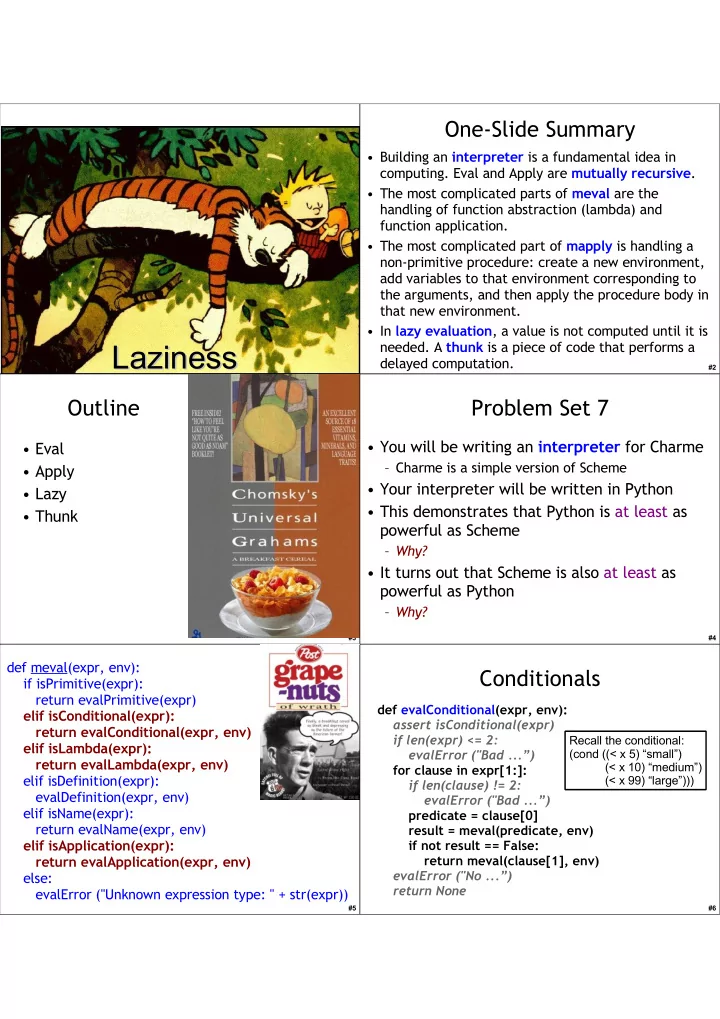
def meval(expr, env): if isPrimitive(expr): return evalPrimitive(expr) elif isConditional(expr): return evalConditional(expr, env) elif isLambda(expr): return evalLambda(expr, env) elif isDefinition(expr): evalDefinition(expr, env) elif isName(expr): return evalName(expr, env) elif isApplication(expr): return evalApplication(expr, env) else: evalError ("Unknown expression type: " + str(expr))
#6
def evalConditional(expr, env): assert isConditional(expr) if len(expr) <= 2: evalError ("Bad ...”) for clause in expr[1:]: if len(clause) != 2: evalError ("Bad ...”) predicate = clause[0] result = meval(predicate, env) if not result == False: return meval(clause[1], env) evalError ("No ...”) return None
Conditionals
Recall the conditional: (cond ((< x 5) “small”) (< x 10) “medium”) (< x 99) “large”)))