Clams Bivalve mollusks Appearance A clams shell consists two - - PowerPoint PPT Presentation

clams
SMART_READER_LITE
LIVE PREVIEW

Clams Bivalve mollusks Appearance A clams shell consists two - - PowerPoint PPT Presentation

Clams Bivalve mollusks Appearance A clams shell consists two halves that are usually equal which are connected by a hinge joint and a ligament that can be internal or external. Most clams have smooth outer shells. Features


slide-1
SLIDE 1

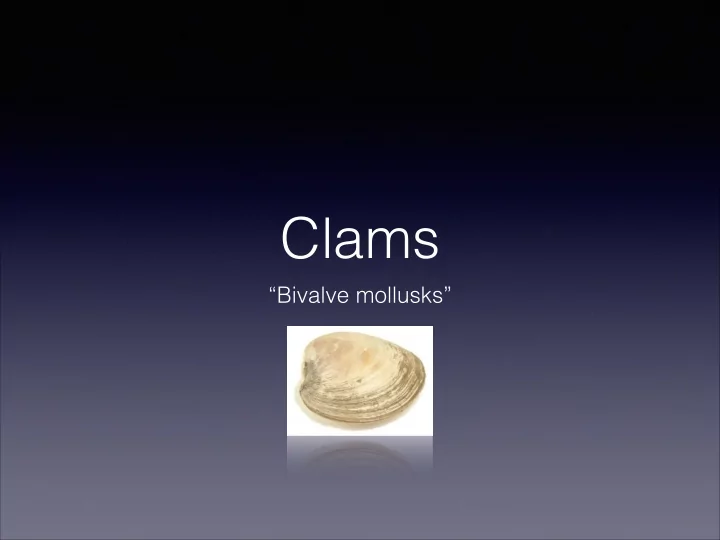
Clams

“Bivalve mollusks”
slide-2
SLIDE 2

Appearance

  • A clam’s shell consists two halves that are

usually equal which are connected by a hinge joint and a ligament that can be internal or external.

  • Most clams have smooth outer shells.
slide-3
SLIDE 3

Features

  • Clams have two adductor muscles contract to

close the shells.

  • No head or mouth (besides scallops)
  • Have kidneys, a heart, a mouth, and an anus
  • Have a natural glue that causes it to connect to
  • ther shells or things at the bottom of the river/sea
  • Clams are bilateral
slide-4
SLIDE 4

Clam parts

slide-5
SLIDE 5

Facts

  • There are approximately 2000 different species
  • f clams
  • 20% of them are not edible
  • Oysters make Pearls, not clams. They are not

the same, but very similar

slide-6
SLIDE 6

Reproduction

  • Clams may be male, female, or both
  • Females produce up to 60 million eggs in a
  • season. They release the eggs into open water

and then the male releases sperm. The eggs are fertilized in open water

slide-7
SLIDE 7

Growth

  • Once fertilized, the young clam goes through a

larvae stage where it is carried by waves and

  • currents. Eventually it develops a shell and sinks

to the bottom where it feeds on plankton

  • Once the shell is developed, clams dont grow as

much anymore

slide-8
SLIDE 8

Evolution

  • Clams and cephalopods first appeared in the

lower to middle Ordovician period

  • Clam-like Brachiopods existed before Earth’s

largest mass extinction

  • After the clarity when little existed, a different

kind of clam-like organism called a Bivalve, took

  • ver
slide-9
SLIDE 9

Clams today

  • As you may know, clams are most useful in

providing food for us

  • We also use the shells for multiple other reasons
slide-10
SLIDE 10

Works Cited

  • www.Wikipedia.com
  • www.astrobio.net
  • Yahoo answers