RESPIRATION Aquatic mollusks breathe using gills inside their - - PowerPoint PPT Presentation

respiration
SMART_READER_LITE
LIVE PREVIEW

RESPIRATION Aquatic mollusks breathe using gills inside their - - PowerPoint PPT Presentation

RESPIRATION Aquatic mollusks breathe using gills inside their mantle cavity. Snails, clams, octopi Oxygen from water moves into the blood flowing through the gills Carbon dioxide moves out of the blood into the gills Land


slide-1
SLIDE 1

RESPIRATION

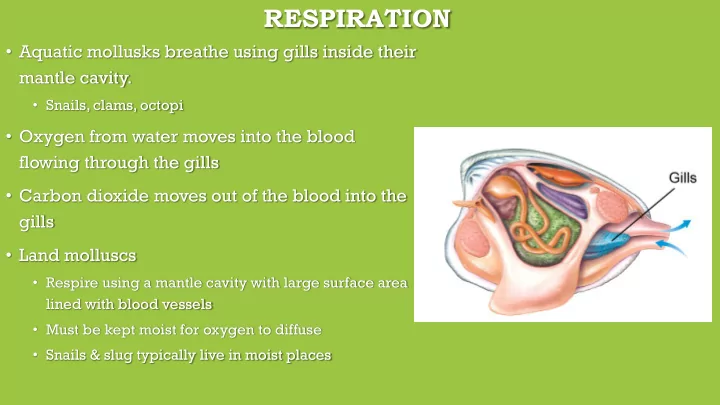
  • Aquatic mollusks breathe using gills inside their

mantle cavity.

  • Snails, clams, octopi
  • Oxygen from water moves into the blood

flowing through the gills

  • Carbon dioxide moves out of the blood into the

gills

  • Land molluscs
  • Respire using a mantle cavity with large surface area

lined with blood vessels

  • Must be kept moist for oxygen to diffuse
  • Snails & slug typically live in moist places
slide-2
SLIDE 2

CIRCULATION

  • Oxygen and nutrients carried to all parts
  • f the body via circulatory system
  • Open circulatory system,
  • blood is pumped through vessels by a simple

heart

  • Blood eventually leaves the vessels and works

it way through different sinuses

  • A large saclike space
  • Blood passes from the sinuses to the gills

where gases are exchanged

  • Blood then returns to the heart
slide-3
SLIDE 3
  • Closed circulatory system
  • More efficient
  • Developed in fast moving mollusks
  • Transports blood quicker
  • Octopi & squid
slide-4
SLIDE 4

EXCRETION

  • Cells of the body

release cellular waste into blood

  • Nephridia remove

ammonia from the blood and release it

  • utside the body.
slide-5
SLIDE 5

RESPONSE

  • Varies greatly
  • Clams and two shelled mollusks
  • Simple nervous system
  • Small ganglia near mouth
  • Few nerve cords
  • Simple sense organs (eyespots)
  • Octopi and relatives
  • Most highly developed nervous systems of all invertebrates
  • Well developed brains
  • Memory/intelligence
  • Active and intelligent predators
  • Release ink
slide-6
SLIDE 6

MOVEMENT

  • Move in

different ways

  • Snails
  • Secrete mucus
  • n base of foot
  • Use rippling

motion of foot

  • Fast moving

molluscs

  • Jet propulsion
  • Clam
  • Scallop
  • Octopus
  • Snail
  • Snail
slide-7
SLIDE 7

REPRODUCTION

  • Snails & two shelled

molluscs

  • External fertilization (sexual)
  • Tentacled molluscs and

certain snails

  • Internal fertilization (sexual)
  • Some species are

hermaphrodites