Role of marine and freshwater aquatic protected areas: pros and - - PowerPoint PPT Presentation

role of marine and freshwater
SMART_READER_LITE
LIVE PREVIEW

Role of marine and freshwater aquatic protected areas: pros and - - PowerPoint PPT Presentation

Role of marine and freshwater aquatic protected areas: pros and cons Steve Healy, Roger Chen, Mike Brassard CONS 486 Feb 27 th , 2015 Overview Introduction to Marine Protected Areas (MPAs) Paper review Pros and cons of MPAs


slide-1
SLIDE 1

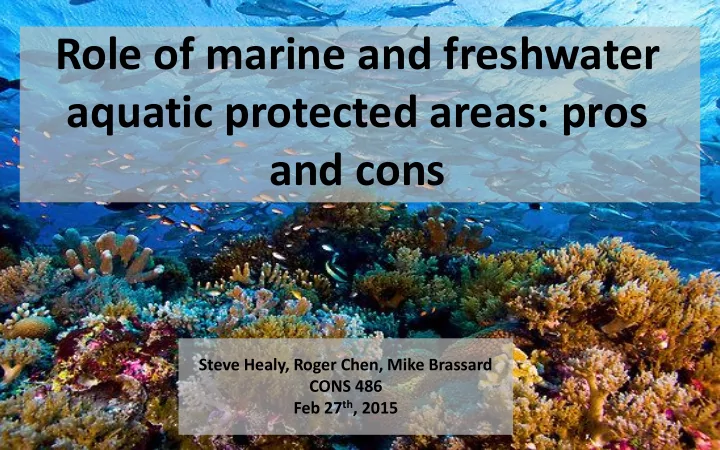
Role of marine and freshwater aquatic protected areas: pros and cons

Steve Healy, Roger Chen, Mike Brassard CONS 486 Feb 27th, 2015
slide-2
SLIDE 2

Overview

  • Introduction to Marine Protected Areas (MPAs)
  • Paper review
  • Pros and cons of MPAs
  • Discussion Questions

Mediterranean.panda.org

slide-3
SLIDE 3

Definition

Marine protected areas can be defined as ‘‘Any area of intertidal or subtidal terrain, together with its overlying water and associated flora, fauna, historical and cultural features, which has been reserved by law or other effective means to protect part or all of the enclosed environment’’ (Kelleher and Kenchington, 1992) A clearly defined geographical space, recognized, dedicated and managed, through legal

  • r other effective means, to achieve the long-term conservation of nature with associated

ecosystem services and cultural values. IUCN

slide-4
SLIDE 4

Categories

  • Strict Nature Reserve
  • Wilderness Area
  • National Park
  • Natural Monument or Feature
  • Habitat/Species Management Area
  • Protected Landscape/ Seascape
  • Protected area with sustainable use
  • f natural resources

IUCN Commission on National Parks and Protected Areas

Image: noaa.gov

slide-5
SLIDE 5

Categories

Conservation focus:

  • Natural heritage
  • Cultural heritage
  • Sustainable production

US government categorizes MPAs according to conservation focus and level of protection:

Image: noaa.gov

slide-6
SLIDE 6

Categories

Level of protection:

  • Uniform multiple-use
  • Zoned multiple-use
  • Zoned multiple-use with no-take area
  • No-take
  • No-impact
  • No-access

US government categorizes MPAs according to conservation focus and level of protection:

Image: noaa.gov

slide-7
SLIDE 7

Examples

Biggest MPA in the world:

  • The Papahānaumokuākea Marine National

Monument

  • In the middle of pacific ocean near Hawaii
  • 362,072 km2
  • Over 7,000 marine species
  • Home to many rare and endangered

species such as the green sea turtle and the Hawaiian monk seal.

Images: noaa.gov

slide-8
SLIDE 8

Examples

The Bowie Seamount Marine Protected Area:

  • The Bowie is the shallowest seamount

in Canada's Pacific waters and one of Earth's most biologically rich submarine volcanoes.

  • Situated about 180 kilometers offshore
  • f Haida Gwaii

Image: DFO

slide-9
SLIDE 9

Examples (Freshwater)

Great Lakes:

  • Have 10800 km2 protected area
  • Reduce non-native sea lamprey

(Petomyzoa marinus) in the North American Great Lakes,

  • Combined with reduced fishing

pressure, has allowed native lake trout (Salvelinus namaycush) and whitefish (Coregonus clupeaformis) populations to rebound

Image: DFO

slide-10
SLIDE 10

Examples (Freshwater)

Lake Superior National Marine Conservation Area , Ontario:

  • The world's largest freshwater

protected area with a surface area of over 10 000 km2

  • It covers about one third of the

Canadian portion of Lake Superior and extends to the Canada-United States border.

slide-11
SLIDE 11

Functions and impacts

Protect and conserve:

  • Commercial and non-commercial

Fishery resources and their habitats;

  • Endangered marine species and

their habitats;

  • Unique habitats;
  • Marine areas of high biodiversity
  • r Biological productivity; and
  • Any other marine resource or

habitat necessary to fulfill the Minister’s mandate.

  • - DFO
slide-12
SLIDE 12

Paper Overview and Critique

www.sayleeseafood.com

slide-13
SLIDE 13

Great Scallop (Pecten maximus)

  • Marine bivalve mollusc
  • Inequivalve
  • Right/lower shell is convex
  • Left/upper is flat
  • Typically 10-15 cm in length
  • Recorded sizes up to 24 cm
  • Sand, gravel, and mud bottoms
  • Range from intertidal to 250 m
  • Attached to substrate when young
  • Free swimming as adults
  • Filter feeders
  • Most active during day

Paul Naylor FAO.org

slide-14
SLIDE 14

Global Capture of Pecten maximus

slide-15
SLIDE 15

Aims of study

“The specific aims of the study were to test for differences in the abundance, body size, and allocation of tissue mass to gonads or soma in scallops sampled in areas subjected to different regimes of fishing activity.”

  • Kaiser et al. 2000
slide-16
SLIDE 16

Hypothesis

  • Areas open to commercial scallop fishing activity expected to have on

average:

  • 1. Lower abundance
  • 2. Smaller scallops

And  the release of competition for resources might lead to larger somatic growth and investment in reproductive tissues.

slide-17
SLIDE 17

Design

  • Inshore Potting Agreement (IPA)
  • area of ~500km2
  • established for over 25 yrs
  • voluntary participation until 2002
  • excludes the use of towed bottom-
  • 3 fishing regimes tested:

– Fished sites open to scallop dredging year round or fished illegally on annual basis (1,2,3,4,5) – Ex-fished sites illegally scallop dredged 18 months previously but not before this period (6,7) – No-fishing sites never subjected to towed bottom-fishing gear (8,9)

fishing gear

slide-18
SLIDE 18

Scallop Dredging - Process

lookforthehook.wordpress.com scotland.gov.uk

slide-19
SLIDE 19

Methods

  • 3 replicate tows per site

– 10 minute bottom-time durations

  • Minimum landing size of 10cm shell height
  • Habitat similar across all sites

– Coarse gravel, sand, and mud

  • 4 dredges used per tow

http://www.gulfofmaine-census.org/education

slide-20
SLIDE 20

Methods

  • Annual rings on shell used to determine age of individuals
  • Gonads and adductor muscle dissected out, dried, and weighed

– Gonads  larger = greater reproductive success (broadcast-spawners) – Adductor muscle is main mechanism of protection from most common predators (Common starfish)

  • Damage scars counted on right-hand valve

– Any irregular indentations on edge of shell or previously repaired injuries

flickrhivemind.net forestryimages.org

slide-21
SLIDE 21

Methods

Gonad Adductor muscle

Wikipedia Commons

slide-22
SLIDE 22

Results

  • Mean abundance of scallops was highest in no-fishing areas

– 12.8 times higher abundance than fished sites – Lowest in fished areas immediately surrounding the IPA

  • Scallops sampled from no-fishing areas had highest mean ratio of gonad dry

weight to adductor muscle dry weight – 19% and 24% compared to fished and ex-fished sites respectively

  • Scallops collected in ex-fished areas were smaller in size and abundance

– Short but intense period of selectivity for large individuals

  • Fished sites also showed higher incidence of shell scars due to injury

– Due to inefficiency of dredging

slide-23
SLIDE 23

Discussion

  • An estimated 15.9 times greater reproductive potential in scallops sampled

from protected areas compared to fished sites

  • Larger gonads believed to increase reproductive potential
  • Broadcast spawning means reproductive success is highly density

dependent

  • Energy expended repairing injuries lowers reproductive potential
slide-24
SLIDE 24

Criticisms

  • Small # of sites sampled

– Permission needed from fishers with static gear in plots (legal fishing)

  • Information on historical use of fishing grounds provided by fishers and

govt.

– Nothing to gain or lose by lying? – 10 yr working relationship

  • Scallop abundance varied significantly among replicate sample sites

– Few replicates and little consistency in site history

  • Not certain whether reduced gonad size resulted in fewer or smaller eggs

– Smaller egg size directly effects egg survival (Martinez & Perez 2003)

slide-25
SLIDE 25

Positive Aspects

  • Comparison of observations to other, larger surveys

– NE coast of USA (Murawski et al. 2000)

  • X 14 increase in biomass within MPAs

– Isle of Man, UK (Beukers-Stewart et al. 2005)

  • X 11 increase in biomass within MPAs
  • Observation of injuries caused by fishing equipment

– Effects on allocation of individual’s resources (repair vs reproduction) – Chronic fishing and associated injuries lower reproductive potential

  • Repeated suspension of sediments caused by bottom fishing and effects on

food supply

  • Reproduction through broadcast spawning

– Density dependency

slide-26
SLIDE 26

In summary…

“It would appear that areas protected from the effects of bottom fishing not only conserve population abundance and biomass of bivalve molluscs, but also maintain reproductive quality, which is greatly reduced in areas exposed to chronic fishing.”

  • Kaiser et al. 2000
slide-27
SLIDE 27

Pros and Cons

Of Marine Protected Areas

Photo: Wikimedia Commons

slide-28
SLIDE 28

Ecology - Pros

(Lester et al., 2009)

A 2009 Meta-analysis study of Marine Protected areas (MPAs) worldwide:

  • Data from 124 fully no-take reserves
  • Improvements in biomass, density, size

and species richness

  • Huge variation!

(site-specific differences, or activities

  • utside MPAs?)
slide-29
SLIDE 29

Ecology - Cons

  • Of 1306 MPAs studied, only 31% were meeting conservation goals

(Kelleher et al., 1995)

  • Not all species respond equally

to MPAs (Lester et al., 2009)

%

slide-30
SLIDE 30

Socio-economic - Pros

  • MPAs for tourism = good for economy! (Brown et al., 2001)

 eg. diving opportunities on coral reefs  positive feedback: tourism encourages further conservation of corals (Brown et al., 2001)

  • Can create jobs for locals (Brown et al., 2001)

 management, monitoring

www.donquijote.org www.isvolunteers.org

slide-31
SLIDE 31

Socio-economic - Cons

  • Can put fishers in area out of work (Brown et al., 2001)
  • and/or push locals out of area entirely
  • Development of tourism near

MPAs can cause increases in non-point sources of pollution! (Brown et al., 2001)  (eg. urban runoff, eutrophication)

  • MPAs are expensive to implement,

manage and monitor (White, 2002)

Flickr.com

slide-32
SLIDE 32

Socio-economic + Ecological (it’s complex!)

(Brown et al., 2001)

Low development, Low management Low development, High management High development, Low management High development, High management

slide-33
SLIDE 33

Socio-economic + Ecological (it’s complex!)

(Brown et al., 2001)

Low development, Low management Low development, High management High development, Low management High development, High management

slide-34
SLIDE 34

Fisheries? - Pros

  • Freshwater protected area to protect black bass nesting

sites in Lake Erie increase in reproductive success and CPUE for recreational fishers (Sztramko, 1985)

  • Spillover effect (Lester et al., 2009)

 increase fisheries yields

  • utside MPA
  • Can Increase abundance of target

species (White, 2002) (eg. San Salvadore Island, Phillipines)  banned destructive fishing gear, resource committee, community involvement and organization! MPA implemented

slide-35
SLIDE 35

Fisheries? - Cons

  • Fishing the line? (Roberts et al., 2005)

 impacts unclear: reduce spillover?

  • Often only complete closure of fisheries in

MPAs will provide benefit (Roberts et al., 2005)  loss of jobs, food sources for locals

  • Can redirect and intensify fishery in other surrounding areas (Roberts et al., 2005)

Noaanews.noaa.gov

slide-36
SLIDE 36

When are MPAs successful?

  • Site-dependant species with limited dispersal (Boersma and Parrish, 1999)
  • Cooperation (and/or co-management) of community and stakeholders often very

important for success! (White, 2002)

  • Five important features: full protection, enforcement, age >10yrs, size >100km2, isolation!

(Halpern, 2014)

Less effective More effective

(Halpern, 2014)

slide-37
SLIDE 37

When are MPAs unsuccessful?

  • Unlikely to be effective if they are subject >1 external stressors from

terrestrial, atmospheric or oceanic sources (Jameson et al., 2002)  eg. runoff, turbidity, dioxin

  • Smaller MPAs tend to

be less successful

  • Migratory species

Grist.org

slide-38
SLIDE 38

Lastly....

  • MPAs allow for a precautionary approach

(Agardy, 1994)  much uncertainty in marine environments  err on the side of caution: protection!

  • Allow for adaptive management (Agardy, 1994)

 field test concepts, conservation  allows feedback between science and conservation management

  • Protected areas can minimize human disturbance (Suski and Cooke, 2007)

 important because people are usualy sources of the problem!

Saveourshores.org

slide-39
SLIDE 39

Discussion Questions:

slide-40
SLIDE 40

Discussion Questions:

  • 1. What are some key or important factors conservationists should

consider before implementing an MPA?

slide-41
SLIDE 41

Discussion Questions:

  • 1. What are some key or important factors conservationists should

consider before implementing an MPA?

  • 2. What would be some examples of situations where an MPA may not

help a species?

slide-42
SLIDE 42

Discussion Questions:

  • 1. What are some key or important factors conservationists should

consider before implementing an MPA?

  • 2. What would be some examples of situations where an MPA may not

help a species?

  • 3. How would you re-design or change the experimental setup of the

Kaiser et al. paper?

slide-43
SLIDE 43

Discussion Questions:

  • 1. What are some key or important factors conservationists should

consider before implementing an MPA?

  • 2. What would be some examples of situations where an MPA may not

help a species?

  • 3. How would you re-design or change the experimental setup of the

Kaiser et al. paper?

  • 4. How can you keep balance between ecology and social-economy in

MPA area? (Or is this possible?)

slide-44
SLIDE 44

Discussion Questions:

  • 1. What are some key or important factors conservationists should

consider before implementing an MPA?

  • 2. What would be some examples of situations where an MPA may not

help a species?

  • 3. How would you re-design or change the experimental setup of the

Kaiser et al. paper?

  • 4. How can you keep balance between ecology and social-economy in

an MPA? (Or is this possible?)

  • 5. What do you think would be best? Few, no-take reserves OR many

multiple-use (ie. still with some fishing)?

slide-45
SLIDE 45

References

  • Agardy, M. T. (1994). Advances in marine conservation: the role of marine protected areas. Trends in

Ecology & Evolution, 9(7), 267-270.

  • Beukers-Stewart, B.D. et al. (2001). The efficiency and selectivity of spring-toothed scallop dredges:

a comparison of direct and indorect methods of assessment. J. Shellfish Res. 20: 121-126

  • Brown, K., Adger, W. N., Tompkins, E., Bacon, P., Shim, D., & Young, K. (2001). Trade-off analysis for

marine protected area management. Ecological Economics, 37(3), 417-434.

  • Gell FR, Roberts CM (2003). Benefits beyond boundaries: the fishery effects of marine reserves.

Trends Ecol Evol 18: 448-455

  • Halpern, B. S. (2014). Conservation: Making marine protected areas work. Nature.
  • Jameson, S. C., Tupper, M. H., & Ridley, J. M. (2002). The three screen doors: can marine “protected”

areas be effective?. Marine pollution bulletin, 44(11), 1177-1183.

  • Kaiser, M. J., Blyth-Skyrme, R. E., Hart, P. J., Edwards-Jones, G., & Palmer, D. (2007). Evidence for

greater reproductive output per unit area in areas protected from fishing. Canadian Journal of Fisheries and Aquatic Sciences, 64(9), 1284-1289.

  • Kelleher, G., Bleakley, C., Wells, S., 1995. Global representative system of marine protected areas.

The World Bank, Washington, 4 volumes.

  • Lester, S. E., Halpern, B. S., Grorud-Colvert, K., Lubchenco, J., Ruttenberg, B. I., Gaines, S. D., ... &

Warner, R. R. (2009). Biological effects within no-take marine reserves: a global synthesis. Marine Ecology Progress Series, 384(2), 33-46.

slide-46
SLIDE 46

References (cont’d)

  • Murawski, S.A. at al. 2000. Large-scale closed areas as a fishery-management tool in temperate

marine systems: the Georges Bank experiment. Science 66: 775-798

  • Myers RA et al. (2000). A fisheries management strategy robust to ignorance: rotational harvest in

the presence of indirect fishing mortality. Can J Fish Aquatic Science 57: 2357-2362

  • Roberts CM et al. (2001). Effects of marine reserves on adjacent fisheries. Science 294: 1920-1923
  • Roberts, C. M., Hawkins, J. P., & Gell, F. R. (2005). The role of marine reserves in achieving

sustainable fisheries. Philosophical Transactions of the Royal Society B: Biological Sciences, 360(1453), 123-132.

  • Smith, B. R., and J. J. Tibbles. 1980. Sea lamprey (Petromyzon marinus) in Lakes Huron, Michigan, and

Superior: history of invasion and control, 1936–87. Canadian Journal of Fisheries and Aquatic Science 37:1780–1801.

  • Suski, C. D., & Cooke, S. J. (2007). Conservation of aquatic resources through the use of freshwater

protected areas: opportunities and challenges. Biodiversity and Conservation, 16(7), 2015-2029.

  • Sztramko LK (1985) Effects of a sanctuary on the smallmouth bass fishery of Long Point Bay, Lake
  • Erie. North Am J Fish Manage 5:223–241
  • White, A. T., Courtney, C. A., & Salamanca, A. (2002). Experience with marine protected area

planning and management in the Philippines. Coastal Management, 30(1), 1-26.