SLIDE 1
mkke Phylum Mollusca General characteristics - molluscus soft - - PowerPoint PPT Presentation
mkke Phylum Mollusca General characteristics - molluscus soft (latin) - second largest animal phylum - includes chitons, snails, slugs, clams, oysters, squid, octopus & nautilus - bilaterally symmetrical - cephalization - have
SLIDE 2
SLIDE 3
General characteristics
- molluscus – soft (latin)
- second largest animal phylum - includes chitons, snails, slugs,
clams, oysters, squid, octopus & nautilus
- bilaterally symmetrical
- cephalization - have a distinct head with sense
- rgans & brain
- go through free-swimming larval stage called
trochophore
SLIDE 4
General characteristics
- all share similar development pattern and common body
plan:
- mantle – protective „coat“covering soft-bodies that may or may not
form a hard, calcium carbonate shell
- visceral mass - body organs below mantle
- muscular foot for movement which is modified into tentacles for
squid & octopus
- gills between the mantle & visceral mass used for gas exchange
SLIDE 5
General characteristics
- all share similar development pattern and common body
plan:
- mantle – protective „coat“covering soft-bodies that may or may not
form a hard, calcium carbonate shell
- visceral mass - body organs below mantle
- muscular foot for movement which is modified into tentacles for
squid & octopus
- gills between the mantle & visceral mass used for gas exchange
SLIDE 6
General characteristics
Includes 4 classes: Polyplacophora (chitons) Gastropoda (snails, slugs, nudibranchs, conchs) Bivalvia (clams, oysters & mussels) Cephalopoda (squid, octopus & nautilus)
SLIDE 7
Chitons
Polyplacophora
SLIDE 8
snail slug
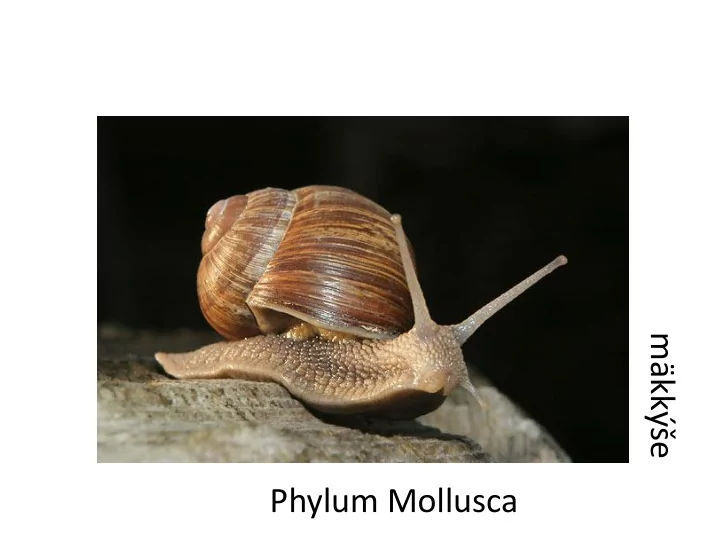
Gastropoda (ulitníky)
- 1 shell often coiled
- distinct head with eyes
and sense organs
- radula
- some terrestrial, aquatic
SLIDE 9
SLIDE 10
conch
SLIDE 11
Bivalvia (lastúrniky)
clams
- ysters
mussels
SLIDE 12
- 2 part shells
- no head or eyes
- filter-feeders
- live in water (gills)
Bivalvia
SLIDE 13
Cephalopoda (hlavonožce)
squid
- ctopus
nautilus
SLIDE 14
Cephalopoda
- well developed brain and eyes
- fast moving predators
- foot is modified to tentacles
- camouflage or jet propulsion when threated
SLIDE 15
Structure of Mollusca
SLIDE 16
Structures and functions
Digestive system
- complete one-way digestive tract mouth → anus
(mouth, oesophagus, stomach, intestine, anus)
- radula - a scraping, tongue-like structure (gastropoda)
beak (cephalopodes) Excretory system
- nephridia – remove metabolic waste (amoniac)
- digestive waste through anus
SLIDE 17
Structures and functions
Respiratory system
- aquatic mollusks have gills
- terrestrail mollusks have primitive lungs (highly folded
mantle) Circulatory system
- open circulatory system (gastropodes, bivalvia) – heart
pumps hemolymph (blood) through open space
- close circulatory system (cephalopodes)
SLIDE 18
Structures and functions
Nervous system
- Bivalvia – reduced NS, no head
- Gastropoda – fairy basic (nerve cord and ganglia)
- Cephalopoda – very well developed
- very good vision
- ability to learn (memory)!!!
Reproduction system
- most gonochorists (separate sexes)
- external or internal (terrestrial species)
fertilisation
SLIDE 19
Ecology
- used by humans for food
- pearls from oysters
- shells used for jewelry
- do crop & garden damage
- serve as intermediate hosts for some parasites such as flukes
SLIDE 20
Slizniak karpatský