19/12/2012 1
1
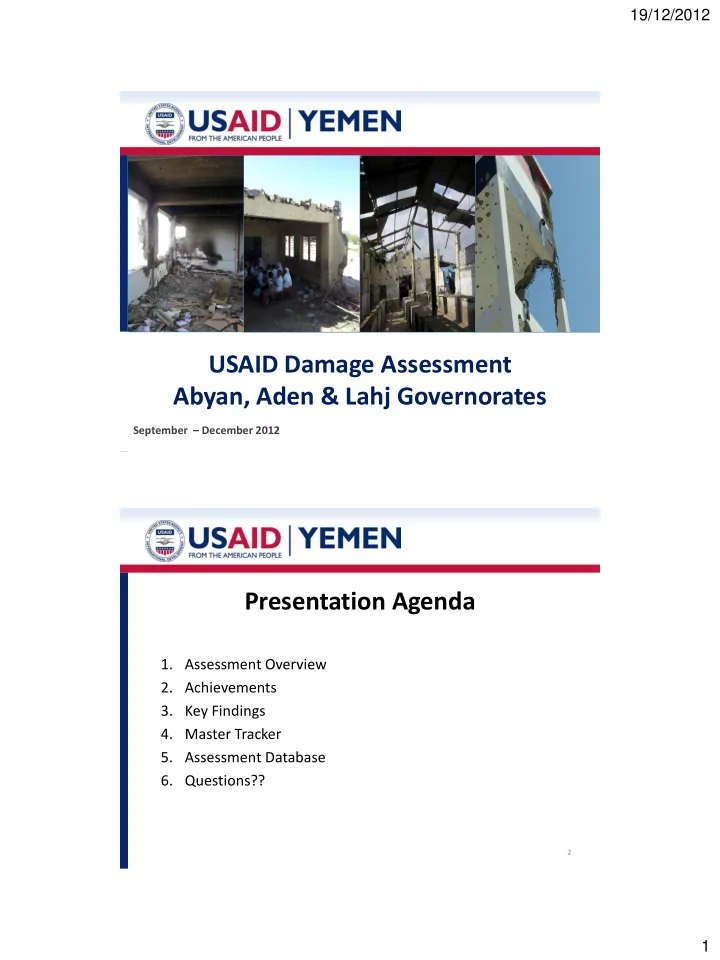
USAID Damage Assessment Abyan, Aden & Lahj Governorates
September – December 2012
2
Presentation Agenda
- 1. Assessment Overview
- 2. Achievements
- 3. Key Findings
- 4. Master Tracker
- 5. Assessment Database
- 6. Questions??
USAID Damage Assessment Abyan, Aden & Lahj Governorates - - PDF document
19/12/2012 USAID Damage Assessment Abyan, Aden & Lahj Governorates September December 2012 1 Presentation Agenda 1. Assessment Overview 2. Achievements 3. Key Findings 4. Master Tracker 5. Assessment Database 6. Questions?? 2 1
1
September – December 2012
2
3
4
September 2012: Met with the Abyan Governor to discuss the Assessment goals, request permission to travel within the governorate and to request introductions to key Abyan Ministries (Health, Education, Public Works and Highways, Electricity) September 2012: Asked the Governor, MOPIC and key Ministries for a list
October 2012: Met with OCHA, UNICEF, WHO, UNHCR and key INGOs working in Abyan to coordinate Assessment, share data and identify priorities October & November 2012: Conducted the Assessment of 164 total structures in Abyan: schools, markets, health facilities, roads, electricity networks December 2012: Shared the Assessment results and database access with USAID, ROYG, other donors and INGOs
5
114 37 5 7 1 78 39 Public Schools/Abyan Public Health/Abyan Public Markets/Abyan Primary Roads/Abyan Electrical Power Lines/Abyan IDP Schools/Aden IDP Schools/Lahj
6
114 schools assessed in Abyan / 98 entries in the Assessment database 12 / 114 schools assessed in Abyan remain occupied by IDPs 4 / 114 schools were assessed as having “major damage” (75% damage
Khanfir 23 / 114 schools were assessed as having “moderate damage” (25-75%) 5 schools in Zingibar already rehabilitated by USAID/CLP (Oct-Nov 2012) 6 additional schools in Zingibar and Khanfir to commence USAID/CLP rehabilitation in Dec 2012 A number of rural schools in Abyan remain unfinished, poorly constructed and are poorly equipped. This is a good opportunity for donor assistance, despite not being directly impacted by the conflict.
7
8
9
External damage to schools in Zingibar, Abyan
10
External damage to schools in Zingibar, Abyan
11
Substantial structural damage to schools in Zingibar
12
Internal damage to schools and school equipment in Zingibar, Abyan
13
Example of unfinished school in rural Abyan district, requiring rehabilitation
14
Example of school “under construction” in rural Abyan district, with classes taking place in at-risk conditions for children
15
Example of unfinished basic school structure in remote Abyan district, requiring rehabilitation and equipping
16
Example of an unfinished school in a rural Abyan district, requiring rehabilitation and equipping
17
37 health facilities in Abyan assessed / 34 entries in Assessment database 2 / 37 health facilities in Zinjibar remain occupied by IDPs 0 / 37 health facilities in Abyan assessed as having “major damage” (more than 75%) 2 / 37 health facilities assessed as having “moderate damage” (25-75% damage or more) 2 out of the health facilities in Zinjibar and Khanfir with moderate damage are proposed by USAID / CLP for rehabilitation 2 of the health facilities assessed were comprehensively rehabilitated recently by WHO and ICRC 5 of the health facilities assessed were rehabilitated or equipped by USAID / OTI within the past 2 years Small Health Units in Abyan are poorly equipped and would benefit greatly from assistance
18
19
Zingibar Hospital that sustained extensive damage during the conflict
20
Zingibar Hospital showing damage to internal rooms and damage to the hospital’s water tank, requiring rehabilitation
21
Rehabilitation of health facilities in Zingibar is slowly starting to take place. This is the Zingibar Maternal and Child Health Center, recently rehabilitated by WHO.
22
Example of rural Health Unit in Khanfir, Abyan that is non functional and needs to be equipped and rehabilitated
23
24
25
Examples of conflict-related damage to roads in Abyan that have already been repaired by the Yemen government
26
Dangerous road damage due to erosion on major highway in Abyan and an example of ongoing road maintenance
27
Examples of commonly occurring damage to walkways and median strips in urban areas in Abyan
28
Examples of common damage to walkways and median strips in Abyan urban areas and looting of paving bricks
29
Mountainous roads in Abyan have different maintenance requirements, mostly weather-related erosion
30
Mountainous roads in Abyan showing barrier damage and mountain erosion on main highway
31
The major bridges in Abyan did not sustain damage during the conflict and do not require rehabilitation.
32
33
34
The Fish Market in Zingibar sustained heavy damage during the conflict in Abyan and requires complete rehabilitation. The market is currently operating in temporary stalls outside the main facility.
35
The Ja’ar Central Market did not sustain damage in the Abyan conflict but is in a bad state of disrepair and requires substantial maintenance and
stalls outside the main facility.
36
Examples of temporary stalls operating outside the main Abyan public market facilities.
37
38
39
Electrical cables and poles were extensively damaged and/or looted during the Abyan conflict
40
Further examples of looted electrical parts and a stolen electricity transformer
41
Damaged electrical insulators and highway lighting along the N2 Highway
42
43
44
The external structures in Aden IDP schools were not damaged by the
classrooms and major looting of school equipment and fixtures.
45
IDP schools in Aden are largely overcrowded and lack student desks and basic education equipment. Classes are ongoing, despite these challenges.
46
During the November 2012 assessment of the IDP schools in Aden, 20 of the 78 schools assessed remained occupied by IDPs. According to the MoE in Aden by December 5, 2012 this number has been reduced to 7 IDP-occupied schools.
47
Examples of the state of the Aden schools following departure of IDPs. Damage to the school interiors and looting of plumbing and electrical fixtures is common.
48
Examples of Aden IDP schools showing looting of electrical fixtures and removal of previously installed windows and doors.
49
Aden IDP schools require 14,878 double student desks. These photos depict examples of locally produced student double desks showing two different models and quality.
50
39 IDP schools were assessed No schools remained occupied by IDPs at time of the assessment Total number of student double desks required = 4,810 Significant looting by IDPs of school equipment and fixtures (electrical, doors, windows, fans, toilets) has occurred. Damage to the structure of these IDP schools is related to IDP occupation and is minor to moderate (painting, tiling, replacement of fixtures, windows and doors and repair of WASH facilities. Two of the IDP schools were considered “major damage” due to poor construction of original structures and significant disrepair. A number of rural schools in Abyan remain unfinished, poorly constructed and are poorly equipped. This is a good opportunity for USAID assistance, despite not being directly impacted by the conflict.
51
52
Examples of conflict-related damage in IDP schools in Lahj. Conditions in these schools are similar to those of the Aden IDP schools and require both rehabilitation and equipping.
53
The 39 schools in Lahj are now fully vacated of IDPs but lack basic educational equipment and desks required for a normal learning environment. Lahj IDP schools require 4,810 double student desks.
54
Examples of the state of the Lahj schools following IDP departure. The WASH facilities in general were badly damaged or looted and require rehabilitation.
55
Major support to the education facilities in Yemen is needed to assist both teachers and students to function in an improved learning environment.
56
57
58
59
Yemen Monitoring and Evaluation Project