Anniston PCB Site Natural Resource Damage Assessment and - - PowerPoint PPT Presentation

anniston pcb site natural resource damage assessment and
SMART_READER_LITE
LIVE PREVIEW

Anniston PCB Site Natural Resource Damage Assessment and - - PowerPoint PPT Presentation

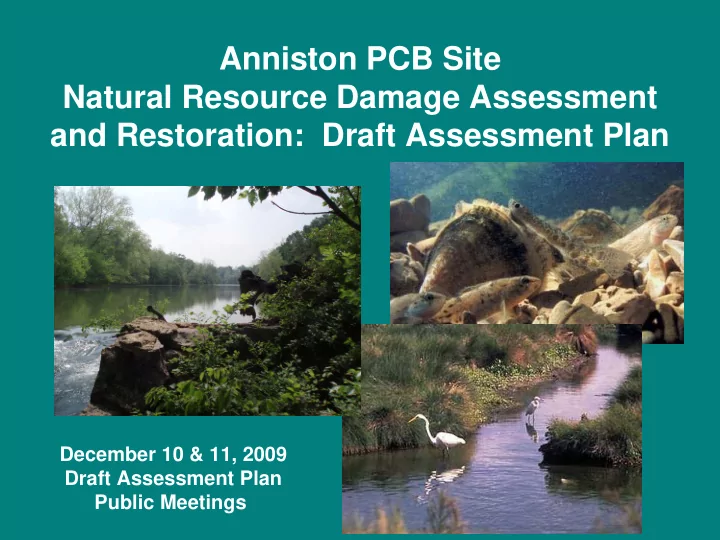
Anniston PCB Site Natural Resource Damage Assessment and Restoration: Draft Assessment Plan December 10 & 11, 2009 Draft Assessment Plan Public Meetings Presentation Objectives - overview of the Natural Resource Damage Assessment and

slide-1
SLIDE 1

Anniston PCB Site Natural Resource Damage Assessment and Restoration: Draft Assessment Plan

December 10 & 11, 2009 Draft Assessment Plan Public Meetings

slide-2
SLIDE 2

Presentation Objectives

  • overview of the Natural Resource Damage

Assessment and Restoration (NRDAR) process

  • update on the NRDAR activities at the Anniston

PCB Site

  • overview of draft Anniston NRDAR

Assessment Plan

  • review schedule
  • questions
slide-3
SLIDE 3
  • EPA led
  • Goals are the Overall

Protection of Human Health and the Env.

  • Reduction of toxicity,

mobility or volume through treatment (Removing the PCBs)

  • Natural Resource

Trustee Led – ADCNR, GSA & USFWS

  • Goals are to Make the

Public WHOLE for injury to their resources. (Conducting Restoration)

CERCLA Process CERCLA Process NRDAR Process NRDAR Process Basic Differences B/W CERCLA & NRDAR

slide-4
SLIDE 4

It is the process used by natural resource trustees to determine the nature and extent

  • f injury to trust

resources caused by an oil spill or release

  • f a hazardous

substance (PCBs).

What is Natural Resource Damage Assessment?

slide-5
SLIDE 5

The NRDAR Process – What we do!

  • Basically, the Trustees assess the past, current and

future PCB injuries to resources and identify and plan restoration actions to address these injuries.

  • The money recovered from the responsible party is used

to restore, replace or acquire the equivalent of the injured resource. (eye for an eye!)

  • BASIC GOAL: Reimburse the public for the injuries as a

result of the incident if the incident had never occurred through restoration.

slide-6
SLIDE 6

Anniston PCB Site Natural Resource Trustees

Alabama Department of Conservation and Natural Resources

slide-7
SLIDE 7

Major Concepts in NRDAR

  • Damages (usually $) are for compensation to

injuries to natural resources or/and response actions

  • Damages ($) are to be used for Restoration
  • This is NOT a punitive process (not a fine)!!
  • The Public and the PRPs are involved in the

process

slide-8
SLIDE 8

General Steps in the NRDAR Process

  • Pre-assessment Screen:

Final - February 2005

  • Assessment Planning:

Draft Stage 1 Assessment Plan November 2009

  • Injury Determination:

Ongoing

  • Injury Quantification
  • Damage Calculation
  • Settlement or Litigation
  • Restoration
slide-9
SLIDE 9

CERCLA ERA Process CERCLA ERA Process

Screening-level Problem Formulation Study Design Field Reconnaissance Site Investigation Risk Characterization Risk Management Pre-Assessment Screen Assessment Plan Injury Determination Injury Quantification Damage Assessment Settlement

Remediation and Restoration Construction & Monitoring NRDAR Process NRDAR Process

slide-10
SLIDE 10

concepts: … the process used by natural resource trustees to determine the nature and extent of injury to trust resources caused by an oil spill

  • r release of a hazardous substance.

What is Natural Resource Damage Assessment?

slide-11
SLIDE 11

Anniston PCB Site CERCLA Operable Units

  • Operable Unit 1 – Residential Areas
  • Operable Unit 2 – Non-Residential Areas
  • from facility to HWY 78
  • Operable Unit 3 – Solutia Facility
  • includes South and West End Landfills
  • Operable Unit 4 – Choccolocco Creek and

associated floodplain

slide-12
SLIDE 12

% % % % Red Denotes Fish Consumption Advisories

Not to Scale CERCLA Site NRDAR Site Anniston

Choccolocco Creek

Logan Martin

Lake

Lay Lake Neely Henry Lake Mitchell Lake

Anniston PCB Site

#

Neely Henry Dam Logan Martin Dam Lay Dam

slide-13
SLIDE 13

concepts: … the process used by natural resource trustees to determine the nature and extent of injury to trust resources caused by an oil spill

  • r release of a hazardous substance.

What is Natural Resource Damage Assessment?

slide-14
SLIDE 14

Injury

… any adverse change in the condition of a resource caused by exposure to contaminants, including response actions

  • examples: death, malformation, loss of

reproductive capability, change in water quality, changes in soil quality, etc.

slide-15
SLIDE 15

Examples of Injuries to Fish and Wildlife

 Death  Disease  Cancer  Genetic Mutations  Physical Deformities  Behavioral Abnormalities

slide-16
SLIDE 16

concepts: … the process used by natural resource trustees to determine the nature and extent of injury to trust resources caused by an oil spill

  • r release of a hazardous substance.

What is Natural Resource Damage Assessment?

slide-17
SLIDE 17

Anniston PCB Site Natural Resources

  • surface water
  • groundwater
  • soils
  • sediment
  • benthos
  • mollusks
  • fish
  • terrestrial invertebrates
  • reptiles and amphibians
  • birds
  • mammals
  • threatened/endangered

species (12)

slide-18
SLIDE 18

concepts: … the process used by natural resource trustees to determine the nature and extent of injury to trust resources caused by an oil spill

  • r release of a hazardous substance.

What is Natural Resource Damage Assessment?

slide-19
SLIDE 19

bottom-line: … NRDA is designed to compensate the environment and public for injuries to natural resources resulting from the release of hazardous materials

  • compensation achieved through:
  • restoration, rehabilitation, replacement of

injured resources

What is Natural Resource Damage Assessment?

slide-20
SLIDE 20

So What Is Restoration? Returning resources to the condition they would have experienced if the hazardous exposure (PCBs) had never

  • ccurred.
slide-21
SLIDE 21

Examples of Restoration

Enhance or restore quality of existing habitat (ex. Planting trees in a bare area, stream restoration)

Increase populations through reintroduction or restocking (ex. Fish)

Purchase quality habitat for management by States, Tribes, or non-profit organizations (ex. wildlife management areas/parks)

Public access and education (ex. Nature trails, fishing access, educational kiosks)

slide-22
SLIDE 22

E&T Species/Ecosystem

slide-23
SLIDE 23

Restore Habitat Benefits Wildlife I mprove Water Quality

slide-24
SLIDE 24

Create Riparian Buffer Benefits Wildlife I mprove Water Quality

slide-25
SLIDE 25
  • Pre-assessment Screen
  • Assessment Planning
  • Injury Determination
  • Injury Quantification
  • Damage Calculation
  • Settlement or Litigation
  • Restoration

Anniston PCB Site NRDAR - Status

slide-26
SLIDE 26

CERCLA ERA Process CERCLA ERA Process

Screening-level Problem Formulation Study Design Field Reconnaissance Site Investigation Risk Characterization Risk Management Pre-Assessment Screen Assessment Plan Injury Determination Injury Quantification Damage Assessment Settlement

Remediation and Restoration Construction & Monitoring NRDAR Process NRDAR Process

slide-27
SLIDE 27

Anniston PCB Site Draft NRDAR Assessment Plan

slide-28
SLIDE 28

Anniston PCB Site Draft NRDAR Assessment Plan Chapter 1: Introduction

  • overview of the NRDA Process
  • summary of the Anniston PCB

Site Pre-Assessment Screen

  • description of the intent and
  • rganization of the Plan
  • details on the Public Comment

process

slide-29
SLIDE 29

Anniston PCB Site Draft NRDAR Assessment Plan Chapter 2: Background

  • description of Assessment Area
  • site history
  • hazardous substance releases
  • overview of CERCLA activities
slide-30
SLIDE 30

Anniston PCB Site Draft NRDAR Assessment Plan Chapter 3: Authorities

  • review of legal authorities
  • Trustee Agency authorities
  • identification of natural resources

considered in the NRDA

slide-31
SLIDE 31

Anniston PCB Site Draft NRDAR Assessment Plan Chapter 4: Coordination and Previous Actions of Trustees

slide-32
SLIDE 32

Anniston PCB Site Draft NRDAR Assessment Plan Chapter 5: Confirmation

  • f Exposure
  • provides evidence/justification

for NRDA action

  • evaluates available data for:
  • surface water resources
  • groundwater resources
  • geological resources
  • biological resources
  • estimates time for recovery
slide-33
SLIDE 33

Anniston PCB Site Draft NRDAR Assessment Plan Chapter 6: Stage 1 Injury Assessment

  • describes proposed injury

assessment approach

  • identifies data sources
  • evaluates exposure pathways
  • defines injury criteria

* Injury Determination and Quantification Steps

slide-34
SLIDE 34

Anniston PCB Site Draft NRDAR Assessment Plan Chapter 7: Damage Determination

  • describes proposed approach to

place a value on injured resources

  • describes restoration planning
  • bjectives and processes
  • describes coordination with the

CERCLA action * Damage Calculation Step

slide-35
SLIDE 35

Anniston PCB Site Draft NRDAR Assessment Plan Chapter 8: References

slide-36
SLIDE 36

Anniston PCB Site Draft NRDAR Assessment Plan Appendices

A: Threatened and Endangered Species B: List of Chemicals of Potential Concern

slide-37
SLIDE 37

Anniston PCB Site Draft NRDAR Assessment Plan

  • A copy may be downloaded at

http://www.fws.gov/daphne

  • Or, request a copy from:

Karen Marlowe Propst Hall, Rm. 229 800 Lakeshore Drive Birmingham, AL 35229-2234 (205)726-2667 karen_marlowe@fws.gov

slide-38
SLIDE 38

Anniston PCB Site Draft NRDAR Assessment Plan

  • Open comment period from Nov ___ to

Jan 31, 2010.

  • Send comments to:

Karen Marlowe Propst Hall, Rm. 229 800 Lakeshore Drive Birmingham, AL 35229-2234 (205)726-2667 karen_marlowe@fws.gov

slide-39
SLIDE 39

Anniston PCB Site NRDAR Assessment Plan Schedule:

  • release plan for public review

Nov 2009

  • 60-day review period

Nov 2009-

  • public meeting(s)

Jan 2010

  • respond to comments/finalize plan

Feb 2010

  • Phase 1 field sampling with CERCLA

Dec 2010 +

  • restoration scoping

Dec 2010 +

  • Phase 2 studies

?

slide-40
SLIDE 40

In Summary

 The Trustees (ADCNR, GSA, and USFWS) are not part

  • f the Partial Consent Decree with EPA and

Solutia/Pharmacia!!  The Public and Responsible Parties are involved in the NRDAR process.  The NRDAR process is not punitive.  Restoration of injured resources is the primary objective

  • f the Natural Resource Damage Assessment and

Restoration (NRDAR) process.  Provide your comments on the Draft Assessment Plan by January 31, 2010.  Start thinking about restoration projects or types that you would like to see in your community.

slide-41
SLIDE 41

Questions?

Contact:

Karen Marlowe Propst Hall, Rm. 229 800 Lakeshore Drive Birmingham, AL 35229-2234 (205) 726-2667 karen_marlowe@fws.gov