
SLIDE 1
OFFICE OF THE GOVERNMENT MINISTRY OF PLANNING AND INVESTMENT
USAID Linkages for Small and Medium Enterprises
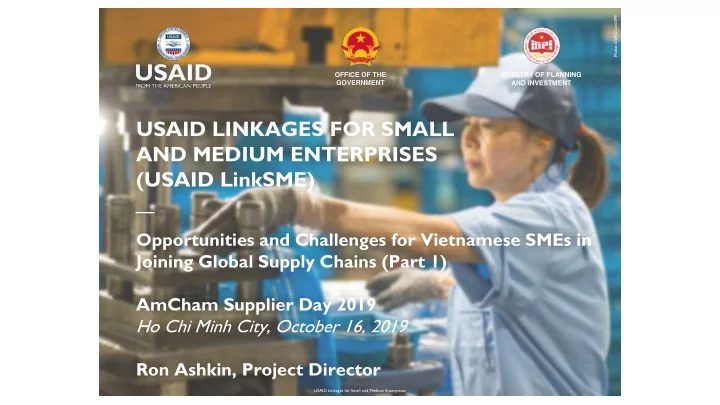
USAID LINKAGES FOR SMALL AND MEDIUM ENTERPRISES (USAID LinkSME)
Photo: USAID LinkSME
AND MEDIUM ENTERPRISES (USAID LinkSME) Opportunities and Challenges - - PowerPoint PPT Presentation
Photo: USAID LinkSME OFFICE OF THE MINISTRY OF PLANNING GOVERNMENT AND INVESTMENT USAID LINKAGES FOR SMALL AND MEDIUM ENTERPRISES (USAID LinkSME) Opportunities and Challenges for Vietnamese SMEs in Joining Global Supply Chains (Part 1)
OFFICE OF THE GOVERNMENT MINISTRY OF PLANNING AND INVESTMENT
USAID Linkages for Small and Medium Enterprises
Photo: USAID LinkSME
manufacturing locations
Slide No. 2
USAID Linkages for Small and Medium Enterprises
– Vietnam Panorama, October 1, 2019
– Vietnamnet, August 22, 2019
– Vietnamnet, February 11, 2019
– VN Express International, November 28, 2018
– Vietnam Economic News, October 7, 2018
– Vietnamnet, April 18, 2018
– Thoi Dai Vietnam Times, November 30, 2017
Slide No. 3
■ 98 percent of total enterprises ■ 63 percent of employment ■ 45 percent of GDP ■ Only 1,800 SMEs in supporting industries across all sectors (MOIT)
Small and Medium Enterprise (SME) Landscape
■ Foreign direct investment (FDI): $35 billion in 2018 – up a further
69% year-on-year through June 2019
■ Largest investors: South Korea, Japan, Singapore, now China ■ FDI firms dominate Vietnam’s exports (70%) ■ Lead firms co-locate with their foreign suppliers
Lead Firms in Vietnam
■ Local content in Vietnam is low by regional and global standards ■ Why? Low technology adoption, poor productivity, lack of
experience with lead firms, inadequate standardization, shortage of skilled staff and management, language barriers, limited access to finance, low reliability…
SME Linkages to Lead Firms
USAID Linkages for Small and Medium Enterprises 4 Slide No. 4
Slide No. 5
Overall, is Vietnam a lower cost manufacturing location than China?
and medium-sized enterprises (SMEs) and lead firms
Vietnamese SMEs and lead firms
Strengthen the SME-lead firm business linkage framework
Enhance Vietnamese SMEs’ capacity to participate in supply chains
Slide No. 6
USAID Linkages for Small and Medium Enterprises
Slide No. 7
USAID Linkages for Small and Medium Enterprises
Slide No. 8
Key Personnel Ron Ashkin Duong Thi Kim Lien Frank Weiand Project Director Deputy Project Director Technical Team Lead 6th Floor, 10 Chu Văn An, Dien Bien Ward, Ba Dinh District, Ha Noi Main Office: Hanoi Unit 14.4, E-town Central, 11 Doan Van Bo, Ward 12, District 4, HCM City Regional Office: Ho Chi Minh City
USAID Linkages for Small and Medium Enterprises
Slide No. 9
USAID Linkages for Small and Medium Enterprises
Slide No. 10
USAID Linkages for Small and Medium Enterprises
VIETNAMFLAVOR.COM
USAID Linkages for Small and Medium Enterprises Contact Information: USAID: Thuy Nguyen, Contracting Officer’s Representative (COR) thunguyen@usaid.gov Greg Leon, Director, Office of Economic Growth and Governance gleon@usaid.gov LinkSME: Ron Ashkin, Project Director rashkin@linksme.org Lien Duong, Deputy Project Director duonglien@linksme.org Frank Weiand, Technical Advisor fweiand@linksme.org
Slide No. 11
OFFICE OF THE GOVERNMENT MINISTRY OF PLANNING AND INVESTMENT
USAID Linkages for Small and Medium Enterprises
Photo: USAID LinkSME
Slide No. 13
Slide No. 14
Source: US Census18
√ √ √ √ √ √
Slide No. 15
* All sectors, based on 2018 trade flows
Slide No. 16
USAID Linkages for Small and Medium Enterprises
capabilities and what buyers need?
echnology
first, while addressing longer-term challenges
partners to connect with buyers and upgrade your capabilities
Slide No. 17
USAID Linkages for Small and Medium Enterprises
Slide No. 18
USAID Linkages for Small and Medium Enterprises
USAID Linkages for Small and Medium Enterprises Slide No. 19
THE INFORMATION HEREON IS THE PROPERTY OF LinkSME AND/OR ITS SUBSIDIARIES. WITHOUT WRITTEN PERMISSION, ANY COPYING, TRANSMITTAL TO OTHERS, AND ANY USE EXCEPT THAT FOR WHICH IT IS LOANED, IS PROHIBITED
Design demand and planning Purchasing Performance management Contract management Supplier relationship management
and operations advisory
compliance
procurement
capability assessment
levers
management ( KPI tracking, PPM surveillance, delivery performance, supplier review…)
procurement
management
management
Procurement process at most International Organizations looks as below: Activities Sub Activities Key Processes
Contract Management Negotiation Strategic Sourcing & Tendering Contract Finalization & Implementation Requisition & Approval Receipt, Inspection & Invoicing Supply Order Management Reconciliation, Control & Payment Requirements & Specifications Make vs. Buy Analysis Planning and Demand assessment Pricing, SLA Definition Supplier Risk Management Supplier Relationship Management Identification & Registration Performance Management Quality Management Warehouse Management Logistics Management Inventory Management
Key supplier touch points
Slide No. 20
THE INFORMATION HEREON IS THE PROPERTY OF LinkSME AND/OR ITS SUBSIDIARIES. WITHOUT WRITTEN PERMISSION, ANY COPYING, TRANSMITTAL TO OTHERS, AND ANY USE EXCEPT THAT FOR WHICH IT IS LOANED, IS PROHIBITED
Assessment OEM Supplier Approval
Evaluation
Audit Assessment of Organization, Management, Financial Status, Capability, Know How Detailed evaluation of capability + know how of all departments, quality, capacity Process or System Audit Audit Passed Supplier approved to attend RFQ / RFP process Result
In order to become a part of an International Organization’s Supply Chain, the Supplier undergoes the following onboarding process:
Criteria
▪ Technologies ▪ Quality ▪ Cost ▪ Responsiveness ▪ Dependability
Behaviors
▪ Trust and integrity ▪ Respect and care for each other ▪ Teamwork and collaboration ▪ Closed loop communication ▪ Metrics
Key considerations for supplier evaluation
Slide No. 21
THE INFORMATION HEREON IS THE PROPERTY OF LinkSME AND/OR ITS SUBSIDIARIES. WITHOUT WRITTEN PERMISSION, ANY COPYING, TRANSMITTAL TO OTHERS, AND ANY USE EXCEPT THAT FOR WHICH IT IS LOANED, IS PROHIBITED
As a part of the Request For Quotation (RFQ) / Request For Proposal (RFP) process, Supplier is required to fulfill all the requirements of the RFQ / RFP package. Shown below is a typical RFQ / RFP process Step 1 Organization floats the RFQ / RFP package Step 2 Suppliers submit their competitive bid Step 3 Review bids and shortlist suppliers for negotiation Step 4 Suppliers undergo negotiations with the
Step 5 Finalize suppliers & implement contracts Typical contents of RFQ / RFP Package
Confirmation of Interest from Suppliers Confidentiality Agreement / NDA RFQ / RFP Overview RFQ / RFP related questions from Suppliers Supplier Questionnaire Specification & pricing Workbook General T erms + Conditions
Slide No. 22
THE INFORMATION HEREON IS THE PROPERTY OF LinkSME AND/OR ITS SUBSIDIARIES. WITHOUT WRITTEN PERMISSION, ANY COPYING, TRANSMITTAL TO OTHERS, AND ANY USE EXCEPT THAT FOR WHICH IT IS LOANED, IS PROHIBITED
During the RFQ / RFP stage, suppliers maybe evaluated on one or more of the following criteria:
Service Capabilities
etc.)
Cooperation
Others
Quality
Price
Supply Market Insights Requirements Possible Selected Evaluation Criteria – EXAMPLE
Location
Slide No. 23
THE INFORMATION HEREON IS THE PROPERTY OF LinkSME AND/OR ITS SUBSIDIARIES. WITHOUT WRITTEN PERMISSION, ANY COPYING, TRANSMITTAL TO OTHERS, AND ANY USE EXCEPT THAT FOR WHICH IT IS LOANED, IS PROHIBITED
For global players, the key idea behind a negotiation may include one or more of the following aspects. If the suppliers are able to fulfill the requirements, they may win an opportunity to develop business relationships with the global players Continuous Improvemen t initiatives Better Compliance and Customer Service Cost Transparency Average Annual Cost Reduction Annual Productivity increase Expected Annual Savings in the form T
Ownership (TCO) initiatives
Slide No. 24
THE INFORMATION HEREON IS THE PROPERTY OF LinkSME AND/OR ITS SUBSIDIARIES. WITHOUT WRITTEN PERMISSION, ANY COPYING, TRANSMITTAL TO OTHERS, AND ANY USE EXCEPT THAT FOR WHICH IT IS LOANED, IS PROHIBITED
Typically, the International Organizations (with supplier involved in development process) have following expectations from T1 Suppliers:
Solid and Reliable Management Project Management Organization in place (Project Teams) Account Management with one face to the customer approach Technical Change Management Development responsibility & regular simultaneous engineering team participation QM System certification: ISO 9001,19949 14001, OHSAS, IATF 16949 Systems functionality Highly Innovative Supplier
T1 Supplier
Slide No. 25
THE INFORMATION HEREON IS THE PROPERTY OF LinkSME AND/OR ITS SUBSIDIARIES. WITHOUT WRITTEN PERMISSION, ANY COPYING, TRANSMITTAL TO OTHERS, AND ANY USE EXCEPT THAT FOR WHICH IT IS LOANED, IS PROHIBITED
Contracting is not the end of the Supplier Journey. Once finalized for contracting, International Organizations constantly monitor the performance of these suppliers. Common Key Performance Indicators for suppliers are developed around the following areas: Experienced with specific customer processes (purchasing, ordering, accounting, etc.) 2 Well managed company with healthy financial background 3 High production flexibility to cover volume change (+ / - 10% to 20%) 4 Innovation, annual cost reduction, annual savings, continuous improvement 5 Cost Transparency (cost break down, quotation analysis forms, etc.) 6 1 Understand and listen to your customer A reliable, professional and stable organization 7
Slide No. 26
THE INFORMATION HEREON IS THE PROPERTY OF LinkSME AND/OR ITS SUBSIDIARIES. WITHOUT WRITTEN PERMISSION, ANY COPYING, TRANSMITTAL TO OTHERS, AND ANY USE EXCEPT THAT FOR WHICH IT IS LOANED, IS PROHIBITED
For successful integration into global value chains, suppliers must get rid of the following drawbacks:
Lack of and / or fragmentary operation / control system across supplier’s supply chain
Gap between Commitment and Delivery to the customer
Short term gain vs. long term win approach
Lack of LEAN practices and insufficient Quality Management (QM) system
Lack in problem solving techniques – no analytical approach
Absence of Safety Standards / Safety behavior
Missing customer orientation
Communication (Language, system, structure…)
Slide No. 27
Slide No. 29
VIETNAMFLAVOR.COM
USAID Linkages for Small and Medium Enterprises Contact Information: USAID: Thuy Nguyen, Contracting Officer’s Representative (COR) thunguyen@usaid.gov Greg Leon, Director, Office of Economic Growth and Governance gleon@usaid.gov LinkSME: Ron Ashkin, Project Director rashkin@linksme.org Lien Duong, Deputy Project Director duonglien@linksme.org Frank Weiand, Technical Advisor fweiand@linksme.org
Slide No. 30