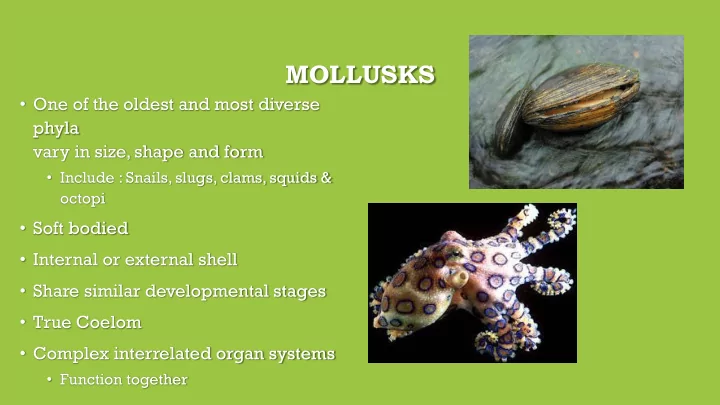
MOLLUSKS One of the oldest and most diverse phyla vary in size, - - PowerPoint PPT Presentation

mollusks
SMART_READER_LITE
LIVE PREVIEW

MOLLUSKS One of the oldest and most diverse phyla vary in size, - - PowerPoint PPT Presentation

MOLLUSKS One of the oldest and most diverse phyla vary in size, shape and form Include : Snails, slugs, clams, squids & octopi Soft bodied Internal or external shell Share similar developmental stages True Coelom


slide-1
SLIDE 1

MOLLUSKS

  • One of the oldest and most diverse

phyla vary in size, shape and form

  • Include : Snails, slugs, clams, squids &
  • ctopi
  • Soft bodied
  • Internal or external shell
  • Share similar developmental stages
  • True Coelom
  • Complex interrelated organ systems
  • Function together
slide-2
SLIDE 2

DEVELOPMENT

  • Free swimming larval

stage

  • Trochophore
  • Also characteristic of

annelids

  • Shows relation
  • Shared a common

anscestor 550 mya

slide-3
SLIDE 3

FORM AND FUNCTION

  • Body plan
  • The body plan of most mollusks has four parts: foot, mantle,

shell, and visceral mass.

  • Foot: takes many forms
  • Mantle
  • Thin layer of tissue covering most of the mollusks body
  • Shell
  • Made by glands in the mantle that secrete calcium carbonate
  • Has been reduced or lost in some mollusk groups (slugs)
  • Visceral mass
  • Below mantle, contains internal organs
slide-4
SLIDE 4

BODY PLAN

  • The muscular foot takes

many forms

  • flat structures for

crawling

  • spade-shaped

structures for burrowing

  • tentacles for

capturing prey

slide-5
SLIDE 5

FEEDING

  • Mollusks can be
  • Herbivores
  • Carnivores
  • Filter feeders
  • Detritivore
  • Parasites
slide-6
SLIDE 6

FEEDING

  • Snails and slugs feed using a flexible,

tongue-shaped structure known as a radula.

  • Hundreds of tiny teeth are attached to

the radula.

  • The radula is used to scrape algae off

rocks or to eat the soft tissues of plants.

  • Carnivorous mollusks use their radula

to drill through shells to get at soft tissue

slide-7
SLIDE 7
  • Use sharp jaws
  • Octopi and certain sea

slugs

  • Feathery gills
  • Food is carried by water
  • Enters incurrent siphon
  • Tubelike structure in which

water enters the body

  • The water flows over the

gills and leaves by the

excurrent siphon.

  • Clams oysters and scallops