GROUPS OF MOLLUSCS The three major classes of mollusks are - - PowerPoint PPT Presentation

groups of molluscs
SMART_READER_LITE
LIVE PREVIEW

GROUPS OF MOLLUSCS The three major classes of mollusks are - - PowerPoint PPT Presentation

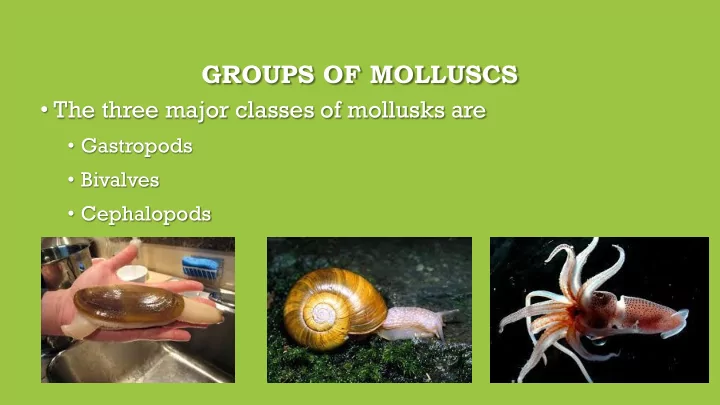
GROUPS OF MOLLUSCS The three major classes of mollusks are Gastropods Bivalves Cephalopods GASTROPODS Class Gastropoda Pond snails, land slugs, limpets, nudibranchs Shell-less or single-shelled Move by using a


slide-1
SLIDE 1

GROUPS OF MOLLUSCS

  • The three major classes of mollusks are
  • Gastropods
  • Bivalves
  • Cephalopods
slide-2
SLIDE 2

GASTROPODS

  • Class Gastropoda
  • Pond snails, land slugs, limpets, nudibranchs
  • Shell-less or single-shelled
  • Move by using a muscular foot located on

the ventral side.

  • Many gastropods have a single shell that

protects their bodies.

  • When threatened, they can pull completely

into their shells.

  • Shell-less gastropods protect themselves in
  • ther ways
  • Releasing ink, chemicals, hiding
slide-3
SLIDE 3

BIVALVES

  • Class Bivalvia
  • Bivalves have two shells that are held

together by one or two powerful muscles.

  • Common bivalves include:
  • Clams
  • Burrow in mud or sand
  • oysters
  • Mussels
  • Attach to rocks
  • Scallops
  • Least sedentary
  • Move around rapidly by flapping shells
slide-4
SLIDE 4

CEPHALOPODS

  • Class Cephalopoda
  • Octopi, squids, cuttlefish,

nautiluses

  • Cephalopods
  • Soft-bodied mollusks
  • Head is attached to a single

foot

  • The foot is divided into

tentacles or arms

  • 8 or more tentacles equipped

with sucking disks that grab and hold prey

slide-5
SLIDE 5
  • Cephalopods have

complex sense organs

  • Detect and respond to

external stimuli

  • Distinguish shapes by

sight, texture by touch

  • Eyes are as complex as

some vertebrates

  • Can be the size of a dinner

plate

  • Can distinguish objects as

small as 0.5 cm away