CHARACTERISTICS OF COILED- -COIL DOMAINS COIL DOMAINS - - PDF document

characteristics of coiled coil domains coil domains
SMART_READER_LITE
LIVE PREVIEW

CHARACTERISTICS OF COILED- -COIL DOMAINS COIL DOMAINS - - PDF document

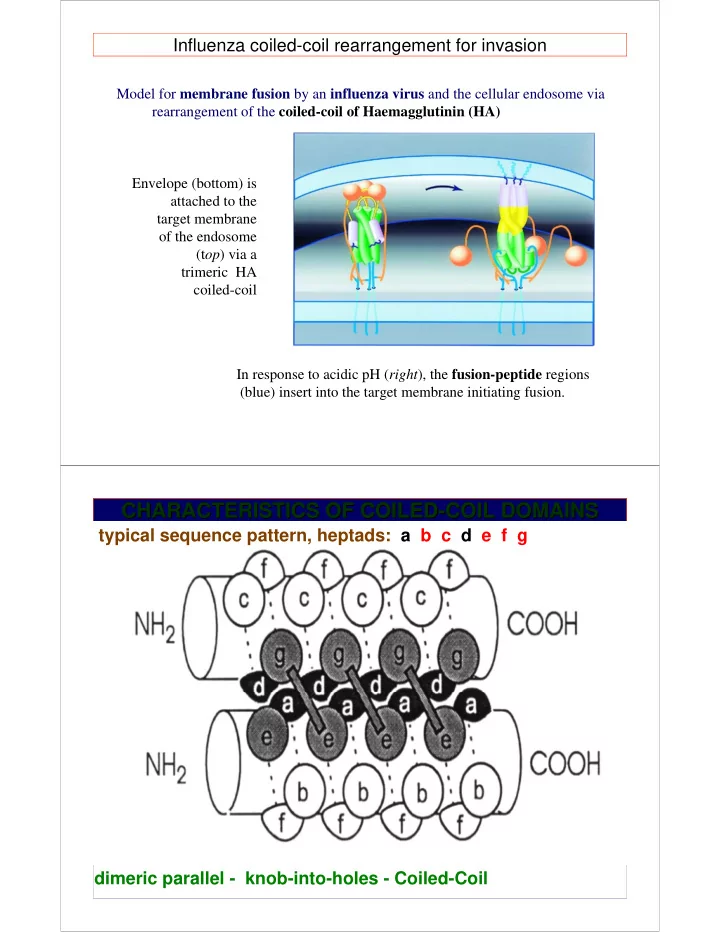
Influenza coiled-coil rearrangement for invasion Model for membrane fusion by an influenza virus and the cellular endosome via rearrangement of the coiled-coil of Haemagglutinin (HA) Envelope (bottom) is attached to the target membrane of the


slide-1
SLIDE 1

Model for membrane fusion by an influenza virus and the cellular endosome via rearrangement of the coiled-coil of Haemagglutinin (HA) In response to acidic pH (right), the fusion-peptide regions (blue) insert into the target membrane initiating fusion. Envelope (bottom) is attached to the target membrane

  • f the endosome

(top) via a trimeric HA coiled-coil

Influenza coiled-coil rearrangement for invasion

CHARACTERISTICS OF COILED CHARACTERISTICS OF COILED-

  • COIL DOMAINS

COIL DOMAINS

dimeric parallel - knob-into-holes - Coiled-Coil typical sequence pattern, heptads: a b c d e f g

slide-2
SLIDE 2

COILED COILED-

  • COIL CHARACTERISTICS

COIL CHARACTERISTICS

  • PERIODICAL ALTERNATION OF HYDROPHILIC AND HYDROPHOBIC AAs

mainly characterised by the positions of the h'phobic AAs:

  • very variable length between ~ 11 and many hundreds of aas
  • frequently hphobic=>hphilic and vice-versa
  • WHAT IS THE BEST MODEL / METHOD FOR DESCRIBING

AND RECOGNISING / PREDICTING THE OCCURRENCE OF THIS (HEPTAD) PATTERN ?

COILED COILED-

  • COIL DOMAINS

COIL DOMAINS

dimeric Coiled-Coil with superhelical twist

slide-3
SLIDE 3

COILED COILED-

  • COIL GROUPS

COIL GROUPS

  • 1. TROPOMYOSINS
  • 2. MYOSINS
  • 3. INTERMEDIATE

FILAMENTS

  • 4. DYNEINS
  • 5. KINESINS
  • 6. LAMININS
  • 7. SNARE PROTEINS
  • 8. LEU-ZIPPERS/TF
  • 9. OTHER PROTEINS

CC CC-

  • PROBABILITY PROFILE AND PREDICTED DOMAINS

PROBABILITY PROFILE AND PREDICTED DOMAINS

Fusogenic Fusogenic Protein of simian Protein of simian parainfluenza parainfluenza Virus 5 Virus 5

threshold

y = P[coiled − coil(i)] = 1− P[state 0(i)]

predicted domain

slide-4
SLIDE 4

DESIGNING A MODEL DESIGNING A MODEL

  • desired is a PARSING:
  • of sequences into coiled-coil and

non coiled-coil (background) zones

. - M - D - L - A - K - .....

DESIGNING A MODEL DESIGNING A MODEL

Ca - Cb - Cc - Cd - Ce - Cf - Cg - Ca

slide-5
SLIDE 5

DESIGNING A MODEL DESIGNING A MODEL

Cb - Cc - Cd - Ce - Cf - Cg - Ca - Cb Ca - Cb - Cc - Cd - Ce - Cf - Cg - Ca

DESIGNING A MODEL DESIGNING A MODEL

C1 C2 C3 C4 C5 C6 C7

the first simple model arrows for the main alllowed transitions

slide-6
SLIDE 6

DESIGNING A MODEL DESIGNING A MODEL

Design Issues:

  • LENGTH OF A COILED-COIL ZONE
  • FIRST AND LAST STRETCH ("CAPS")
  • REGULARITY OT THE HEPTAD PATTERN
  • COMPLEXITY AND PARAMETRISATION

C1 C2 C3 C4 C5 C6 C7

DESIGNING A MODEL DESIGNING A MODEL

simplified structure of Marcoil

slide-7
SLIDE 7

MARCOIL: architecture MARCOIL: architecture

N-cap, 4 amino acids C-cap, 4 amino acids Internal Zone

Marcoil Marcoil states: 10 groups, 9x7+1= 64 states states: 10 groups, 9x7+1= 64 states

slide-8
SLIDE 8

PARAMETRISATION PARAMETRISATION

9*7+1=64 states 64*19 emission parameters ⇒TYING reduces to 8*19=152 degrees of freedom for emission space (identical to COILS) 64*63 transitions parameters ? the important ones are much less, approx. 80 For the paper-version of Marcoil and a fairer comparison to Coils, the transition space was completely reparametrised and reduced to 3 degrees

  • f freedom

MARCOIL: MARCOIL: emiss

  • emiss. prob.

. prob.

L: 25 .6% I : 1 3 .1% V: 11 .1% A: 7 .1% . K: 8 .5% . . W: .2%

Example: state: a

56.9 %

slide-9
SLIDE 9

PARAMETERISATION PARAMETERISATION

3 parameters for all transition: i, t, r: i: initiation of a domain t: termination of a domain r: ratio btw "canonical" (heptad) transitions and "irregular" transitions In the productive mode: high i: frequent initiation of a domain high t: domain of shorter length In the decoding mode: The coiled-coil probability is increased by higher values of i. The ease with which a domain of length L is recognised is affected by i and t. For Viterbi decoding the dependency can be expressed quantitatively and the length-preference of the model is shifted towards shorter domains by increasing i and / or t. We believe (on theoretical and empirical grounds) that the same relationship holds qualitatively for Posterior Decoding.

PARAMETERISATION PARAMETERISATION

i ; t

1 i t

slide-10
SLIDE 10

PARAMETERISATION PARAMETERISATION

x rx

i, t, r

r = ratio between the minor and the major transitions (r << 1)

HMM: decoding principle HMM: decoding principle

WGP ARQLNES VKD INKM LER HP BBB CCCCCCC CCCCCCC CCC BB 000 abcdefg abcdefg abc 00 00c defgabc defgabc def g0

Sequence Labels

Path1 Path2

HMM-based model (“induced-fit principle”) a) VITERBI-decoding: of all possible states-path, we determine the best one (highest likelihood) (DP: log comlexity 10’000 => 8) b) POSTERIOR-decoding: at each single position, we determine the state with the highest probability (posterior to the given amino-acid sequence)

slide-11
SLIDE 11

MARCOIL: decoding methods MARCOIL: decoding methods

VITERBI

  • based only on the best path

+ SIMPLE + FAST + STABLE (log-space) + “CONSISTENT” PATH & MINIMAL LENGTH => VLR-VITERBI: slower

POSTERIOR

+ uses all paths (weighted)

  • SLOWER / less STABLE

+ EFFICIENT/NATURAL MEASURE OF STRINGENCY

CC CC-

  • PROBABILITY PROFILE AND PREDICTED DOMAINS

PROBABILITY PROFILE AND PREDICTED DOMAINS

Fusogenic Fusogenic Protein of simian Protein of simian parainfluenza parainfluenza Virus 5 Virus 5

threshold

y = P[coiled − coil(i)] = 1− P[state 0(i)]

predicted domain

slide-12
SLIDE 12

LAB EXERCISE LAB EXERCISE

We use a simplified model Starting with an initial set of parameters Train the parameters using a set of data by EM (Baum- Welch) Model File:

Alphabet: ACDEFGHIKLMNPQRSTVWY ################################################ State BEGIN E: 0.05 0.05 0.05 0.05 0.05 0.05 0.05 0.05 0.05 0.05 0.05 0.05 0.05 0.05 0.05 0.05 0.05 0.05 0.05 0.05 T: BG 0.983 CCA 0.001 CCB 0.001 CCC 0.001 CCD 0.001 CCE 0.001 CCF 0.001 CCG 0.001 END 0.01 State BG E: 0.076 0.019 0.05 0.061 0.039 0.071 0.023 0.053 0.057 0.093 0.023 0.042 0.053 0.043 0.054 0.073 0.06 0.064 0.014 0.032 T: BG 0.983 CCA 0.001 CCB 0.001 CCC 0.001 CCD 0.001 CCE 0.001 CCF 0.001 CCG 0.001 END 0.01 State CCA E: 0.097 0.012 0.006 0.026 0.023 0.011 0.013 0.128 0.062 0.245 0.041 0.055 0.007 0.024 0.044 0.027 0.027 0.12 0.002 0.03 T: BG 0.001 CCA 0.001 CCB 0.983 CCC 0.001 CCD 0.001 CCE 0.001 CCF 0.001 CCG 0.001 END 0.01