10:50 Paul McNamee : "Retrieval 09:10 Mikko Kurimo: " - - PowerPoint PPT Presentation

10 50 paul mcnamee retrieval 09 10 mikko kurimo morpho
SMART_READER_LITE
LIVE PREVIEW

10:50 Paul McNamee : "Retrieval 09:10 Mikko Kurimo: " - - PowerPoint PPT Presentation

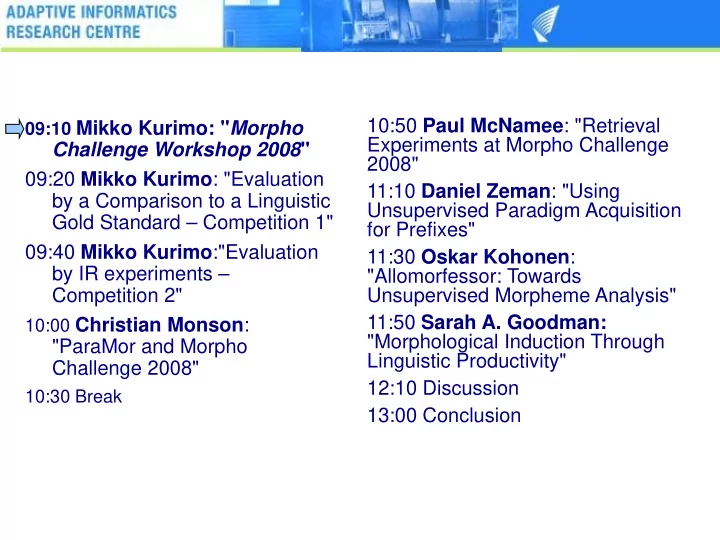
10:50 Paul McNamee : "Retrieval 09:10 Mikko Kurimo: " Morpho Experiments at Morpho Challenge Challenge Workshop 2008 " 2008" 09:20 Mikko Kurimo : "Evaluation 11:10 Daniel Zeman : "Using by a Comparison to a


slide-1
SLIDE 1

09:10 Mikko Kurimo: "Morpho

Challenge Workshop 2008" 09:20 Mikko Kurimo: "Evaluation by a Comparison to a Linguistic Gold Standard – Competition 1" 09:40 Mikko Kurimo:"Evaluation by IR experiments – Competition 2"

10:00 Christian Monson:

"ParaMor and Morpho Challenge 2008"

10:30 Break

10:50 Paul McNamee: "Retrieval Experiments at Morpho Challenge 2008" 11:10 Daniel Zeman: "Using Unsupervised Paradigm Acquisition for Prefixes" 11:30 Oskar Kohonen: "Allomorfessor: Towards Unsupervised Morpheme Analysis" 11:50 Sarah A. Goodman: "Morphological Induction Through Linguistic Productivity" 12:10 Discussion 13:00 Conclusion

slide-2
SLIDE 2

Unsupervised Morpheme Analysis

Morpho Challenge Workshop 2008

Mikko Kurimo, Matti Varjokallio and Ville Turunen

Helsinki University of Technology, Finland

slide-3
SLIDE 3

Opening

Welcome to the Morpho Challenge 2008 workshop:

  • challenge participants
  • workshop speakers
  • other CLEF researchers
  • everybody who is interested in the topic!
slide-4
SLIDE 4

Motivation

  • To design statistical machine learning

algorithms that discover which morphemes words consist of

  • Follow-up to Morpho Challenge 2005 and 2007
  • Find morphemes that are useful as vocabulary

units for statistical language modeling in: Speech recognition, Machine translation, Information retrieval

slide-5
SLIDE 5

Discussion topics for the end

  • New ways to evaluate morphemes ?
  • Use context for more accurate gold standard and

evaluation, also in IR ?

  • New test languages: Hungarian, Estonian,

Russian, Korean, Japanese, Chinese ?

  • New application evaluations: MT,..?
  • New organizing partners ?
  • Next Morpho Challenge 2009 / 2010 ?
  • Journal special issue ?
  • Next Morpho Challenge workshop ?
slide-6
SLIDE 6

Thanks

Thanks to all who made Morpho Challenge 2008 possible:

  • PASCAL network, CLEF, Leipzig corpora collection
  • Gold standard providers: Nizar Habash, Ebru Arisoy,

Stefan Bordag and Mathias Creutz

  • Morpho Challenge organizing committee, program

committee and evaluation team

  • Morpho Challenge participants
  • CLEF 2008 workshop organizers
slide-7
SLIDE 7

09:10 Mikko Kurimo: "Morpho

Challenge Workshop 2008" 09:20 Mikko Kurimo: "Evaluation by a Comparison to a Linguistic Gold Standard – Competition 1" 09:40 Mikko Kurimo:"Evaluation by IR experiments – Competition 2"

10:00 Christian Monson:

"ParaMor and Morpho Challenge 2008"

10:30 Break

10:50 Paul McNamee: "Retrieval Experiments at Morpho Challenge 2008" 11:10 Daniel Zeman: "Using Unsupervised Paradigm Acquisition for Prefixes" 11:30 Oskar Kohonen: "Allomorfessor: Towards Unsupervised Morpheme Analysis" 11:50 Sarah A. Goodman: "Morphological Induction Through Linguistic Productivity" 12:10 Discussion 13:00 Conclusion

slide-8
SLIDE 8

Unsupervised Morpheme Analysis Evaluation by a Comparison to a Linguistic Gold Standard – Competition 1

Mikko Kurimo and Matti Varjokallio

slide-9
SLIDE 9

Contents

  • Objectives
  • Call for participation, Rules, Datasets
  • Evaluation
  • Participants
  • Results
  • Conclusion
slide-10
SLIDE 10

Scientific objectives

  • To learn of the phenomena underlying word

construction in natural languages

  • To discover approaches suitable for a wide

range of languages

  • To advance machine learning methodology
slide-11
SLIDE 11

Call for participation

  • Part of the EU Network of Excellence

PASCAL’s Challenge Program

  • Organized in collaboration with CLEF
  • Participation is open to all and free of charge
  • Word sets are provided for: Finnish, English,

German, Turkish and Arabic

  • Implement an unsupervised algorithm that

discovers morpheme analysis of words in each language!

slide-12
SLIDE 12

Rules

  • Morpheme analysis are submitted to the
  • rganizers for two different evaluations:
  • Competition 1: Comparison to a linguistic

morpheme "gold standard“

  • Competition 2: Information retrieval

experiments, where the indexing is based on morphemes instead of entire words.

slide-13
SLIDE 13

Datasets

  • Word lists downloadable at our home page
  • Each word in the list is preceded by its

frequency

  • Finnish: 3M sentences, 2.2M word types
  • Turkish: 1M sentences, 620K word types
  • German: 3M sentences, 1.3M word types
  • English: 3M sentences, 380K word types
  • Arabic: no context, 140K* word types
  • Small gold standard sample available in each

language

slide-14
SLIDE 14

Examples of gold standard analyses

  • English: baby-sitters: baby_N sit_V er_s +PL
  • Finnish: linuxiin:

linux_N +ILL

  • Turkish: kontrole:

kontrol +DAT

  • German:zurueckzubehalten:

zurueck_B zu be halt_V +INF

  • Arabic: Algbn:

gabon_POS:N Al+ +SG

slide-15
SLIDE 15

Evaluation method

  • Problem: The unsupervised morphemes may

have arbitrary names, not the same as the ”real” linguistic morphemes, nor just subword strings

  • Solution: Compare to the linguistic gold

standard analysis by matching the morpheme- sharing word pairs

  • Compute matches from a large random sample
  • f word pairs where both words in the pair have

a common morpheme

slide-16
SLIDE 16

Evaluation measures

  • F-measure = 1/(1/Precision + 1/Recall)
  • Precision is the proportion of suggested word

pairs that also have a morpheme in common according to the gold standard

  • Recall is the proportion of word pairs sampled

from the gold standard that also have a morpheme in common according to the suggested algorithm

slide-17
SLIDE 17

Participants

  • (Burcu Can, Univ. York, UK – no submission)
  • Sarah A. Goodman, Univ. Maryland, USA

– late submission

  • Oskar Kohonen et al., Helsinki Univ. Tech, FI
  • Paul McNamee , JHU, USA

– only in Competition 2 (IR evaluation)

  • Daniel Zeman, Karlova Univ., CZ
  • Christian Monson et al., CMU, USA
slide-18
SLIDE 18

Example morphemes for “baby-sitters”

  • Gold Standard: baby_N sit_V er_s +PL
  • Morfessor: baby- sitters
  • Kohonen: baby- sitters
  • Monson paramor: bab +y, sitt +er +s
  • Monson Morfessor: +baby-/PRE sitter/STM +s/SUF
  • Zeman1: baby-sitter s, baby-sitt ers
  • Zeman3: baby-sitt ers, baby-sitter s
slide-19
SLIDE 19

Results: Finnish, 2.2M word types

Column B 5 10 15 20 25 30 35 40 45 50

Results: Finnish, 2.2M word types

Monson Paramor+Morf essor Monson Paramor Monson Mor- fessor Zeman 1 Kohonen et al Zeman 3 Morfessor MAP best 2007 Bernhard 1 Morfessor baseline Goodman methodB deduped

F

  • m

e a s u re

slide-20
SLIDE 20

5 10 15 20 25 30 35 40 45 50 55

Results: Turkish, 620K word types

Monson Para- mor+Morfessor Monson Paramor Monson Mor

  • fessor

Zeman 1 Kohonen et al Zeman 3 Morfessor MAP best 2007 Zeman Morfessor baseline Goodman pruned

F

  • m

easure

slide-21
SLIDE 21

5 10 15 20 25 30 35 40 45 50 55

Results: German, 1.3M word types

Monson Paramor+Morfessor Monson Morfessor Monson Paramor Zeman 1 Kohonen et al Zeman 3 best 2007 Monson p+m Morfessor MAP Morfessor baseline Goodman methodB deduped

F-measure

slide-22
SLIDE 22

5 10 15 20 25 30 35 40 45 50 55 60 65

Results: English, 380K word types

Monson Para- mor+Morfessor Monson Paramor Monson Mor - fessor Zeman 1 Kohonen et al Zeman 3 best 2007 Bernhard 2 Morfessor baseline Morfessor MAP Goodman methodB de-

F

  • m

e a s u re

slide-23
SLIDE 23

5 10 15 20 25 30 35 40 45

Results: Arabic, 140K word types

Monson Para - mor+Morfessor Monson Mor - fessor Zeman 1 Monson Paramor Zeman 3 Morfessor baseline Morfessor MAP

F-measure

slide-24
SLIDE 24

About 2008 results

  • One algorithm best in all tasks
  • Monson ParaMor better than Morfessor in TUR

but worse in ARA

  • The ”simple” Morfessor Baseline still hard to beat

in ENG and ARA

  • Large improvements over 2007 in FIN and TUR
  • Highest F in ENG and lowest in ARA, but the best

algorithms survived >30% in all tasks

  • Features of the gold standard affect the results
slide-25
SLIDE 25

Conclusion

  • 10 different unsupervised algorithms
  • 6 participating research groups
  • Evaluations for 5 languages
  • Good results in all languages
  • Full report and papers in the CLEF proceedings
  • Details, presentations, links, info at:

http://www.cis.hut.fi/morphochallenge2008/

slide-26
SLIDE 26

09:10 Mikko Kurimo: "Morpho

Challenge Workshop 2008" 09:20 Mikko Kurimo: "Evaluation by a Comparison to a Linguistic Gold Standard – Competition 1" 09:40 Mikko Kurimo:"Evaluation by IR experiments – Competition 2"

10:00 Christian Monson:

"ParaMor and Morpho Challenge 2008"

10:30 Break

10:50 Paul McNamee: "Retrieval Experiments at Morpho Challenge 2008" 11:10 Daniel Zeman: "Using Unsupervised Paradigm Acquisition for Prefixes" 11:30 Oskar Kohonen: "Allomorfessor: Towards Unsupervised Morpheme Analysis" 11:50 Sarah A. Goodman: "Morphological Induction Through Linguistic Productivity" 12:10 Discussion 13:00 Conclusion

slide-27
SLIDE 27

Unsupervised Morpheme Analysis Evaluation by IR experiments – Competition 2

Mikko Kurimo and Ville Turunen

slide-28
SLIDE 28

Motivation

  • Real world application for morpheme

analysis: Information Retrieval (IR)

  • Analysis is needed to handle the inflection,

compounding and agglutination of words

  • IR tasks for Finnish, English and German

used as in CLEF 2007

slide-29
SLIDE 29

June 16, 2008

  • Speech recognition,

information retrieval and machine translation require a large vocabulary

  • Agglutinative and

highly-inflected languages suffer from a severe vocabulary explosion

  • More efficient

representation units needed

The vocabulary problem

slide-30
SLIDE 30

IR data sets (as in CLEF 2007)

  • Finnish (CLEF 2004)

– 55K documents from articles in Aamulehti 1994-95 – 50 test queries, 23 binary relevance assessments

  • English (CLEF 2005)

– 107K documents from articles in Los Angeles Times 1994 and Glasgow Herald 1995 – 50 test queries, 20K binary relevance assessments

  • German (CLEF 2003)

– 300K documents from short articles in Frankfurter Rundschau 1994, Der Spiegel1994-95 and SDA German 1994-95 – 60 test queries, 23K binary relevance assessments

slide-31
SLIDE 31

IR evaluation

  • words in the documents and queries were

replaced by the suggested segmentations

  • OOV words un-replaced
  • all morphemes used for indexing
  • stoplist for the most common ones (over a

fixed frequency threshold)

  • LEMUR-toolkit http://www.lemurproject.org/
  • Okapi BM25 retrieval method (default)
slide-32
SLIDE 32

Evaluation measure

  • Precision is the proportion of retrieved

documents that are relevant

  • Recall is the proportion of relevant documents

that are retrieved

  • Compute the average of precisions after

truncating the list of retrieved documents after each relevant document in turn

  • Take the mean of the average precision
  • ver all queries
slide-33
SLIDE 33

Submitted analysis

  • Oskar Kohonen et al., Helsinki Univ. Tech, FI, (b)
  • Paul McNamee , JHU, USA
  • Daniel Zeman, Karlova Univ., CZ (b)
  • Christian Monson et al., CMU, USA

(b) Only analysis of Competition 1 words provided. OOVs unsplit.

slide-34
SLIDE 34

Reference methods

  • Morfessor Baseline: our public code since 2002
  • Morfessor Categories-MAP: improved, public 2006
  • dummy: no segmentation, all words unsplit
  • grammatical: full gold standard segmentation

(reference of competition 1) – all: all alternative segmentations included – first: only the first alternative chosen

  • TWOL: word normalization by a commercial rule-based

morphological analyzer (all & first)

  • Snowball: Language specific stemming
slide-35
SLIDE 35

0.2 0.25 0.3 0.35 0.4 0.45 0.5

McNamee four Monson Morfessor Monson Paramor+Morfessor McNamee five Monson Paramor McNamee lcn5 Kohonen (b) Zeman 3 (b) Zeman 1 (b) TWOL first best 2007 Bernhard 2 (a) TWOL all Morfessor catmap Morfessor baseline grammatical first snowball finnish grammatical all dummy

Mean Average Precision Finnish task Reference scores

slide-36
SLIDE 36

0.2 0.25 0.3 0.35 0.4

Monson Paramor+Morfessor Monson Paramor Monson Morfessor McNamee five McNamee four McNamee lcn5 Kohonen (b) Zeman 3 (b) Zeman 1 (b) snowball porter TWOL first best 2007 Bernhard 2 (a) TWOL all Morfessor baseline grammatical first Morfessor catmap grammatical all dummy

M ean A verage P recision

English task Reference scores

slide-37
SLIDE 37

0.2 0.25 0.3 0.35 0.4 0.45 0.5

Monson Paramor+Morfessor Monson Morfessor McNamee four McNamee five Kohonen (b) Monson Paramor McNamee lcn5 Zeman 3 (b) Zeman 1 (b) best 2007 Bernhard 1 (a) Morfessor baseline Morfessor catmap snowball german dummy grammatical first grammatical all

Mean Average Precision

German task Reference scores

slide-38
SLIDE 38

About 2008 results

  • Bernhard 2007 only very narrowly beaten
  • McNamee4 best in FIN, Monson P+M best in

ENG,GER

  • Monson ParaMor better than Morfessor in ENG,

but worse in FIN,GER

  • Highest MAP in FIN and lowest in ENG, but the

best algorithms survived well in all tasks

  • TWOL good, grammatical not, Snowball only

good in ENG

slide-39
SLIDE 39

Conclusions

  • IR evaluations for 3 languages (out of 5)
  • Good results in all languages
  • Winner not as clear as in Competition 1
  • Full report and papers in the CLEF proceedings
  • Details, presentations, links, info at:

http://www.cis.hut.fi/morphochallenge2008/

slide-40
SLIDE 40

09:10 Mikko Kurimo: "Morpho

Challenge Workshop 2008" 09:20 Mikko Kurimo: "Evaluation by a Comparison to a Linguistic Gold Standard – Competition 1" 09:40 Mikko Kurimo:"Evaluation by IR experiments – Competition 2"

10:00 Christian Monson:

"ParaMor and Morpho Challenge 2008"

10:30 Break

10:50 Paul McNamee: "Retrieval Experiments at Morpho Challenge 2008" 11:10 Daniel Zeman: "Using Unsupervised Paradigm Acquisition for Prefixes" 11:30 Oskar Kohonen: "Allomorfessor: Towards Unsupervised Morpheme Analysis" 11:50 Sarah A. Goodman: "Morphological Induction Through Linguistic Productivity" 12:10 Discussion 13:00 Conclusion