Character Animation Keyframe animation Data-driven methods - - PowerPoint PPT Presentation

character animation
SMART_READER_LITE
LIVE PREVIEW

Character Animation Keyframe animation Data-driven methods - - PowerPoint PPT Presentation

Character Animation Keyframe animation Data-driven methods Dynamic controllers Physics-based optimization Hybrid methods Motion space Keyframe animation Data-driven methods Dynamics controllers highly dynamic motion


slide-1
SLIDE 1

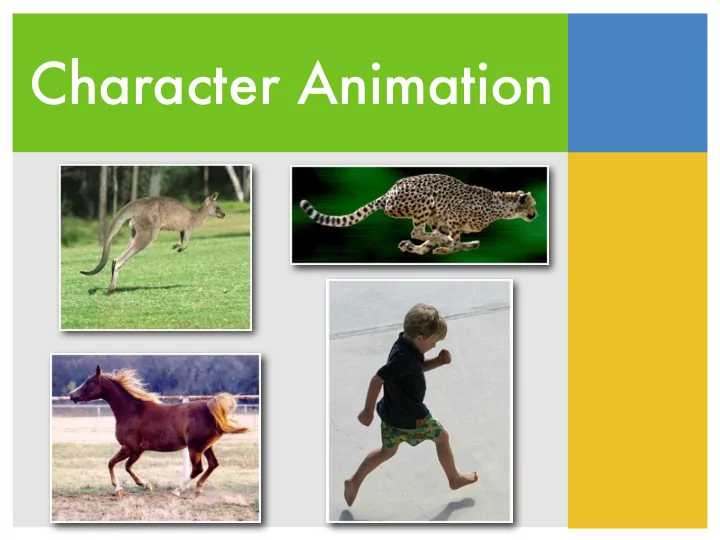
Character Animation

slide-2
SLIDE 2
slide-3
SLIDE 3
slide-4
SLIDE 4
  • Keyframe animation
  • Data-driven methods
  • Dynamic controllers
  • Physics-based optimization
  • Hybrid methods
slide-5
SLIDE 5

Motion space

slide-6
SLIDE 6

Keyframe animation

slide-7
SLIDE 7

Data-driven methods

slide-8
SLIDE 8
slide-9
SLIDE 9

Dynamics controllers

highly dynamic motion

slide-10
SLIDE 10

Physics-based optimization

highly dynamic motion

slide-11
SLIDE 11
  • Data-driven
  • Dynamic controllers
  • Physics-based optimization
  • Hybrid methods
slide-12
SLIDE 12

Goal and approach

  • Use large amount of motion capture data to create

realistic, controllable character motion

  • Given a corpus of motion capture data, construct

a directed graph that encapsulates the connections between motion clips

  • Once the motion graph is built, the system will

automatically find a graph walk that meets the user’s specification

slide-13
SLIDE 13
slide-14
SLIDE 14
slide-15
SLIDE 15
slide-16
SLIDE 16
slide-17
SLIDE 17
  • Data-driven
  • Dynamic controllers
  • Physics-based optimization
  • Hybrid methods
slide-18
SLIDE 18

Goal

  • Use control algorithms to simulate realistic

maneuver for virtual human models

slide-19
SLIDE 19

Human model

  • 17 rigid bodies
  • 30 controlled dofs
  • body segment and density

from biomechanical data

  • mass and inertia calculated

from polygonal model

slide-20
SLIDE 20
slide-21
SLIDE 21

Faloutsos et al. 2000 Yin et al. 2007

slide-22
SLIDE 22
slide-23
SLIDE 23
slide-24
SLIDE 24
  • Data-driven
  • Dynamic controllers
  • Physics-based optimization
  • Hybrid methods
slide-25
SLIDE 25

Goal

  • Cast the motion synthesis into an optimization

problem

  • Physics can be formulated into constraints
  • User preferences and “naturalness” of the motion

can be formulated as an objective function

slide-26
SLIDE 26
slide-27
SLIDE 27
slide-28
SLIDE 28
slide-29
SLIDE 29

input object motion

1. 2. 3.

input grasping pose

slide-30
SLIDE 30
slide-31
SLIDE 31
  • Data-driven
  • Dynamic controllers
  • Physics-based optimization
  • Hybrid methods
slide-32
SLIDE 32

Goal

  • Combine the power of motion capture and

physics

  • Simulate the motion when the character behaves

passively

  • Use mocap data when the character’s motion

requires sophisticated control

slide-33
SLIDE 33
slide-34
SLIDE 34

NaturalMotion

slide-35
SLIDE 35

Data-driven vs. physics

  • Use data-driven methods when
  • data acquisition is easy
  • new motion is similar to existing data
  • physical response is not important
  • stable, long motion sequences are required
  • mocap experts are accessible
slide-36
SLIDE 36

Data-driven vs. physics

  • Use physics methods when
  • dynamical properties are important
  • simulating interaction with the

environment

  • multiple characters are in the scene
slide-37
SLIDE 37

Evaluation

  • Looks good?
  • Side-by-side comparison
  • Perception studies