SLIDE 1
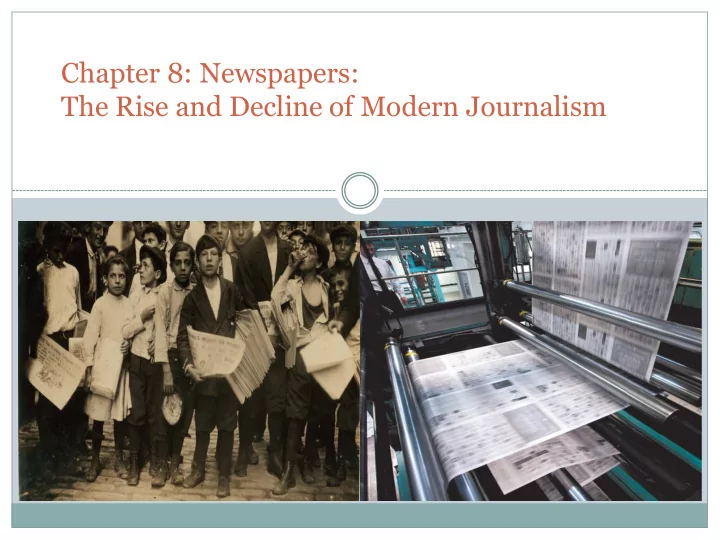
Chapter 8: Newspapers: The Rise and Decline of Modern Journalism
SLIDE 2 “We will stop printing the New York Times sometime in the future, date TBD.”
- Arthur Sulzberger, New York
Times publisher, 2010
The Future of Newspapers?
SLIDE 3
SLIDE 4 First Amendment: Congress shall make no
law respecting an establishment of religion,
exercise thereof; or abridging the freedom of speech, or of the press;
- r the right of the people
peaceably to assemble, and to petition the Government for a redress
SLIDE 5
Freedom of the Press
(1791)
The Founders saw the right
to publish one’s views as a natural right, and considered a free press a means of ensuring justice in government.
While written to apply to
actions of the federal government, the Supreme Court incorporated the amendment into state governments
SLIDE 6 During the colonial period, New York printer John Peter Zenger was
arrested for libel. He eventually won his case, which established the precedent that today allows U.S. journalists and citizens to criticize public officials. In this 1734 issue, Zenger’s New–York Weekly Journal reported his own arrest and the burning of the paper by the city’s “Common Hangman.”
Zenger ultimately won his case in 1735. the colonial government, ruled that newspapers had the right to criticize
government leaders as long as the reports were true.
the Zenger decision would later provide a key foundation for the First
Amendment to the Constitution—the right of a democratic press to criticize public officials.
SLIDE 7 By 1765, about thirty
newspapers operated in the American colonies.
The first daily paper
began in 1784. These papers were of two general types: political and commercial.
partisan press - an early
dominant style of American journalism distinguished by
generally argued one political point of view or pushed the plan of the particular party that subsidized the paper.
The commercial press,
the leaders of commerce, who were interested in economic issues.
SLIDE 8 Colonial Newspapers and the Partisan Press
(1729)
Franklin
political parties as well as advertising
(1733)
seditious libel
- Jury ruled in his favor, as
long as stories were true
foundation for First Amendment
SLIDE 9 Colonial Newspapers and the Partisan Press (cont.)
Two general types of newspapers
Political Partisan press Pushed the plan of a political group Commercial Served business leaders Readership primarily confined to educated or wealthy men
SLIDE 10 The Penny Press Era: Newspapers Become Mass Media
The Industrial Revolution, spawned the
conversion from expensive handmade to inexpensive machine–made paper.
penny papers - refers to newspapers that, because of
technological innovations in printing, were able to drop their price to one cent beginning in the 1830s, thereby making papers affordable to working and emerging middle classes and enabling newspapers to become a genuine mass medium.
In the 1820s, breakthroughs in technology, particularly
steam–powered presses replacing mechanical presses, permitted publishers to produce as many as 4,000 newspapers an hour.
SLIDE 11 Examples & Characteristics of the Penny Press
gradually separating daily front–page reporting
from overt political viewpoints on an editorial page,
New York’s penny papers shifted their economic base
from political party subsidies to the market—to advertising revenue, classified ads, and street sales.
In 1830, 650 weekly and 65 daily papers operated in
the United States, reaching 80,000 readers. By 1840, a total of 1,140 weeklies and 140 dailies attracted 300,000 readers.
SLIDE 12 The Penny Press Era: Newspapers Become Mass Media
- Penny papers
- Made possible by technology
- Sold on the street
- Cheaper paper and higher
literacy rates in the 1820s caused a wave of penny papers, most of which were sold at newsstands instead
- f by subscription.
- New York Sun
- Favored human-interest
stories
- New York Morning Herald
- Independent paper for
middle- and working-class readers
SLIDE 13
The Age of Yellow Journalism: Sensationalism and Investigation
yellow journalism - a
newspaper style or era that peaked in the 1890s, it emphasized high- interest stories, sensational crime news, large headlines, and serious reports that exposed corruption, particularly in business and government.
SLIDE 14 The Age of Yellow Journalism: Sensationalism and Investigation
New York World
Joseph Pulitzer
encouraged plain writing and the inclusion of illustrations.
In addition to
sensational stories, he instituted advice columns and women’s pages, generated a large number of ads, and crusaded for better conditions for women and equitable labor laws.
SLIDE 15 The Age of Yellow Journalism: Sensationalism and Investigation
New York Journal
William Randolph Hearst
was unscrupulous, but a champion of the underdog.
Hearst focused on
lurid, sensational, and exploitative stories, but he also appealed to immigrant readers with large headlines and bold layout
SLIDE 16
Wire Services
Wire services -
commercial organizations, such as the Associated Press, that share news stories and information by relaying them around the country and the world, originally via telegraph and now via satellite transmission.
In 1848, six New York
newspapers formed a cooperative arrangement and founded the Associated Press (AP), the first major news wire service.
SLIDE 17 Wire Services and Feature Syndication
Major daily papers might have
between one hundred and two hundred local reporters and writers, but they still cannot cover the world or produce enough material to fill up the newshole each day.
For this reason, newspapers
rely on wire services and syndicated feature services to supplement local coverage.
the Associated Press and
United Press International (UPI), have hundreds of staffers stationed throughout major U.S. cities and the world capitals.
They submit stories and photos
each day for distribution to newspapers across the country. Some U.S. papers also subscribe to foreign wire services, such as Agence France–Presse in Paris or Reuters in London.
SLIDE 18 Competing Models of Modern Print Journalism “Objectivity” in Modern Journalism
objective journalism - a modern style of
journalism that distinguishes factual reports from
- pinion columns; reporters strive to remain neutral
toward the issue or event they cover, searching out competing points of view among the sources for a story.
SLIDE 19 Competing Models of Modern Print Journalism “Objectivity” in Modern Journalism
York Times
yellow journalism
documenting major events
readership
penny to attract middle-class readers
SLIDE 20 Competing Models of Modern Print Journalism “Objectivity” in Modern Journalism
- Objective journalism
- Distinguishes factual
reports from opinion columns
- Inverted-pyramid style
- Answers who, what,
where, when (sometimes why and how) at top
- Less significant details at
bottom
increasing scrutiny
SLIDE 21 Competing Models of Modern Print Journalism
Interpretive Journalism
- Aims to explain key issues
and events, and place them in a broader context
press responsibilities
- Supply facts for the record
- Give analysis
- Advocate plans
- Embraced by broadcast
news
SLIDE 22 Competing Models of Modern Print Journalism Literary Forms of Journalism
- Literary journalism
- Also called “new
journalism”
techniques applied to nonfictional material
- Attack on journalistic
- bjectivity
- Responses included:
- Advocacy journalism
- Precision journalism
SLIDE 23 Newspapers Target Specific Readers
newspapers
- Faced high illiteracy rates
and hostility from white society during the Civil War era
- Decline of black papers
- TV and black radio stations
- Loss of support from
advertisers
ad budgets.
black papers to integrate their newsrooms.
SLIDE 24 Newspapers Target Specific Readers (cont.)
Spanish-language
newspapers
Hispanic issues and culture
largely ignored until the late 1960s
Mainstream papers added
supplements, but many folded. Asian American
newspapers
Helped readers adjust to
foreign surroundings and retain ties to their traditional heritage
SLIDE 25 Newspapers Target Specific Readers (cont.)
Native American newspapers
Began with Cherokee Phoenix (1828) Educated tribes about their heritage and build
community solidarity Underground press
Questioned mainstream political policies and
conventional values
Documented social tension with the voices of
students, women, minorities, and gay men and women
SLIDE 26
Figure 8.1: Selected Alternative Newspapers in the United States
SLIDE 27 Alternative Voices
- Citizen journalism
- Also known as citizen
media or community journalism
use the Internet and blogs to disseminate news and information
- Many news
- rganizations are
trying to corral citizen journalists to make up for journalists lost to downsizing.
SLIDE 28 Newspapers and Democracy
Journalism is a vital, yet dangerous profession.
Over 900 reporters killed in the line of duty from 1992 to 2012
Newsroom cutbacks also threatening many reporters As digital culture continues to grow, what will
become of newspapers?
SLIDE 29