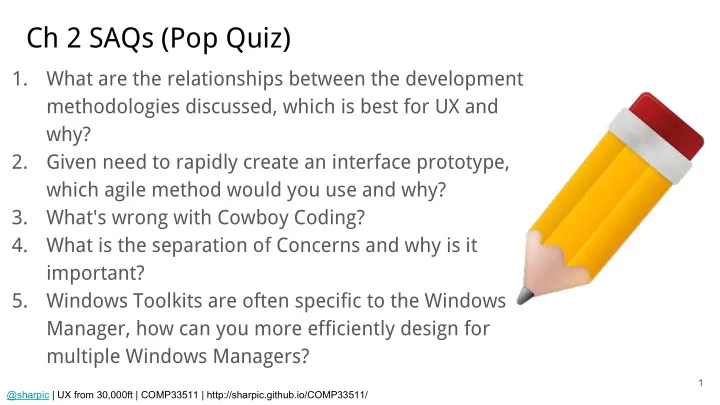
Ch 2 SAQs (Pop Quiz) 1. What are the relationships between the - - PowerPoint PPT Presentation

ch 2 saqs pop quiz
SMART_READER_LITE
LIVE PREVIEW

Ch 2 SAQs (Pop Quiz) 1. What are the relationships between the - - PowerPoint PPT Presentation

Ch 2 SAQs (Pop Quiz) 1. What are the relationships between the development methodologies discussed, which is best for UX and why? 2. Given need to rapidly create an interface prototype, which agile method would you use and why? 3. What's


slide-1
SLIDE 1

@sharpic | UX from 30,000ft | COMP33511 | http://sharpic.github.io/COMP33511/

Ch 2 SAQs (Pop Quiz)

1. What are the relationships between the development methodologies discussed, which is best for UX and why? 2. Given need to rapidly create an interface prototype, which agile method would you use and why? 3. What's wrong with Cowboy Coding? 4. What is the separation of Concerns and why is it important? 5. Windows Toolkits are often specific to the Windows Manager, how can you more efficiently design for multiple Windows Managers?

1

slide-2
SLIDE 2

UX from 30,000ft It’s Complicated!

Lecture 03 (50 minutes) @sharpic http://sharpic.github.io/COMP33511/

slide-3
SLIDE 3

@sharpic | UX from 30,000ft | COMP33511 | http://sharpic.github.io/COMP33511/

It's Complicated!

'Humans are variously skilled and part of assuring the accessibility of technology consists of seeing that an individual's skills match up well with the requirements for

  • perating the technology. There are two

components to this; training the human to accommodate the needs of the technology and designing the technology to meet the needs of the human. The better we do the latter, the less we need of the former.'

3

http://goo.gl/y9yAa6. theory and research in hci

slide-4
SLIDE 4

@sharpic | UX from 30,000ft | COMP33511 | http://sharpic.github.io/COMP33511/

Perception - Visual Interaction

4

The Visual Pathway. M. F. Bear, B. W. Connors, and M. A. Paradiso. Neuroscience: exploring the brain. Lippincott Williams & Wilkins, Philadelphia, PA, 3rd ed edition, 2007.

slide-5
SLIDE 5

@sharpic | UX from 30,000ft | COMP33511 | http://sharpic.github.io/COMP33511/

Perception - Auditory

5

Vertical Sound Localisation. M. F. Bear, B. W. Connors, and M. A. Paradiso. Neuroscience: exploring the brain. Lippincott Williams & Wilkins, Philadelphia, PA, 3rd ed edition, 2007.

slide-6
SLIDE 6

@sharpic | UX from 30,000ft | COMP33511 | http://sharpic.github.io/COMP33511/

Perception - Somatic (Touch)

6

Human Sensory Receptors. M. F. Bear, B. W. Connors, and M. A. Paradiso. Neuroscience: exploring the brain. Lippincott Williams & Wilkins, Philadelphia, PA, 3rd ed edition, 2007.

slide-7
SLIDE 7

@sharpic | UX from 30,000ft | COMP33511 | http://sharpic.github.io/COMP33511/

Perception - Smell (Olfactory)

7

Mouth, Throat, and Nasal Passages. M. F. Bear, B. W. Connors, and M. A. Paradiso. Neuroscience: exploring the brain. Lippincott Williams & Wilkins, Philadelphia, PA, 3rd ed edition, 2007.

slide-8
SLIDE 8

@sharpic | UX from 30,000ft | COMP33511 | http://sharpic.github.io/COMP33511/

Notes - In your own words!

5 minutes

8

slide-9
SLIDE 9

@sharpic | UX from 30,000ft | COMP33511 | http://sharpic.github.io/COMP33511/

Thinking and Learning - Attention

9

FEF Simulation. M. F. Bear, B. W. Connors, and M. A. Paradiso. Neuroscience: exploring the

  • brain. Lippincott Williams & Wilkins, Philadelphia, PA, 3rd ed edition, 2007.
slide-10
SLIDE 10

@sharpic | UX from 30,000ft | COMP33511 | http://sharpic.github.io/COMP33511/

Thinking and Learning - Memory

10

Declarative and Nondeclarative. M. F. Bear, B. W. Connors, and M. A. Paradiso. Neuroscience: exploring the brain. Lippincott Williams & Wilkins, Philadelphia, PA, 3rd ed edition, 2007.

slide-11
SLIDE 11

@sharpic | UX from 30,000ft | COMP33511 | http://sharpic.github.io/COMP33511/

Thinking and Learning - Exploration

11

slide-12
SLIDE 12

@sharpic | UX from 30,000ft | COMP33511 | http://sharpic.github.io/COMP33511/

Count the Number of Times the Basketball is Passed...

12

slide-13
SLIDE 13

@sharpic | UX from 30,000ft | COMP33511 | http://sharpic.github.io/COMP33511/ 13

slide-14
SLIDE 14

@sharpic | UX from 30,000ft | COMP33511 | http://sharpic.github.io/COMP33511/

Notes - In your own words!

5 minutes

14

slide-15
SLIDE 15

@sharpic | UX from 30,000ft | COMP33511 | http://sharpic.github.io/COMP33511/

Communication - Explicit / Overt

15

slide-16
SLIDE 16

@sharpic | UX from 30,000ft | COMP33511 | http://sharpic.github.io/COMP33511/

Communication - Implicit / Covert

16

slide-17
SLIDE 17

@sharpic | UX from 30,000ft | COMP33511 | http://sharpic.github.io/COMP33511/

Input - General

  • 1. Keyboard: The primary input device which enables

control of everything via scan codes;

  • 2. Cursive: Pen based naturalistic input;
  • 3. Pointing: Mice and trackballs etc.;
  • 4. Force F/B: Physical feedback;
  • 5. Speech: Speech to text recognition and control;
  • 6. Touch: Touch screens, pads, and tablets - including touch

gestures - iPad; and

  • 7. Gesture: 3D gesture recognition - Xbox.

17

slide-18
SLIDE 18

@sharpic | UX from 30,000ft | COMP33511 | http://sharpic.github.io/COMP33511/

Input - Specialist

  • 1. HOM: Different ways to point;
  • 2. Blink: Different ways to click;
  • 3. Gaze/Eye: Different ways to point;
  • 4. Haptic: Different kinds of feedback.
  • 5. Immersive: VR; and
  • 6. Suck/Blow: Pressure switches - boolean input;

18

slide-19
SLIDE 19

@sharpic | UX from 30,000ft | COMP33511 | http://sharpic.github.io/COMP33511/

Notes - In your own words!

3 minutes

19

slide-20
SLIDE 20

@sharpic | UX from 30,000ft | COMP33511 | http://sharpic.github.io/COMP33511/

To Do

1. Read Next Chapter. 2. Be Ready to Answer the Chapter SAQs (Pop Quiz). 3. Is there a Discussion Topic.

20

slide-21
SLIDE 21

@sharpic | UX from 30,000ft | COMP33511 | http://sharpic.github.io/COMP33511/

See You Next Time!

21

Open House / Surgery - 2.60 Friday 09:00-11:00 @sharpic

slide-22
SLIDE 22

@sharpic | UX from 30,000ft | COMP33511 | http://sharpic.github.io/COMP33511/

Break Time - Pause Recording

Back in 10 Minutes! Come see me now if you have Questions Regarding this Lecture!

22