Ch 6 SAQs (Pop Quiz) 1. What is the significance of the Xerox Star - - PowerPoint PPT Presentation

ch 6 saqs pop quiz
SMART_READER_LITE
LIVE PREVIEW

Ch 6 SAQs (Pop Quiz) 1. What is the significance of the Xerox Star - - PowerPoint PPT Presentation

Ch 6 SAQs (Pop Quiz) 1. What is the significance of the Xerox Star interface? 2. What are the five main principles proposed by the Xerox Star team? 3. What does GOMS stand for and what does it involve? 4. What are the ten main principles of


slide-1
SLIDE 1

@sharpic | UX from 30,000ft | COMP33511 | http://sharpic.github.io/COMP33511/

Ch 6 SAQs (Pop Quiz)

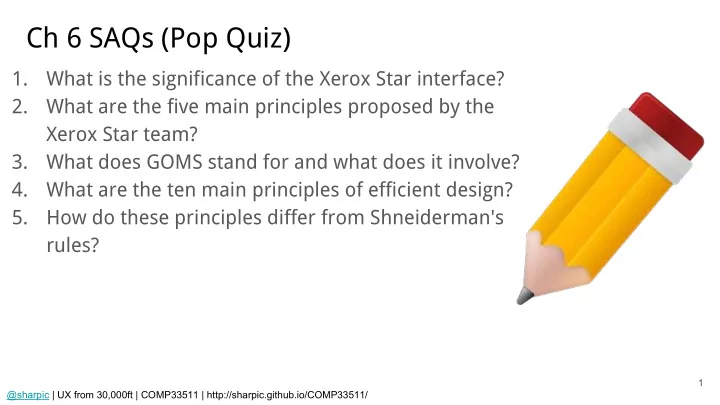
1. What is the significance of the Xerox Star interface? 2. What are the five main principles proposed by the Xerox Star team? 3. What does GOMS stand for and what does it involve? 4. What are the ten main principles of efficient design? 5. How do these principles differ from Shneiderman's rules?

1

slide-2
SLIDE 2

UX from 30,000ft Principles of Affective Experience (part 1)

Chapter 7 - Lecture 11 (50 minutes) @sharpic http://sharpic.github.io/COMP33511/

slide-3
SLIDE 3

@sharpic | UX from 30,000ft | COMP33511 | http://sharpic.github.io/COMP33511/

Principles of Efficient Experience

3

1. Of or relating to the affections or emotions, esp. as contrasted with the intellect or rational faculty; emotional. Psychol. and Psychiatry. Of, relating to, or involving feelings, emotion, or mood. AFFECT - Philos. An emotional, unreflective response. Psychol. (and Psychiatry). A feeling or subjective experience accompanying a thought or action or occurring in response to a stimulus; an emotion, a mood. In later use also (usu. as a mass noun): the outward display

  • f emotion or mood, as manifested by facial expression, posture, gestures, tone of voice, etc --- OED.

2. Of or relating to the emotions; based on or appealing to the emotions. any strong mental or instinctive feeling, as pleasure, grief, hope, fear, etc.,deriving

  • esp. from one's circumstances, mood, or relationship with others --- OED.

Affective1 use, or emotional2 use/design, both mean the same thing, and in reality were going to be using both terms interchangeably. However, you should be thinking of emotional use in more specific terms; the more specialised term of affective use. This is because the concept of emotional design is much broader than we need to address at the interface / interactive level. What we are trying to get to is 'emotional engagement' and to begin with, let me ask you a question...
slide-4
SLIDE 4

@sharpic | UX from 30,000ft | COMP33511 | http://sharpic.github.io/COMP33511/

People Love or Hate the Same Thing

4

Why Do Different People Love or Hate the Same Thing? MicroSoft

slide-5
SLIDE 5

@sharpic | UX from 30,000ft | COMP33511 | http://sharpic.github.io/COMP33511/

Visceral, Behavioural, and Reflective

5

1 minute

slide-6
SLIDE 6

@sharpic | UX from 30,000ft | COMP33511 | http://sharpic.github.io/COMP33511/

Visceral, Behavioural, and Reflective

6

  • Visceral: is equated with appearance, and ties into how we have

evolved within our environment, which drives our perceptions of aesthetic and pleasure at an internal and unconscious level;

  • Behavioural: relates to the pleasure and effectiveness of use, we have

seen this previously, however, Norman contends that there is pleasure in efficiency (we're back to form following function again); and

  • Reflective: is more complicated and coupled with self-image, personal

satisfaction, and memories, it is about message, culture, and the meaning of a product.

slide-7
SLIDE 7

@sharpic | UX from 30,000ft | COMP33511 | http://sharpic.github.io/COMP33511/

Experience by Committee

7

Design of a visceral or reflective experience by committee: "The brilliant conceptual artist Vitaly Komar and Alex Melamaid conducted surveys asking people questions like, what's your favourite colour? Then they produced exhibitions of perfectly 'user centred art.' The results were profoundly disturbing. The works were completely lacking in innovation or finesse of craftsmanship, disliked even by the very same survey respondents. Good art is not an optimal point in a multi dimensional space; that was, of course, their point. Perfectly 'user centred design' would be disturbing as well precisely because it would like that artistry."

slide-8
SLIDE 8

@sharpic | UX from 30,000ft | COMP33511 | http://sharpic.github.io/COMP33511/

Aesthetics? Lavie and Tractinsky

8

Aesthetics is commonly defined as the appreciation of the beautiful or pleasing but the terminology is still controversial [Lavie and Tractinsky, 2004]. Visual aesthetics is 'the science of how things are known via the senses' which refers to user perception and cognition. Current findings suggest that good visual aesthetics enhances positive feelings toward applications. Several studies have established that aesthetic opinions about interfaces are formed quite quickly, and do not wane immediately; this suggests that aesthetic considerations should be seen as an important aspect of any application life cycle.

slide-9
SLIDE 9

@sharpic | UX from 30,000ft | COMP33511 | http://sharpic.github.io/COMP33511/

Psychology of Aesthetics

9

Jacobsen's Framework for Psychology of Aesthetics. Jacobsen

  • Diachronia: Aesthetic preferences may

change with time;

  • Ipsichronia: Social/cultural processes

may shape a person's aesthetic opinions;

  • Mind: An individual's mental model of the

visual stimulus or emotions could influence aesthetic judgements;

  • Body: Brain activities could affect

aesthetic evaluation processes;

  • Content: The stimulus being evaluated

could influence aesthetic processing;

  • Person: The evaluator's background may

play a role in aesthetic preference; and

  • Situation: The surrounding

circumstances (this includes time and place) could influence aesthetic choices.

slide-10
SLIDE 10

@sharpic | UX from 30,000ft | COMP33511 | http://sharpic.github.io/COMP33511/

Notes - In your own words!

3 minutes

10

slide-11
SLIDE 11

@sharpic | UX from 30,000ft | COMP33511 | http://sharpic.github.io/COMP33511/

Manipulating Experiences

1. The use of visual aesthetics can alter the perceptions of the viewer by manipulating visual components such as colours, text style and size, images and animations. 2. In this way the user is unknowingly or unconsciously involved with the message of the software artefact. 3. The visual appeal of an interface can be assessed within 50 milliseconds in which time users make their impression about the software.

11

slide-12
SLIDE 12

@sharpic | UX from 30,000ft | COMP33511 | http://sharpic.github.io/COMP33511/

Clarity and Richness

Visual clarity and richness was shown to be two of the most important aesthetic dimensions that strongly influence software users: 1. Visual clarity refers to 'classical' aesthetic qualities pointing to clean, clear, and symmetric designs. 2. Visual richness refers to 'expressive' aesthetics such as creativity,

  • riginality of the interface's aspects and designers' finesse and ability

to 'break design conventions'.

12

slide-13
SLIDE 13

@sharpic | UX from 30,000ft | COMP33511 | http://sharpic.github.io/COMP33511/

Narrative Art

13

Hunters with Elephants -- Cederberg Mountains, South Africa. Wikipedia

slide-14
SLIDE 14

@sharpic | UX from 30,000ft | COMP33511 | http://sharpic.github.io/COMP33511/

Models of Visual Attention

Selective visual attention is a complex action composed of conscious and subconscious processes in the brain that are used to find and focus on relevant information quickly and efficiently. There are two general visual attention processes, bottom-up and top-down, which determine where humans next locate their attention.

14

Bottom-Up Bottom-up models of visual attention suggest that low-level salient features, such as contrast, size, shape, colour, and brightness correlate well with visual

  • interest. For example, a red apple (a source of

nutrition) is more visually salient, and therefore attractive, than the green leaves surrounding it. Top-Down Top-down models, on the other hand, explain visual search driven by semantics, or knowledge about the environment: when asked to describe the emotion of a person in a picture, for instance, people will automatically look to the person's face.

slide-15
SLIDE 15

@sharpic | UX from 30,000ft | COMP33511 | http://sharpic.github.io/COMP33511/

Notes - In your own words!

3 minutes

15

slide-16
SLIDE 16

@sharpic | UX from 30,000ft | COMP33511 | http://sharpic.github.io/COMP33511/

Berlyne's Arousal Theory

Berlyne's theory holds that people love to experience aesthetic pleasure at moderate levels. There are also studies that have focused more on investigating the relationship between visual aesthetics and different aspects of user experience. Some of the aspects of user experience investigated so far include usability, credibility, desirability, complexity and accessibility.

16

slide-17
SLIDE 17

@sharpic | UX from 30,000ft | COMP33511 | http://sharpic.github.io/COMP33511/

The Sweet Spot

17

Hebbian version of the Yerkes Dodson Law (this version leaves out that hyper-arousal does not adversely impact simple tasks) Wikipedia

slide-18
SLIDE 18

@sharpic | UX from 30,000ft | COMP33511 | http://sharpic.github.io/COMP33511/

Flow

18

Flow: the psychology of optimal experience M. Csikszentmihalyi. Harper & Row, New York, 1st ed edition, 1990

slide-19
SLIDE 19

@sharpic | UX from 30,000ft | COMP33511 | http://sharpic.github.io/COMP33511/

A Word of Warning

19

slide-20
SLIDE 20

@sharpic | UX from 30,000ft | COMP33511 | http://sharpic.github.io/COMP33511/

To Do

1. Read Next Chapter. 2. Be Ready to Answer the Chapter SAQs (Pop Quiz). 3. Is there a Discussion Topic.

20

slide-21
SLIDE 21

@sharpic | UX from 30,000ft | COMP33511 | http://sharpic.github.io/COMP33511/

See You Next Time!

21

Open House / Surgery - 2.60 Friday 09:00-11:00 @sharpic

slide-22
SLIDE 22

@sharpic | UX from 30,000ft | COMP33511 | http://sharpic.github.io/COMP33511/

Break Time - Pause Recording

Back in 10 Minutes! Come see me now if you have Questions Regarding this Lecture!

22