CEE 370 Environmental Engineering Principles Lecture #14 - - PDF document

cee 370 environmental engineering principles
SMART_READER_LITE
LIVE PREVIEW

CEE 370 Environmental Engineering Principles Lecture #14 - - PDF document

CEE 370 Lecture #14 10/4/2019 Print version Updated: 4 October 2019 CEE 370 Environmental Engineering Principles Lecture #14 Environmental Biology III: Cell structure/function Reading: Mihelcic & Zimmerman, Chapter 5 Davis &


slide-1
SLIDE 1

CEE 370 Lecture #14 10/4/2019 Lecture #14 Dave Reckhow 1

David Reckhow CEE 370 L#14 1

CEE 370 Environmental Engineering Principles

Lecture #14

Environmental Biology III: Cell structure/function

Reading: Mihelcic & Zimmerman, Chapter 5

Davis & Masten, Chapter 3

Updated: 4 October 2019

Print version

David Reckhow

CEE 370 L#14

2

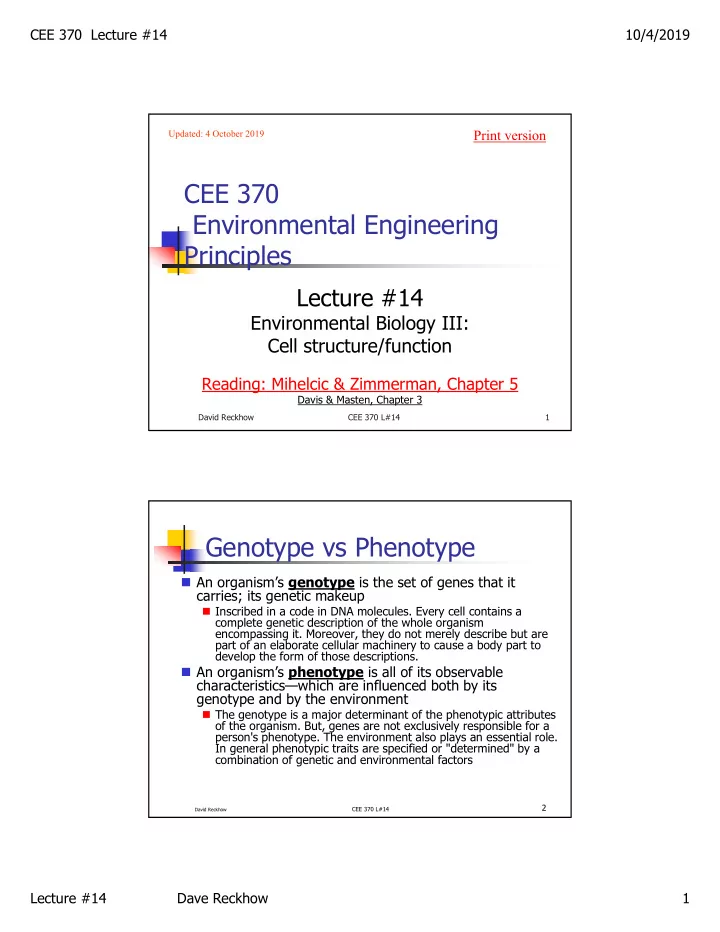
Genotype vs Phenotype

 An organism’s genotype is the set of genes that it carries; its genetic makeup

 Inscribed in a code in DNA molecules. Every cell contains a complete genetic description of the whole organism encompassing it. Moreover, they do not merely describe but are part of an elaborate cellular machinery to cause a body part to develop the form of those descriptions.

 An organism’s phenotype is all of its observable characteristics—which are influenced both by its genotype and by the environment

 The genotype is a major determinant of the phenotypic attributes

  • f the organism. But, genes are not exclusively responsible for a

person's phenotype. The environment also plays an essential role. In general phenotypic traits are specified or "determined" by a combination of genetic and environmental factors

slide-2
SLIDE 2

CEE 370 Lecture #14 10/4/2019 Lecture #14 Dave Reckhow 2

David Reckhow

CEE 370 L#14

3

Genomes

 the term genome refers to the complete complement of DNA for a given species

 the human genome consists of 46 chromosomes.

 every cell (except sex cells and mature red blood cells) contains the complete genome of an organism

 Cells from the different parts of an organism have the same DNA

 Distinction: The portion of the DNA that is transcribed and translated into protein

David Reckhow

CEE 370 L#14

4

Cells, genome, gene and DNA

 Overall function of genome: Control the generation of molecules (mostly proteins) that will

 Regulate the metabolism of a cell and its response to the environment, and  Provide structural integrity.

 Analogy

 Nucleotide => letter  Gene => sentence  Contig => chapter  Chromosome => book

 Gender, hair/eye color, …  Disorders: down syndrome, turner syndrome, …  Chromosome number varies for species  We have 46 (23 + 23) chromosomes

 Complete genome => volumes of encyclopedia

slide-3
SLIDE 3

CEE 370 Lecture #14 10/4/2019 Lecture #14 Dave Reckhow 3

David Reckhow

CEE 370 L#14

5

Functions of Genes

 Signal transduction: sensing a physical signal and

turning into a chemical signal  Structural support: creating the shape and pliability of a cell

  • r set of cells

 Enzymatic catalysis: accelerating chemical transformations

  • therwise too slow.

 Transport: getting things into and out of separated compartments  Movement: contracting in order to pull things together or push things apart.  Transcription control: deciding when other genes should be turned ON/OFF  Trafficking: affecting where different elements end up inside the cell

David Reckhow

CEE 370 L#14

6

A gene codes for a protein

Protein mRNA DNA

transcription translation CCTGAGCCAACTATTGATGAA

PEPTIDE

CCUGAGCCAACUAUUGAUGAA

Condon (3 bases) codes for one amino acid

slide-4
SLIDE 4

CEE 370 Lecture #14 10/4/2019 Lecture #14 Dave Reckhow 4

David Reckhow

CEE 370 L#14

7

Exons & introns

 Most eukaryotic genes have exons (portions that will be put in the mRNA) and introns (that are normally spliced out and not in mRNA)

 Some introns may have a promoter-like control of the transcription process  If an intron is not spliced out then an alternative splicing product is created.  Various tissue types can flexibly alter their gene products through alternative splicing

 Post-splicing (in Eukaryotes)

 The generated mRNA is exported (through nuclear pore complexes) to the cytoplasm  In the cytoplasm, the ribosonal complex (containing hundreds of proteins and special function RNA molecules) acts to generate the protein on the basis of the mRNA code.

David Reckhow

CEE 370 L#14

8

Introns and Exons

Humans have about 35,000 genes containing 40,000,000 DNA bases

But this is only ~3% of total DNA in genome.

Remaining 2,960,000,000 bases for control information. (e.g. when, where, how long, etc...)

slide-5
SLIDE 5

CEE 370 Lecture #14 10/4/2019 Lecture #14 Dave Reckhow 5

David Reckhow

CEE 370 L#14

9

Structure of DNA

Made up of 4 different building blocks (so called nucleotide bases), each an almost planar nitrogenic organic compound

Adenine (A) Thymine (T) Guanine (G) Cytosine (C) Base pairs (A -- T, C -- G)

David Reckhow

CEE 370 L#14

10

Chemical Structure of Nucleotides

Purines Pyrmidines

slide-6
SLIDE 6

CEE 370 Lecture #14 10/4/2019 Lecture #14 Dave Reckhow 6

David Reckhow

CEE 370 L#14

11

Structure of DNA -- 2

 Base pairs (A -- T,C -- G) are attached to a sugar phosphate backbone to form one of 2 strands of a DNA molecule.

 Phosphate ((PO4) -3)  Deoxyribose

 Two strands are bonded together by the base pairs (A – T, C – G).  Results in mirror image or complementary strands, each is twisted (or helical), and when bonded they form a double helix.  Direction of each strand (5’ meaning beginning or 3’ meaning end of the strand)

 5’ and 3’ refer to position of bases in relation to the sugar molecule in the DNA backbone.  Are important reference points to navigate the genome.  2 complementary strands are oriented in opposite direction to each

  • ther.

Nucleotides to Long Chains

Nucleotides comprise

A base A pentose sugar A phosphate

David Reckhow

CEE 370 L#14

12

slide-7
SLIDE 7

CEE 370 Lecture #14 10/4/2019 Lecture #14 Dave Reckhow 7

Long Chains to double helix

David Reckhow

CEE 370 L#14

13

Base pairs form hydrogen bonds

T=A C=G

Linking chains

David Reckhow

CEE 370 L#14

14

Double Helix I

 Double stranded, helix (Watson & Crick)  Complementary

 A-T  G-C

 Antiparallel

 3’ -> 5’ (downstream)  5’ -> 3’ (upstream)

slide-8
SLIDE 8

CEE 370 Lecture #14 10/4/2019 Lecture #14 Dave Reckhow 8

David Reckhow

CEE 370 L#14

15

Double Helix II

DNA molecules usually consist of two strands arranged in the famous double helix

David Reckhow

CEE 370 L#14

16

Transcription of DNA to RNA

 Why transcription:

 (For genome) to direct or effect changes in the cytoplasm of the cell  Need to generate new proteins to populate the cytosol (heteregenous intracellular soup of the cytoplasm)

 Note: DNA is in the nucleus, while proteins are needed in the cytoplasm, where many of the cell’s functions are performed.  Coding region of the DNA is copied to a more transient molecule called RNA

 Gene is a single segment of the coding region that is transcribed into RNA  Generation of RNA from DNA (in the nucleus) is done trough a process called transcription

slide-9
SLIDE 9

CEE 370 Lecture #14 10/4/2019 Lecture #14 Dave Reckhow 9

David Reckhow

CEE 370 L#14

17

RNA – Ribonucleic acid

Bases: Cytosine - C Guanine

  • G

Adenine - A Uracil

  • U

RNA transmits genetic information from DNA (via transcription) into proteins (by translation). RNA is almost exclusively found in the single-stranded form.  In RNA the base Thymine (T) is replaced by Uracil (U). The other difference to DNA is that the sugar (Pentose) will be Ribose instead of

  • Deoxiribose. Ribose has an additional hydroxyl group.

David Reckhow

CEE 370 L#14

18

RNA – Ribonucleic acid

RNA plays several roles in biology:

  • Messenger RNA (mRNA) is transcribed directly from a gene's DNA and is used to

encode proteins.

  • RNA genes are genes that encode functional RNA molecules; in contrast to mRNA,

these RNA do not code for proteins. The best-known examples of RNA genes are transfer RNA (tRNA) and ribosomal RNA (rRNA). Both forms participate in the process of translation, but many others exist.

  • RNA forms the genetic material (genomes) of some kinds of viruses.
  • Double-stranded RNA (dsRNA) is used as the genetic material of some RNA viruses

and is involved in some cellular processes, such as RNA interference.

slide-10
SLIDE 10

CEE 370 Lecture #14 10/4/2019 Lecture #14 Dave Reckhow 10

David Reckhow

CEE 370 L#14

19

Transcription

David Reckhow

CEE 370 L#14

20

Transcription

slide-11
SLIDE 11

CEE 370 Lecture #14 10/4/2019 Lecture #14 Dave Reckhow 11

David Reckhow

CEE 370 L#14

21

mRNA splicing

David Reckhow

CEE 370 L#14

22

Translation

ribosomes are the machines that synthesize proteins from mRNA the grouping of codons is called the reading frame translation begins with the start codon translation ends with the stop codon

slide-12
SLIDE 12

CEE 370 Lecture #14 10/4/2019 Lecture #14 Dave Reckhow 12

David Reckhow

CEE 370 L#14

23

Translation

 Uses mRNA as template to make proteins  Occurs in ribosomes  One codon corresponds to one amino acid

David Reckhow

CEE 370 L#14

24

Translation

slide-13
SLIDE 13

CEE 370 Lecture #14 10/4/2019 Lecture #14 Dave Reckhow 13

Translation

David Reckhow

CEE 370 L#14

25

Transfer RNA or tRNA

David Reckhow

CEE 370 L#14

26

Amino Acids

20 essential

Special function

slide-14
SLIDE 14

CEE 370 Lecture #14 10/4/2019 Lecture #14 Dave Reckhow 14

David Reckhow

CEE 370 L#14

27

The Genetic Code

David Reckhow

CEE 370 L#14

28

Proteins

proteins are molecules composed of

  • ne or more polypeptides

a polypeptide is a polymer composed of amino acids cells build their proteins from 20 different amino acids a polypeptide can be thought of as a string composed from a 20-character alphabet

slide-15
SLIDE 15

CEE 370 Lecture #14 10/4/2019 Lecture #14 Dave Reckhow 15

David Reckhow

CEE 370 L#14

29

Proteins – Amino Acids

Protein-Sequence (Alphabet: ACDEFGHIKLMNPQRSTVWY): MENFQKVEKIGEGTYGVVY KARNKLTGEVVALKKIRLDT ETEGVPSTAIREISLLK...

  • a typical human cell

contains about 100 million proteins of about 10,000 types

Name 1-letter code Triplet Glycine G GGT,GGC,GGA,GGG Alanine A GCT,GCC,GCA,GCG Valine V GTT,GTC,GTA,GTG Leucine L TTG,TTA,CTT,CTC,CTA,CTG Isoleucine I ATT,ATC,ATA Histidine H CAT,CAC Serine S TCT,TCC,TCA,TCG,AGT,AGC Threonine T ACT,ACC,ACA,ACG Cysteine C TGT,TGC Methionine M ATG Glutamic Acid E GAA,GAG Aspartic Acid D GAT,GAC,AAT,AAC Lysine K AAA,AAG Arginine R CGT,CGC,CGA,CGG,AGA,AGG Asparagine N AAT,AAC Glutamine Q CAA,CAG Phenylalanine F TTT,TTC Tyrosine Y TAT,TAC Tryptophan W TGG Proline P CCT,CCC,CCA,CCG Terminator (Stop) * TAA,TAG,TGA

David Reckhow

CEE 370 L#14

30

Proteins

Huge proportion of cell (after water) Many functions:

Structure (e.g. collagen in bone) Enzymes Transmembrane receptors Hormones

Four levels of structure

slide-16
SLIDE 16

CEE 370 Lecture #14 10/4/2019 Lecture #14 Dave Reckhow 16

David Reckhow

CEE 370 L#14

31

Protein Functions

 structural support  storage of amino acids  transport of other substances  coordination of an organism’s activities  response of cell to chemical stimuli  movement  protection against disease  selective acceleration of chemical reactions

David Reckhow

CEE 370 L#14

32

Peptide Bonds

slide-17
SLIDE 17

CEE 370 Lecture #14 10/4/2019 Lecture #14 Dave Reckhow 17

David Reckhow

CEE 370 L#14

33

Direction of Protein Sequence

David Reckhow

CEE 370 L#14

34

anti-parallel parallel

Secondary Structure: Beta sheet

Phi = -135 Psi = 135

slide-18
SLIDE 18

CEE 370 Lecture #14 10/4/2019 Lecture #14 Dave Reckhow 18

David Reckhow

CEE 370 L#14

35

 3-d structure of a polypeptide sequence

 interactions between non-local atoms

tertiary structure of myoglobin

Tertiary Structure

David Reckhow

CEE 370 L#14

36

Arrangement of protein subunits

quaternary structure

  • f Cro

human hemoglobin tetramer

Quaternary Structure

slide-19
SLIDE 19

CEE 370 Lecture #14 10/4/2019 Lecture #14 Dave Reckhow 19

David Reckhow

CEE 370 L#14

37

Proteins

David Reckhow

CEE 370 L#14

38

Translocation of proteins

 A newly formed protein needs to be translocated to the right place to perform its function (such as structural protein in the cytoskeleton, as a cell membrane receptor, as a hormone that is to be secreted by the cell, etc.)  Signal peptide (header): part of the polypeptide that is one of the determinant of its location and handling

slide-20
SLIDE 20

CEE 370 Lecture #14 10/4/2019 Lecture #14 Dave Reckhow 20

David Reckhow

CEE 370 L#14

39

Transcriptional programs

 Initiation of the transcription process can be caused by external events or by a programmed event within the cell.  External events

 Piezoelectric forces generated in bones through walking can gradually stimulate osteoblastic and osteoclastic transcriptional activity to cause bone remodelling; Heat shock  Appearance or disappearance of new micro or macronutrients around the cell; binding of distantly secreted hormones

 Internally programmed sequences of transcriptional expression (eg. clock and per genes)  Pathological internal derangements of the cell

 Self-repair or damage detection programs can trigger apoptosis (self-destruction) under conditions such as irreparable DNA damage

David Reckhow

CEE 370 L#14

40

Biological function of proteins

 Enzyme catalysis: DNA polymerases, lactate dehydrogenase, trypsin  Transport: hemoglobin, membrane transporters, serum albumin  Storage: ovalbumin, egg-white protein, ferritin  Motion: myosin, actin, tubulin, flagellar proteins  Structural and mechanical support: collagen, elastin, keratin, viral coat proteins  Defense: antibodies, complement factors, blood clotting factors, protease inhibitors  Signal transduction: receptors, ion channels, rhodopsin, G proteins, signalling cascade proteins  Control of growth, differentiation and metabolism: repressor proteins, growth factors, cytokines, bone morphogenic proteins, peptide hormones, cell adhesion proteins  Toxins: snake venoms, cholera toxin

slide-21
SLIDE 21

CEE 370 Lecture #14 10/4/2019 Lecture #14 Dave Reckhow 21

David Reckhow

CEE 370 L#14

41

Gene expression studies

 Allow you to understand how a gene is regulated in a tissue or a cell type.  Most useful way of studying gene expression is by measuring the levels of mRNA produced from a particular gene in a particular tissue.  Application: to understand certain biological process it is useful to study the differences in gene expression which occur during such processes. E.g.

 It is of interest to know which genes are induced or repressed, say in the aquatic environment to know if a particular contaminant can be degraded

 Some techniques for analyzing DNA or mRNA level of a single gene or to quantify gene expression

 Polymerase Chain Reaction (PCR)  DNA microarrays  Proteomics (analysis of the protein synthesis that results from gene expression)

PCR

David Reckhow

CEE 370 L#14

42

 Polymerase Chain Reaction

 Used to amplify (increase concentration) of a single copy of DNA  Primers select for the DNA segment of interest  Thermal cycling with polymerase makes copies of it

 Allows identification and quantification of microorganisms that are not easily cultured

slide-22
SLIDE 22

CEE 370 Lecture #14 10/4/2019 Lecture #14 Dave Reckhow 22

David Reckhow

CEE 370 L#14

43

DNA microarrays

 Consist of thousands of DNA probes corresponding to different genes arranged as an array.  Each probe (sometimes consisting of a short sequences of synthetic DNA) is complementary to a different mRNA (or cDNA)  mRNA isolated from a tissue or cell type is converted to fluorescently labeled mRNA or cDNA and is used to hybridize the array.  All expressed genes in the sample will bind to one probe of the array and generate a fluorescent signal.  A DNA microarray can interrogate the level of transcription of several thousand of different genes from one sample in one experiment. (One DNA microarray experiment reveals the mRNA levels of 1000s of genes from one tissue or cell type at one time point)  Particularly useful when studying the effect of environmental factors on gene expression.  A fingernail size chip can interrogate 10,000 different transcripts. Chip has 30-40 different probes; half of them are designed to perfectly match 20 nucleotide stretches of the gene and the other half contains a mismatch as a control to test for specificity of the hybridization signal.

David Reckhow

CEE 370 L#14

44

Detecting Mutagens

 Radiation and certain chemical compounds are “mutagens”: they cause mutation.  Cancer is caused by somatic mutations, and so mutagens are also carcinogens.  Testing for mutagenicity is a key step is development of pharmaceutical drugs.  Simple test using bacteria (Salmonella, a close relative of E. coli) developed by Bruce Ames: the “Ames test”.

slide-23
SLIDE 23

CEE 370 Lecture #14 10/4/2019 Lecture #14 Dave Reckhow 23

David Reckhow

CEE 370 L#14

45

David Reckhow

CEE 370 L#14

46

Frameshift Mutation

slide-24
SLIDE 24

CEE 370 Lecture #14 10/4/2019 Lecture #14 Dave Reckhow 24

David Reckhow

CEE 370 L#14

47

Ames Test

 An important test for environmental mutagens  Start with Salmonella that are unable to make their own histidine. They will only grow if histidine is added to the growth medium.  Add compound to be tested to growth medium, count number of colonies growing. These are revertants, which have been mutated back to wild type capable of making histidine.  In many cases, mutagens need to be activated, converted to mutagenic state, by enzymes in the liver that are meant to detoxify dangerous compounds. Liver extracts are often added to the growth medium to accomplish this.  Test isn’t perfect: Salmonella are prokaryotes, and we have complex biochemistries that modify foreign

  • compounds. But, it is a good initial screen.

David Reckhow

CEE 370 L#14

48

To next lecture