CEE 370 Environmental Engineering Principles Lecture #11 - - PDF document

cee 370 environmental engineering principles
SMART_READER_LITE
LIVE PREVIEW

CEE 370 Environmental Engineering Principles Lecture #11 - - PDF document

CEE 370 Lecture #11 10/2/2019 Print version Updated: 2 October 2019 CEE 370 Environmental Engineering Principles Lecture #11 Ecosystems I: Water & Element Cycling, Ecological Principles Reading: Mihelcic & Zimmerman, Chapter 4


slide-1
SLIDE 1

CEE 370 Lecture #11 10/2/2019 Lecture #11 Dave Reckhow 1

David Reckhow CEE 370 L#11 1

CEE 370 Environmental Engineering Principles

Lecture #11 Ecosystems I: Water & Element Cycling, Ecological Principles

Reading: Mihelcic & Zimmerman, Chapter 4

Davis & Masten, Chapter 4

Updated: 2 October 2019

Print version

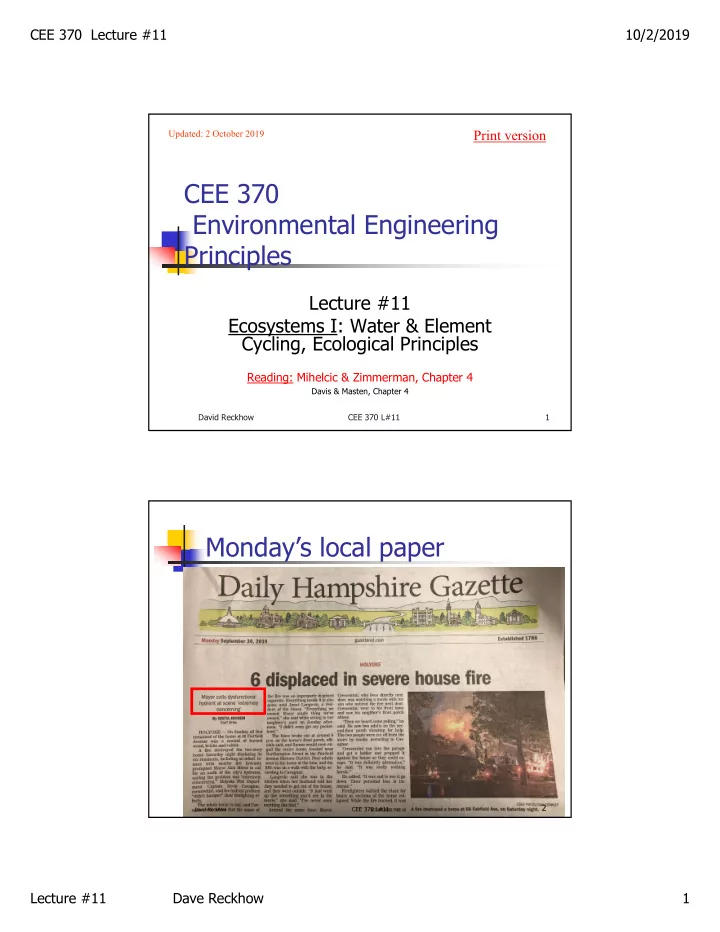
Monday’s local paper

David Reckhow

CEE 370 L#11

2

slide-2
SLIDE 2

CEE 370 Lecture #11 10/2/2019 Lecture #11 Dave Reckhow 2

Follow-up on Tuesday

 dd

David Reckhow

CEE 370 L#11

3

CMFR: non-SS

 Step loads are easier  More complicated when reaction is

  • ccurring

 Simpler for case without reaction

 Example 4-5 (pg 128-129)

 With reaction

 Example 4-4 (pg 125-127)

David Reckhow

CEE 370 L#11

4

slide-3
SLIDE 3

CEE 370 Lecture #11 10/2/2019 Lecture #11 Dave Reckhow 3

David Reckhow

CEE 370 L#11

5

Non-steady State CMFR

 Problem:

 The CMFR is filled with clean water prior to being started. After

start-up, a waste stream containing 100 mg/L of a conservative substance is added to the reactor at a flow rate of 50 m3/day. The volume of the reactor is 500 m3. What is the concentration exiting the reactor as a function of time after it is started?

CA V

CA0 Q0 CA Q0 Equalization tank

David Reckhow

CEE 370 L#11

6

Non SS CMFR (cont.)

 So the general reactor equation reduces to:  And because we’ve got a conservative substance, rA=0:  Now let:

V r Q C Q C = dt dm

A

  • ut

in A

 

Q C Q C = dt dC V

  • ut

in A

 

C C V Q = dt dC

  • ut

in A

in

  • ut

C C y  

slide-4
SLIDE 4

CEE 370 Lecture #11 10/2/2019 Lecture #11 Dave Reckhow 4

David Reckhow

CEE 370 L#11

7

Non SS CMFR without reaction

 So that:  Rearranging and integrating,  Which yields,  or

y V Q = dt dy 

 

 

t t y y

dt V Q y dy

) ( ) (

t V Q y t y           ) ( ) ( ln

t V Q

e y t y

      

 ) ( ) (

David Reckhow

CEE 370 L#11

8

Non SS CMFR w/o reaction (cont.)

 And substituting back in for y:  Since we’re starting with clean water, Co=0  And finally,

t V Q in

  • in

e C C C C

      

  

t V Q in in

e C C C

      

  

t V Q in in

e C C C

      

            

       t V Q in

e C C 1

and

Cin

C t

Decreasing Q/V

slide-5
SLIDE 5

CEE 370 Lecture #11 10/2/2019 Lecture #11 Dave Reckhow 5

David Reckhow

CEE 370 L#11

9

Now add a reaction term

 Returning to the general reactor equation:  And now we’ve got a 1st order reaction, rA=kC=kCout:  This is difficult to solve, but there is a particular case

with an easy solution: where Cin = 0

 This is the case where there is a step decrease in the influent

concentration to zero (M&Z, example 4.4)

V r Q C Q C = dt dm

A

  • ut

in A

 

  • ut
  • ut

in

kVC Q C Q C = dt dC V  

 

  • ut
  • ut

in

kC C C V Q = dt dC  

David Reckhow

CEE 370 L#11

10

Non SS CMFR; Cin=0

 So that:  Rearranging, recognizing that in a CMFR, C=Cout, and

integrating,

 Which yields,  or

 

        

t t C C

dt k V Q C dC

) ( ) (

t k V Q C t C                  ) ( ) ( ln t k V Q

e C t C

             

 ) ( ) (  

  • ut
  • ut

kC C V Q = dt dC  

dt k V Q = C dC        

slide-6
SLIDE 6

CEE 370 Lecture #11 10/2/2019 Lecture #11 Dave Reckhow 6

David Reckhow

CEE 370 L#11

11

SS Comparison of PFR & CMFR

 CMFR  PFR Q kV Ao A

e C C

k Q V C C

Ao A

        1 k Q V C C

Ao A

        1 1

      

Q V k Ao A

e C C

Example: V=100L, Q=5.0 L/s, k=0.05 s-1

 

50 . 05 . 5 100 1 1   

Ao A

C C

 

37 .

5 100 05 .

 

e C C

Ao A

1st order reaction

David Reckhow

CEE 370 L#11

12

 Conclusion:

 PFR is more efficient for a 1st order reaction

Distance Across Reactor CMFR PFR

slide-7
SLIDE 7

CEE 370 Lecture #11 10/2/2019 Lecture #11 Dave Reckhow 7

David Reckhow

CEE 370 L#11

13

 Rate of reaction

  • f A is given by

 VkCA

David Reckhow

CEE 370 L#11

14

Response to Inlet Spikes

slide-8
SLIDE 8

CEE 370 Lecture #11 10/2/2019 Lecture #11 Dave Reckhow 8

David Reckhow

CEE 370 L#11

15

Selection of CMFR or PFR

 PFR

 Requires smaller size for 1st order process

 CMFR

 Less impacted by spikes or toxic inputs

David Reckhow

CEE 370 L#11

16

Comparison

 Davis & Masten, Table 4-1, pg 157

slide-9
SLIDE 9

CEE 370 Lecture #11 10/2/2019 Lecture #11 Dave Reckhow 9

David Reckhow

CEE 370 L#11

17

Retention Time

Q V  

David Reckhow

CEE 370 L#10

18

Analysis of Treatment Processes

 Basic Fluid Principles

 Volumetric Flow Rate  Hydraulic Retention Time

 Conversion  Mass Balances  Reaction Kinetics and Reactor Design

 Chemical Reaction Rates  Reactor Design

 Sedimentation Principles

slide-10
SLIDE 10

CEE 370 Lecture #11 10/2/2019 Lecture #11 Dave Reckhow 10

David Reckhow

CEE 370 L#10

19

Conversion or Efficiency

k aA + bB pP + qQ 

X = (C

  • C )

C

Ao A Ao

A Ao

C = C (1 - X)

And the Conversion, X, is:

  • r

Some use “efficiency” (ɳ) to indicate the same concept

Stoichiometry

David Reckhow

CEE 370 L#10

20

Conversion/efficiency (cont.)

(N

  • N ) = b

a(N

  • N )

Bo B Ao A

where, NAo = moles of A at t = 0, [moles] NA = moles of A at t = t, [moles] NBo = moles of B at t = 0, [moles] NB = moles of B at t = t, [moles] If the volume of the reactor is assumed to remain constant, we can divide both sides of the expression by

  • CAoV. The expression then becomes,

(C

  • C )

C = b a (C

  • C )

C = b aX

Bo B Ao Ao A Ao

slide-11
SLIDE 11

CEE 370 Lecture #11 10/2/2019 Lecture #11 Dave Reckhow 11

David Reckhow

CEE 370 L#10

21

Conversion/efficiency (cont.)

This expression can then be solved for the concentration

  • f B in terms of other known quantities:

B Bo Ao

C = C

  • b

aC X

David Reckhow

CEE 370 L#10

22

Conversion/efficiency Example

The reactor shown in the Figure has an inflow of 750 L/hr. The concentration of A in the influent is 0.3 M and the concentration of B in the influent is 0.5 M. The conversion (of A) is 0.75. The reaction is: A + 2B  Products Find the conversion of B, XB, and the effluent concentration of A and B.

CAo = 0.3M CBo = 0.5M Q=750 L/hr

CA V

CA = ? CB = ?

slide-12
SLIDE 12

CEE 370 Lecture #11 10/2/2019 Lecture #11 Dave Reckhow 12

David Reckhow

CEE 370 L#10

23

Solution to Conversion Ex.

The first step in the solution is to determine the effluent concentration of A. This can be obtained as follows: A Ao

C = C (1 - X) = 0.3M x (1 - 0.75)

A

C = 0.075 M

For each mole of A converted to product, two moles of B are converted to product. Since we know the initial concentration

  • f B we can calculate its final concentration:

Moles/ L of B converted = 2 x (0.3 M - 0.075 M) = 0.45 M

David Reckhow

CEE 370 L#10

24

Solution to Conversion Ex. (cont.)

B

C = 0.5 M - 0.45 M = 0.05 M

Alternatively, using Eqn:

B B o A o

C = C b a C X = 0.5 M 2 1 (0.3 M x 0.75)        

B

C = 0.05 M

The conversion of B is then:

B Bo B Bo

X = (C

  • C )

(C ) = 0.5 M - 0.05 M) 0.5 M

B

X = 0.9

slide-13
SLIDE 13

CEE 370 Lecture #11 10/2/2019 Lecture #11 Dave Reckhow 13

Reactors in Series

David Reckhow

CEE 370 L#11

25

Q Q w w w w w

Reactors in Series

David Reckhow

CEE 370 L#11

26

slide-14
SLIDE 14

CEE 370 Lecture #11 10/2/2019 Lecture #11 Dave Reckhow 14

David Reckhow

CEE 370 L#13

27

Lake Volume (109 m3) Outflow (109 m3 y-1) Superior 12,000 67 Michigan 4,900 36 Huron 3,500 161 Erie 468 182 Ontario 1,634 211

David Reckhow

CEE 370 L#13

28

Example: 90Sr fallout in Great Lakes

1 1 2 3 4

slide-15
SLIDE 15

CEE 370 Lecture #11 10/2/2019 Lecture #11 Dave Reckhow 15

David Reckhow

CEE 370 L#13

29

David Reckhow

CEE 370 L#13

30

slide-16
SLIDE 16

CEE 370 Lecture #11 10/2/2019 Lecture #11 Dave Reckhow 16

David Reckhow

CEE 370 L#13

31

David Reckhow

CEE 370 L#13

32

Loading Function

 Close to an

impulse load, centered around 1963

 estimated

value is: 70x10-9 Ci/m2

 same for all

lakes

slide-17
SLIDE 17

CEE 370 Lecture #11 10/2/2019 Lecture #11 Dave Reckhow 17

David Reckhow

CEE 370 L#13

33

Non Steady State Solution

 Impulse Load

 1st lake  2nd lake  3rd lake

t

  • e

c c

1

1 1  

C11

 

t t

  • t
  • e

e V Q c e c c

2 1 2

) (

1 2 2 12 1 2 2   

 

  

   

C21 C22

 

                  

       2 3 1 3 1 2 2 3 12 23 1 2 3 3 23 2 3 3

3 2 3 1 3 2 3

) ( ) (        

       t t t t

  • t

t

  • t
  • e

e e e V V Q Q c e e V Q c e c c

C31 C33 C32

k V Q   

David Reckhow

CEE 370 L#13

34

Hydrologic Parameters

Parameter Units Superior Michigan Huron Erie Ontario Mean Depth m 146 85 59 19 86 Surface Area 10

6 m 2

82,100 57,750 59,750 25,212 18,960 Volume 10

9 m 3

12,000 4,900 3,500 468 1,634 Outflow 10

9 m 3/yr

67 36 161 182 212

 Michigan  Superior  Huron  Erie  Ontario

m m

c c

11

s s

c c

11

mh sh h h

c c c c

22 22 21

  

mhe she he e e

c c c c c

33 33 32 31

   

mheo sheo heo eo

  • c

c c c c c

44 44 43 42 41

     k V Q   

slide-18
SLIDE 18

CEE 370 Lecture #11 10/2/2019 Lecture #11 Dave Reckhow 18

David Reckhow

CEE 370 L#13

35

 From Chapra,

1997

David Reckhow

CEE 370 L#11

36

 To next lecture